Print House
A print and branding house in Kosovo with six production lines under one roof — given a bilingual site, an 83-piece catalogue, and a browser mockup studio that turns a vague enquiry into a print-ready brief. It took 25 orders on its first day online.
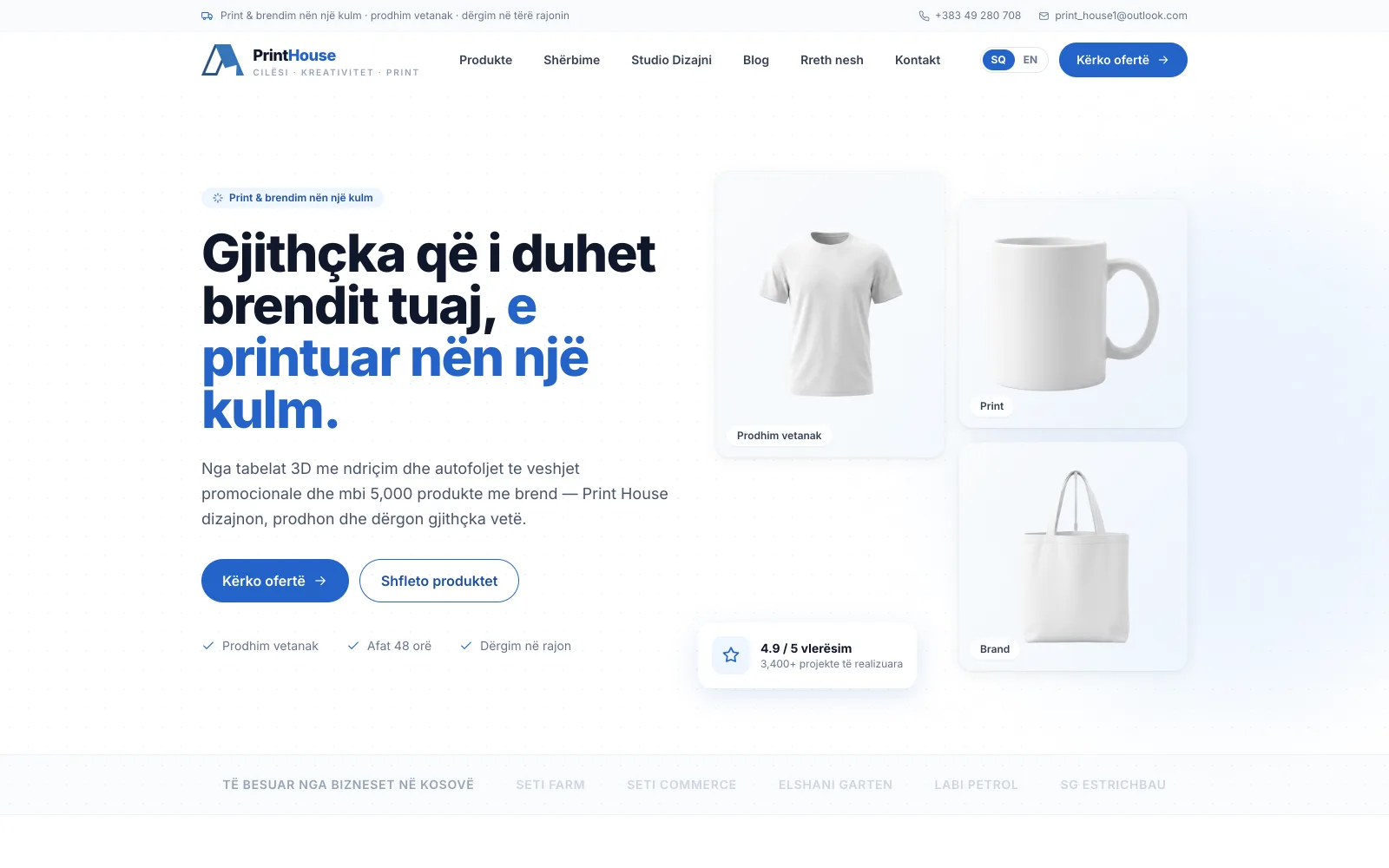
Overview
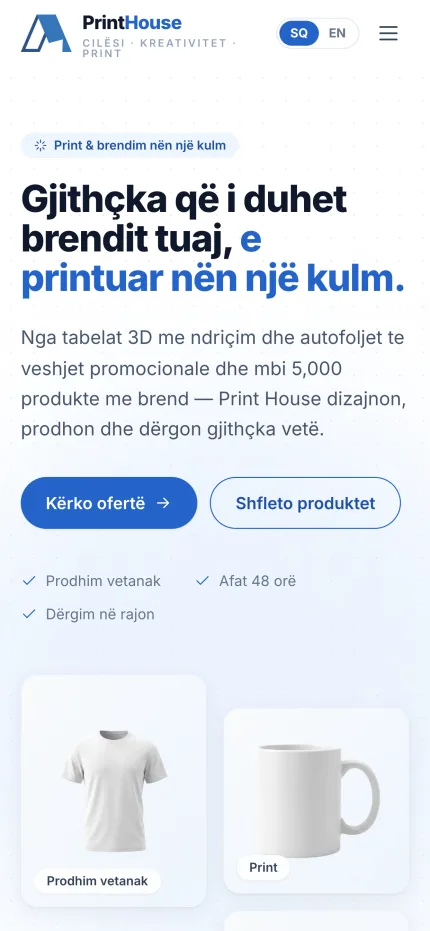
Print House does six different things — printing, signage, 3D lettering, vehicle wraps, workwear and large format — and does all of them in-house. That breadth is the selling point, but it made the website hard: a brochure site flattens six production lines into one vague list, and every enquiry arrives as “can you print something like this?”
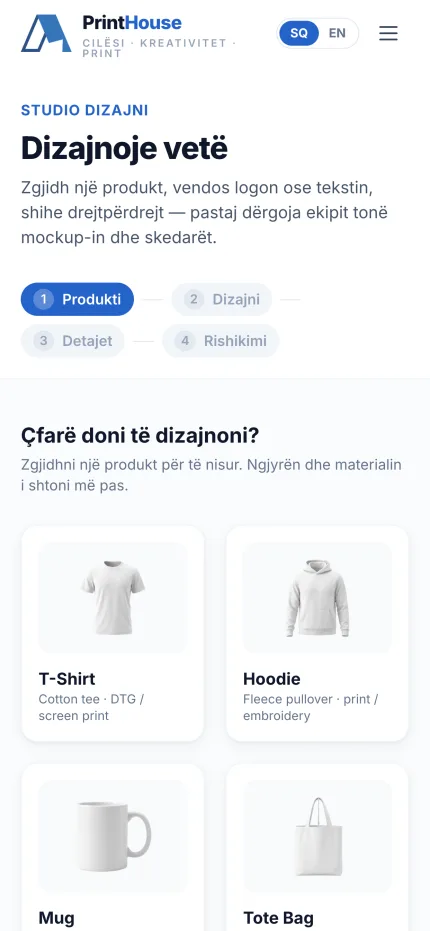
So we built the site around the brief instead of the brochure. Services explain each line, the catalogue makes 83 branded items browsable, and a Design Studio lets a customer place their logo on the actual product, see it against real print guides, and send back a rendered mockup with the source files attached.
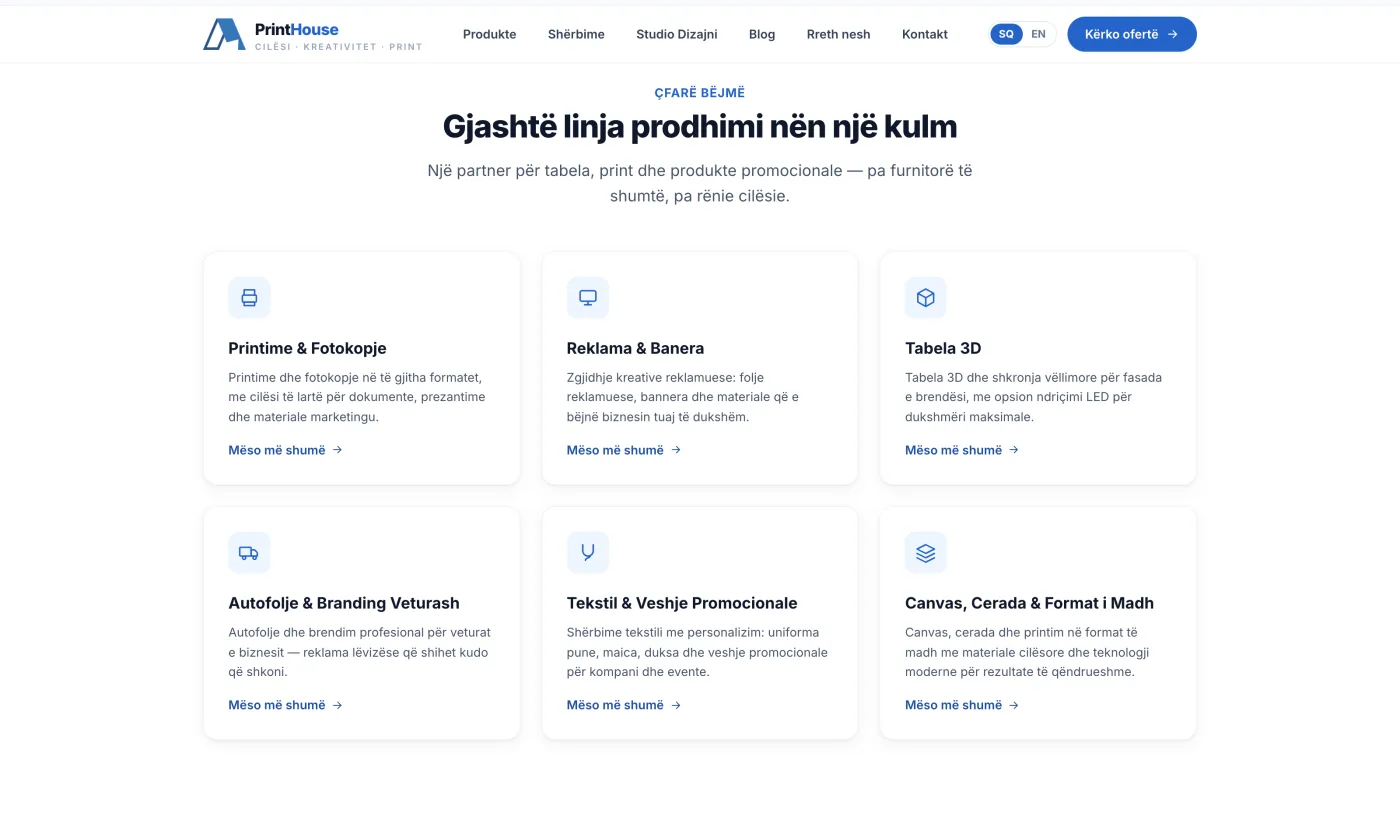
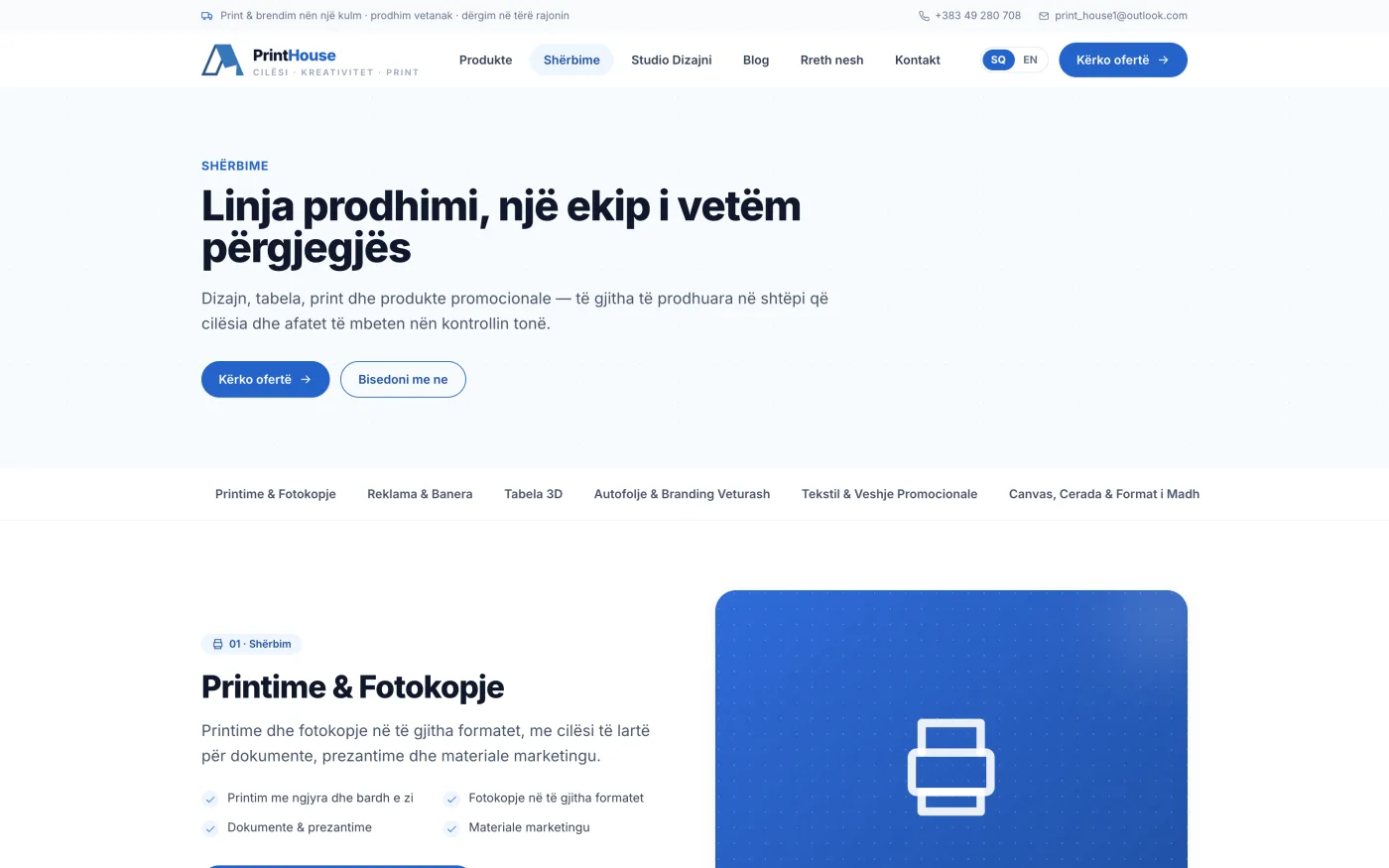
Six production lines, one team to blame.
The competitive advantage is that nothing gets subcontracted. We gave each line its own section with its own capabilities and its own call to action — so a customer looking for illuminated 3D signage never has to read about photocopying to find it.
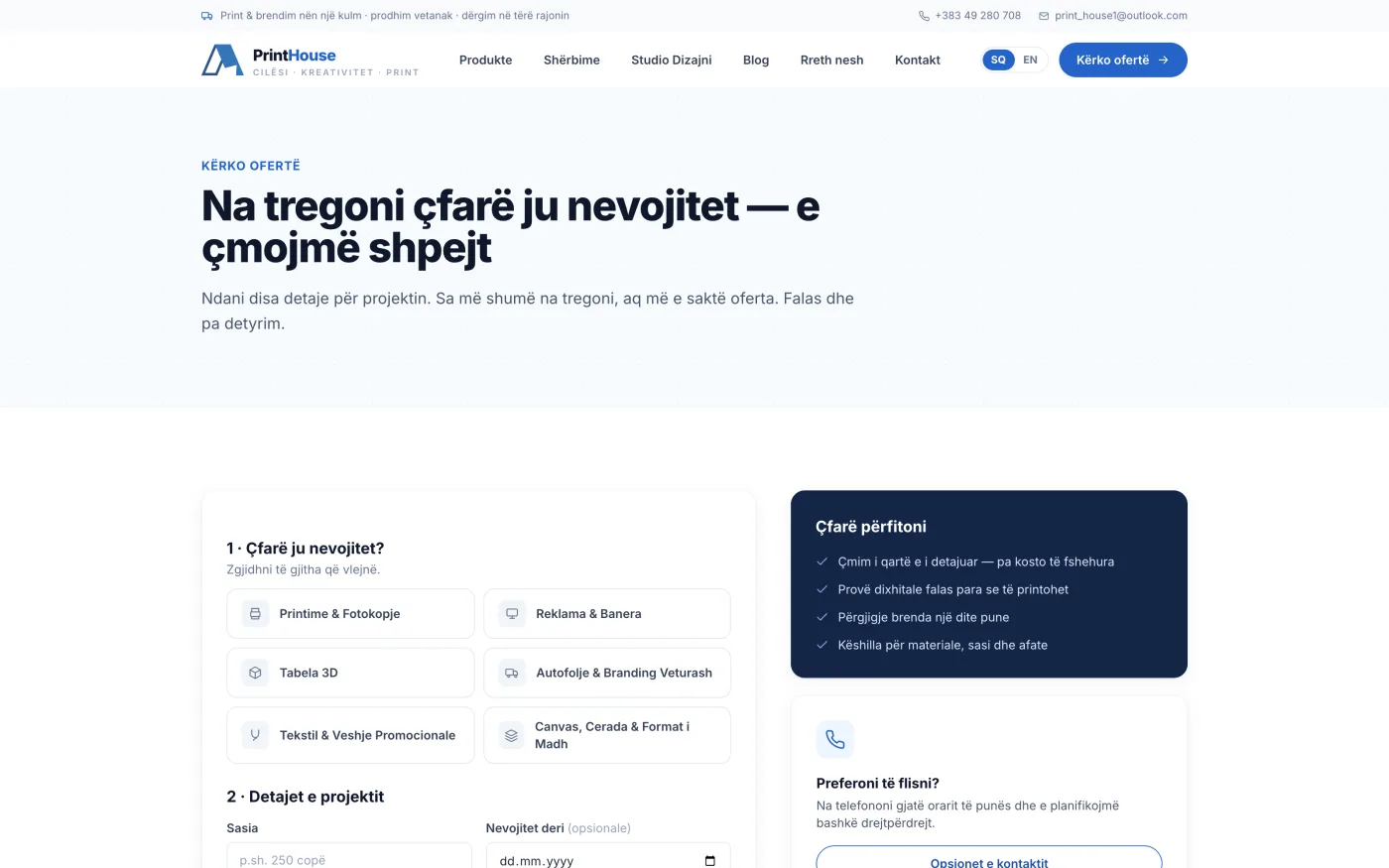
Printime & Fotokopje
Colour and black-and-white printing, copying in every format, documents and marketing material.
Reklama & Banera
Advertising banners, boards and campaign material that make a business visible on the street.
Tabela 3D
Dimensional lettering and facade signage, with an LED-illuminated option for night visibility.
Autofolje & Branding Veturash
Vehicle wraps and fleet branding — advertising that moves with the business.
Tekstil & Veshje Promocionale
Uniforms, tees, hoodies and promotional wear, personalised for companies and events.
Canvas, Cerada & Format i Madh
Canvas, PVC tarpaulin and large-format printing on durable materials.
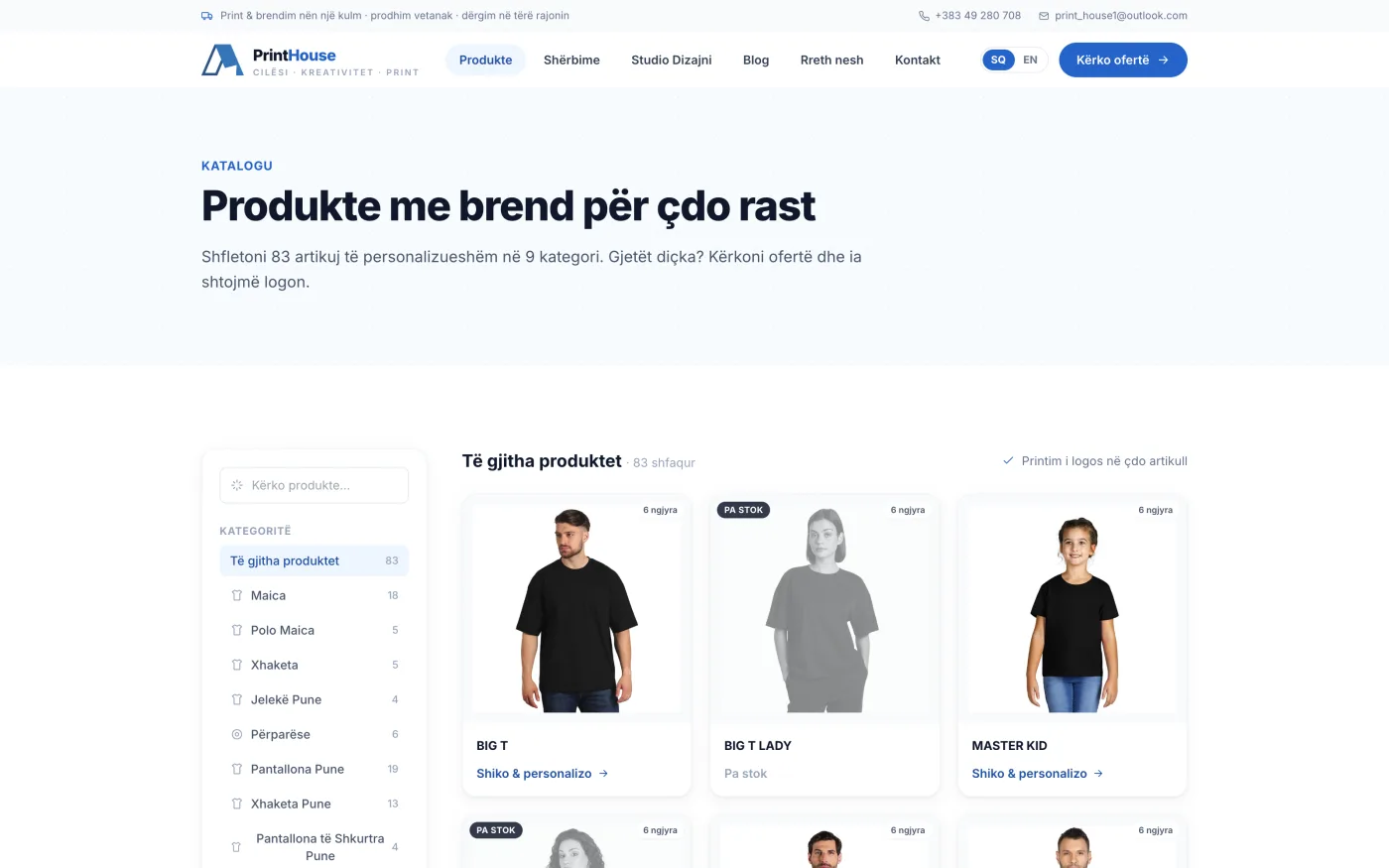
A print shop's stock list, made browsable.
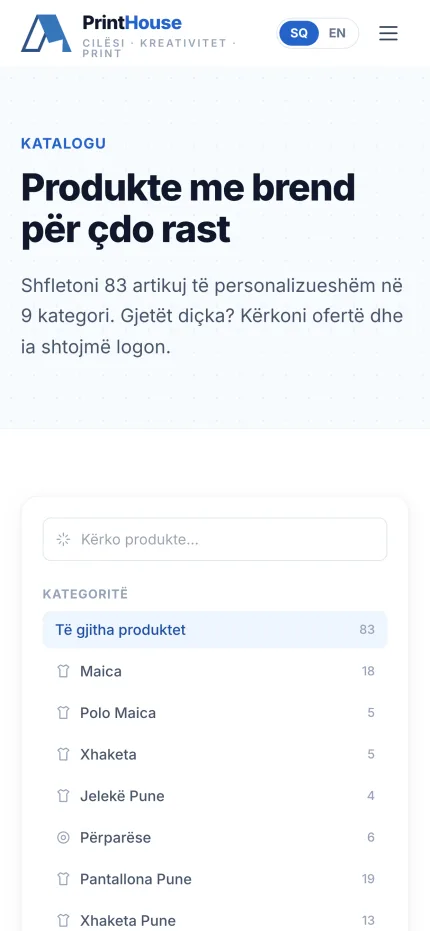
Workwear catalogues normally arrive as a PDF. We turned Print House's into 83 filterable products across 9 categories — each with its photography, fabric weight, colourway count and live stock state. Nothing has a price on it: this is a quoting business, so every product routes to a brief instead of a basket.
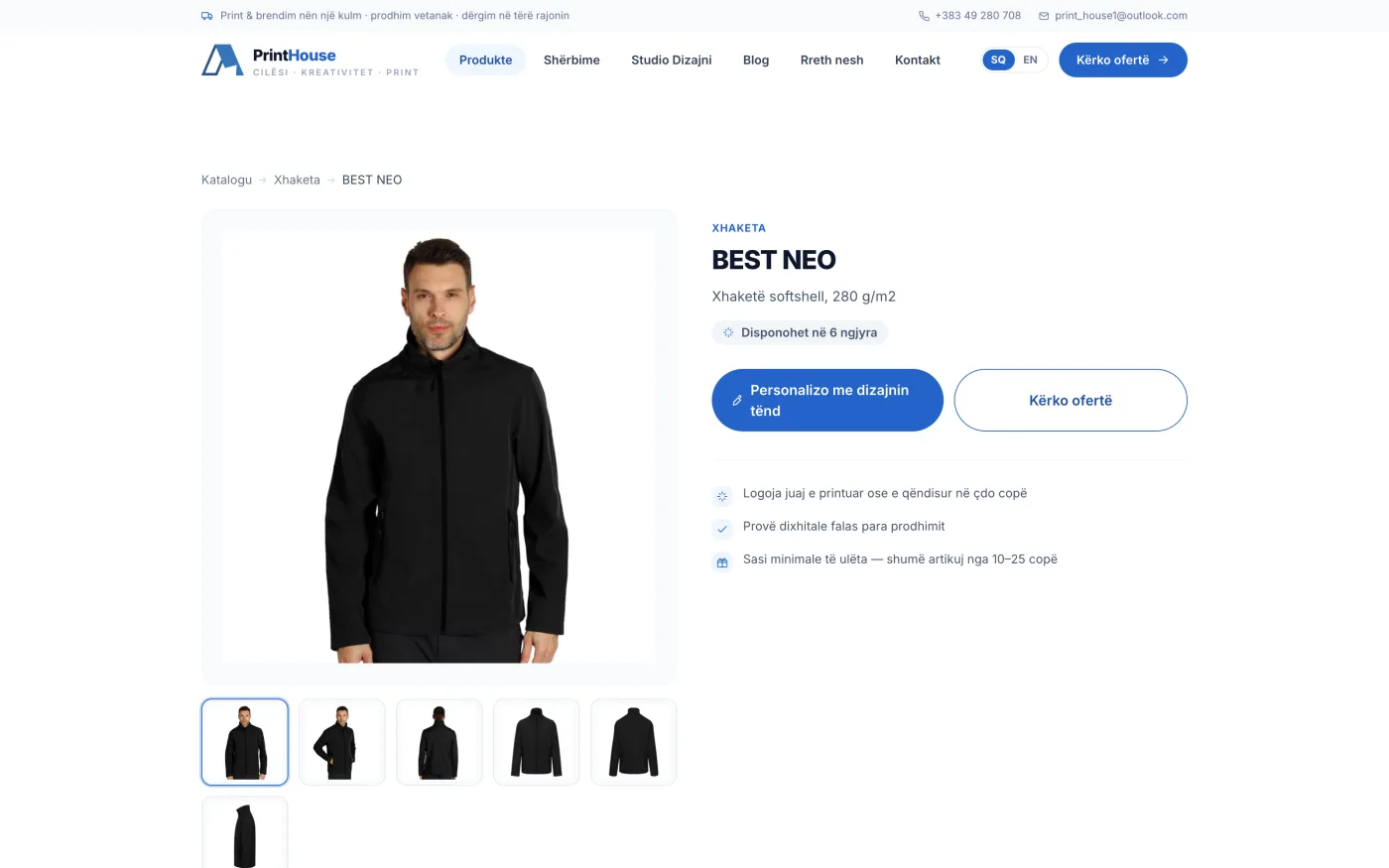
Category counts that stay honest
Every category carries its real item count, derived from the catalogue data rather than typed into the design — so the numbers can never drift from the stock list.
Colourways & stock state
Items show how many colours they come in, and anything unavailable is badged Pa stok and de-emphasised instead of quietly disappearing.
No prices, by design
Quantity, print method and artwork all move the price, so the catalogue never guesses. Each product hands off to the studio or the quote form.
The customer does the prepress without knowing it.
This is the part that changes the business. A customer picks one of nine product types, drops their logo onto it, and drags it into position against a live print zone with a safety area and bleed drawn on the garment. What reaches the shop is not a description — it is a rendered mockup of the front and the back, plus the original artwork files, sizes, quantity and deadline.
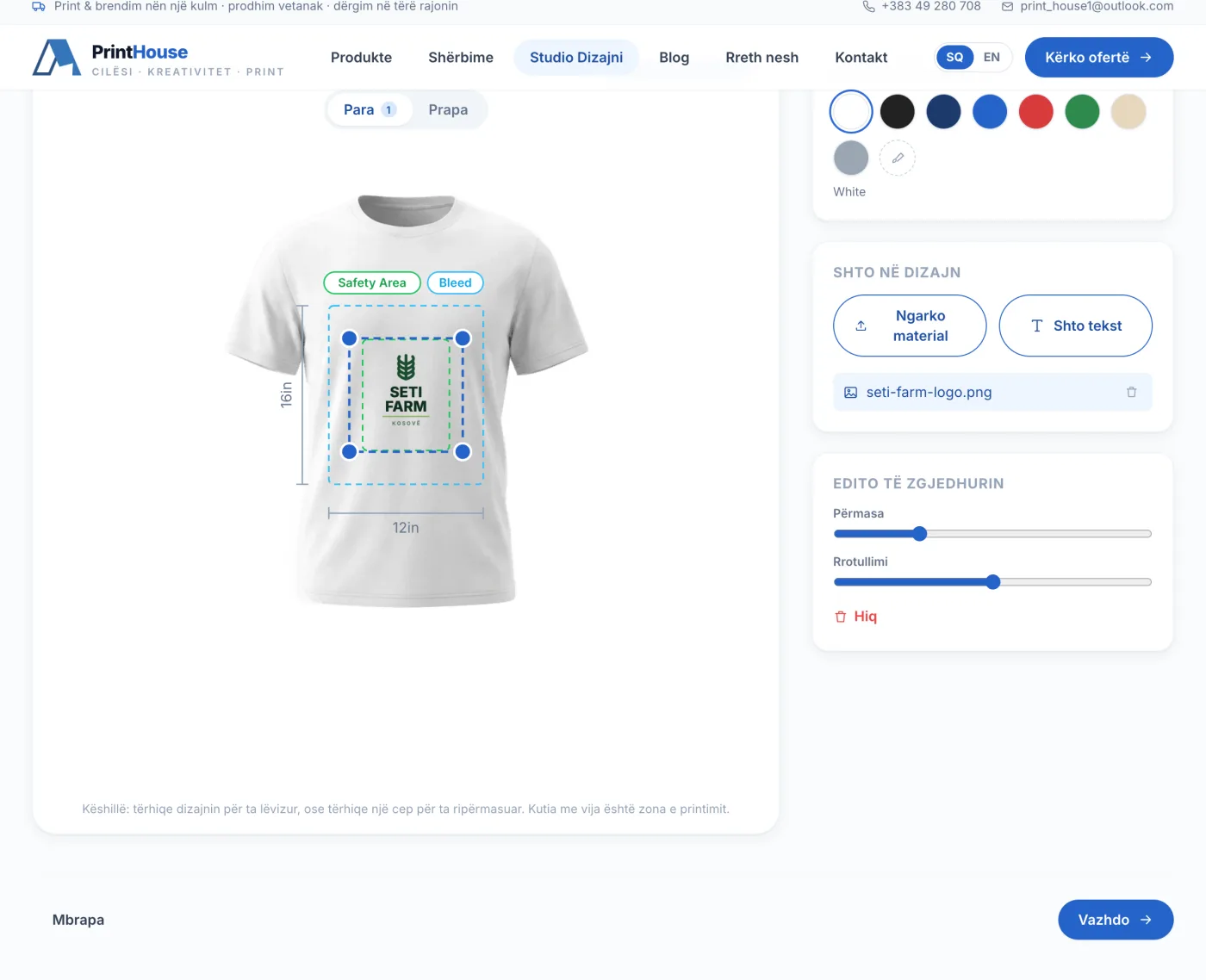
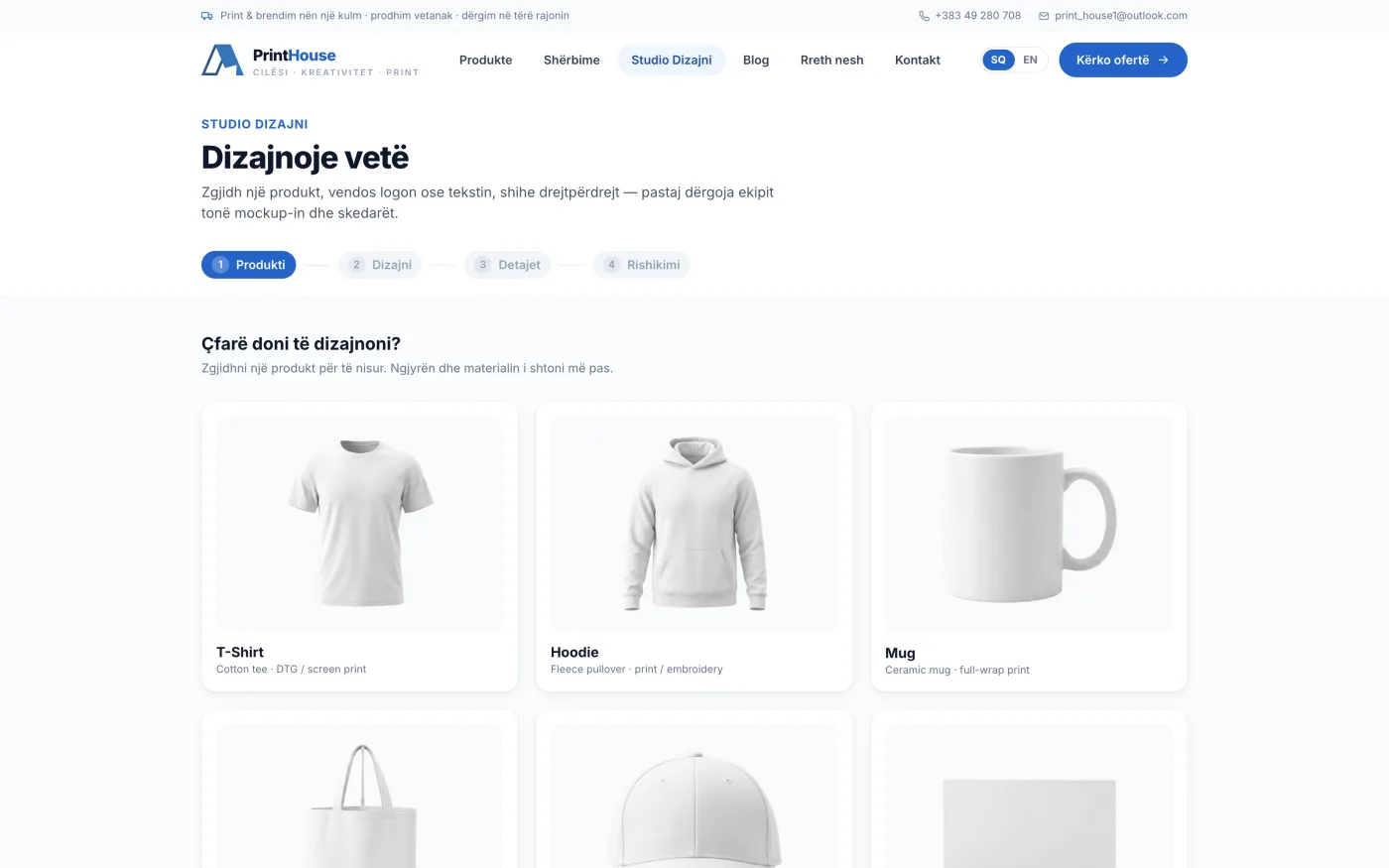
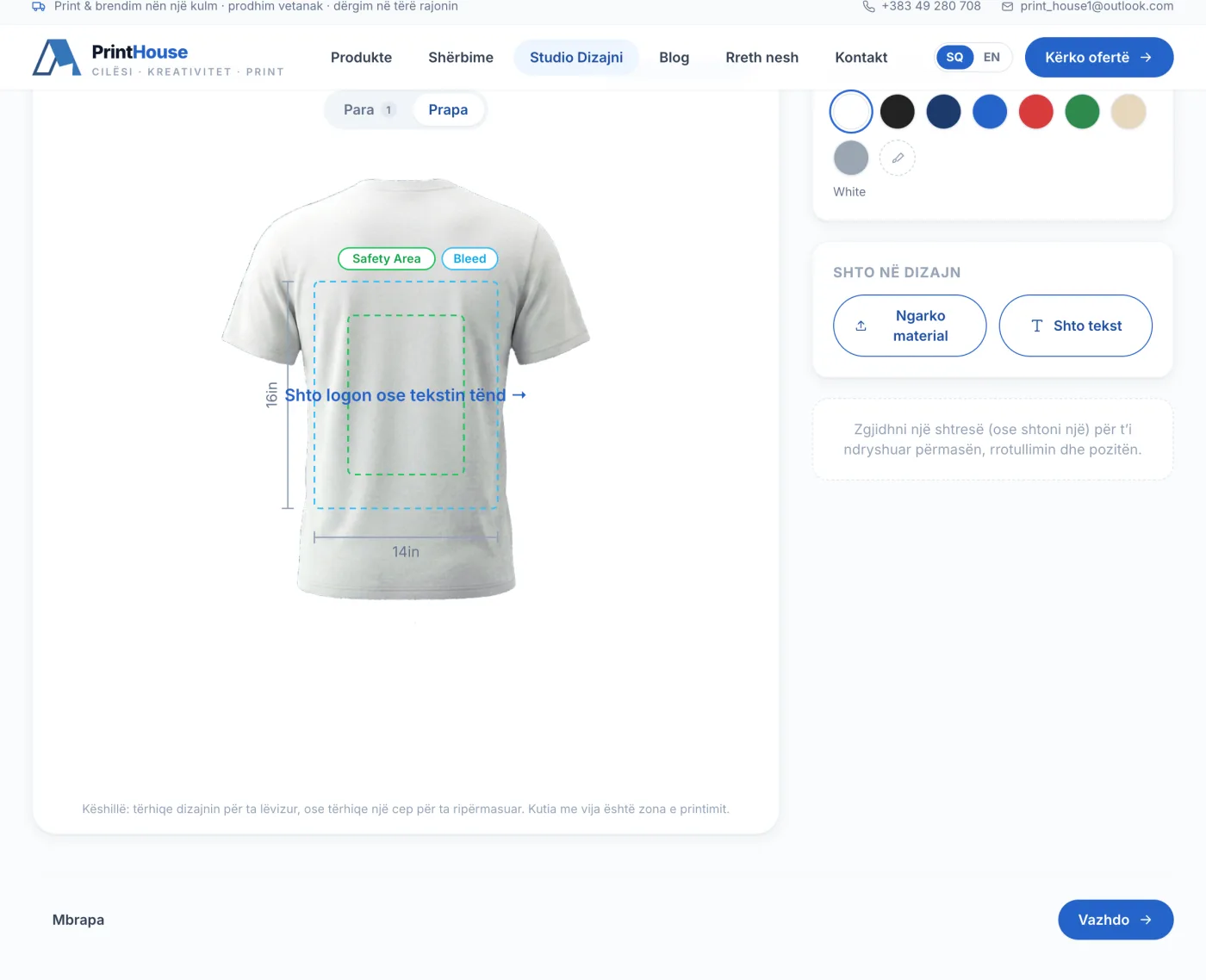
Real print zones
Each product carries its own printable area, labelled in inches on the canvas. A tee is 12in × 16in; a business card is 90×50 mm. The guides are the spec, not decoration.
Bring your own artwork
Upload a logo and it becomes a layer you can move, scale and rotate. Add text layers in four typefaces with colour control if there is no logo to hand.
Colourways, including yours
Eight stocked garment colours to switch between, plus a free colour picker for a brand shade that is not on the shelf.
Nine product types
Tee, hoodie, mug, tote, cap, business card, PVC banner, canvas and vinyl wrap — the studio covers textile, print and large format alike.
The brief, not the enquiry
Step three collects sizes XS–XXXL, quantity, deadline and notes — and takes print-ready attachments in vector, PDF, AI or high-resolution image form.
Rendered, then sent
On submit, the canvas is flattened to a PNG of the front and the back and posted alongside the customer's original files — so the shop sees exactly what the customer saw.
Engineering
The studio is a canvas compositor, not a gallery of pre-baked images. Layers carry their own position, scale and rotation in print-zone coordinates, so the same design description renders to the on-screen preview and to the flattened PNG that gets emailed to the shop.
The whole site ships as a React single-page app built with Vite, on a hand-rolled history router — no routing library, because nine routes did not warrant one. It runs on the client's existing Apache hosting, with submissions posted to a single PHP endpoint that carries the rendered mockups and uploaded files through to the shop's inbox — no new infrastructure to pay for or maintain. Language choice persists locally, so a returning visitor lands in the language they last used.
Two languages, and a phone in every hand.
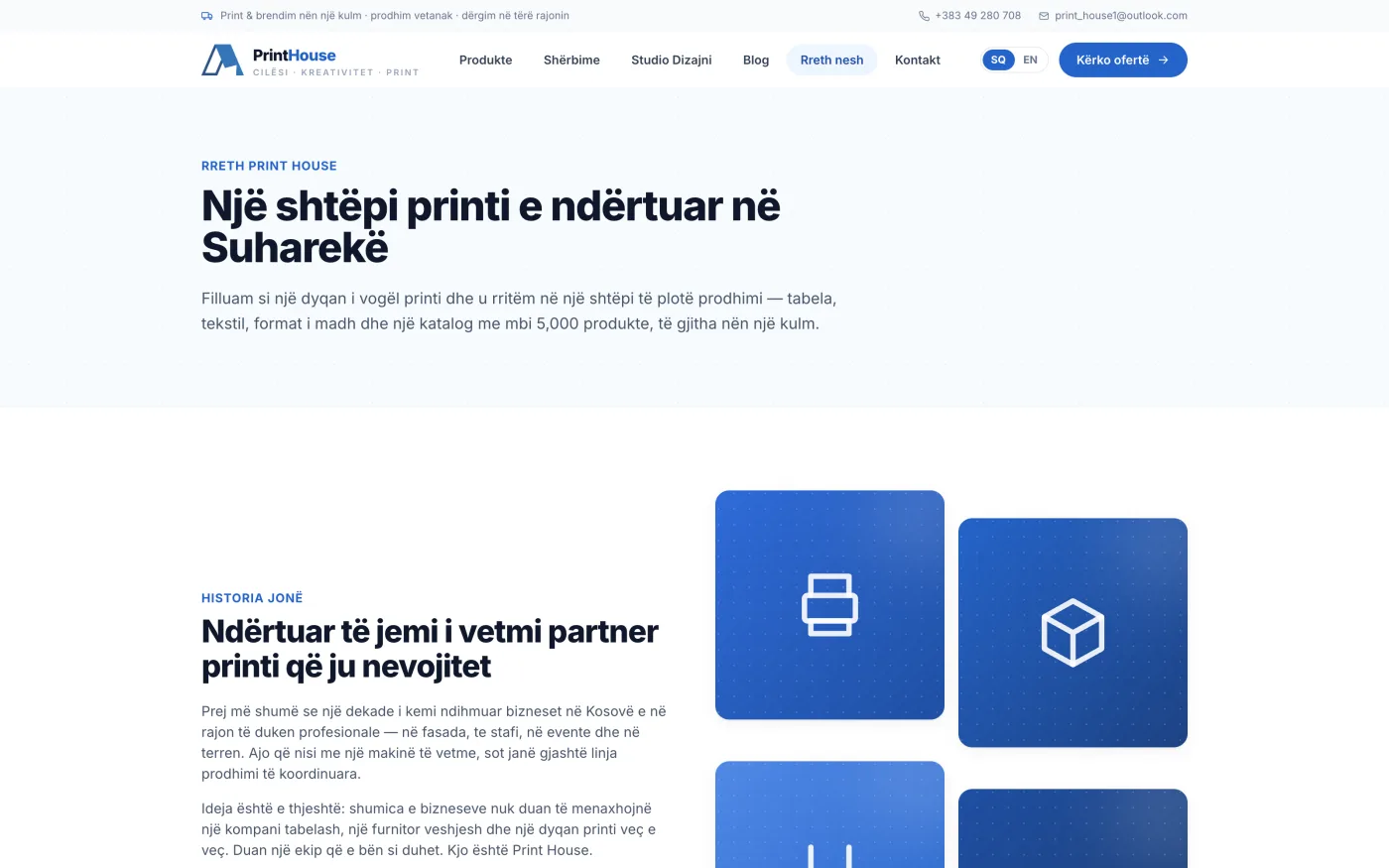
Print House sells into Kosovo and the wider region, and to diaspora businesses ordering from abroad. Every string on the site — including the studio's four steps and form labels — exists in Albanian and English, switchable from the header without losing your place. Contact runs through WhatsApp, because that is where this market actually replies.
Everything else earns the enquiry.
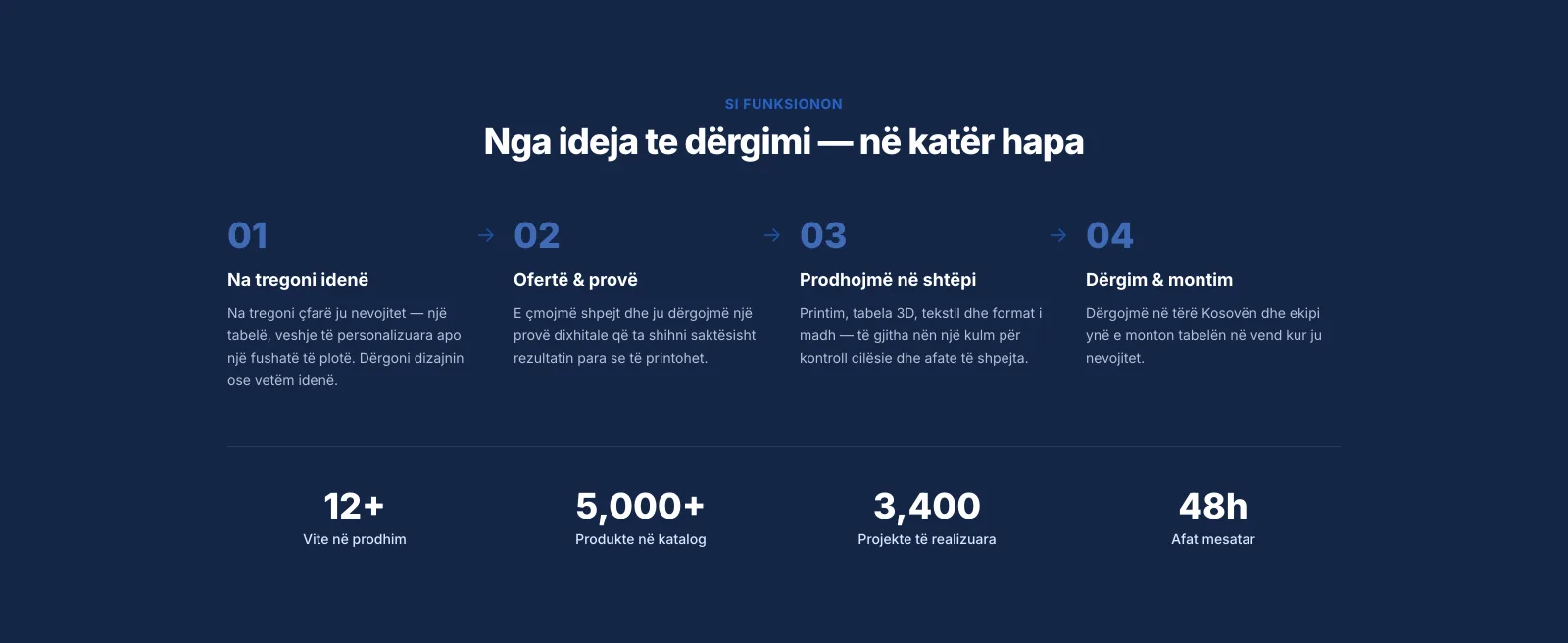
Print House had never sold online. On the first day the site was live, orders came in through the browser — from a town of a few thousand people, for a business whose entire order book had until then arrived by phone, WhatsApp or someone walking through the door.
A-grade delivery, with caching left to tighten.
The live homepage transferred 378 KB in 11 requests, answered in 28 ms and scored 90/100. The remaining opportunities are longer cache lifetimes and removing two render-blocking stylesheets.