The outcome

Release a measured API feature whose quality, safety, privacy, latency, cost, and rollback behavior are documented.

OpenAI API Platform is a Developer platform for multimodal model APIs, the Responses API, tools, realtime applications, agents, files, fine-tuning, batch processing, evaluation, and governance. Building production text, vision, audio, realtime, image, video, retrieval, and tool-using applications through managed models and platform APIs. This guide narrows that broad capability into one repeatable outcome, with checkpoints that keep the source material and your judgment in the loop.

Before you begin

Set the boundary before the tool starts.

Choose one real task, identify who will use the result, and decide what evidence or test will make the result acceptable. Gather only the source material needed for that task. If the work contains confidential, personal, regulated, or client-owned information, confirm that the platform and account are approved before sharing it.

Troiana principle

AI should make the work easier to inspect. If the workflow removes the source, the owner, or the review step, redesign the workflow.

Step by step

A workflow you can repeat.

  1. 01

    Define users, task, modalities, data classes, success and failure metrics, safety policy, output schema, tools, latency, traffic, retention, residency, cost, and rollback thresholds.

  2. 02

    Create a dedicated project and server-side key, choose endpoint storage deliberately, shortlist current models and exact snapshots where stability matters, and record capabilities, limits, and prices.

  3. 03

    Build a frozen representative eval set with normal, edge, adversarial, multilingual, no-answer, unsafe, malformed, long-context, and provider-failure cases plus deterministic graders where possible.

  4. 04

    Run Responses API experiments with explicit instructions, model settings, output format, request and token budgets, timeouts, retries, moderation, safety identifiers, and captured request IDs and usage.

  5. 05

    Gate on quality, safety, privacy, tail latency, errors, and task cost, canary the winning configuration, monitor regressions, and retain a tested model, prompt, and API fallback.

Interface reference

Connect the workflow to the product.
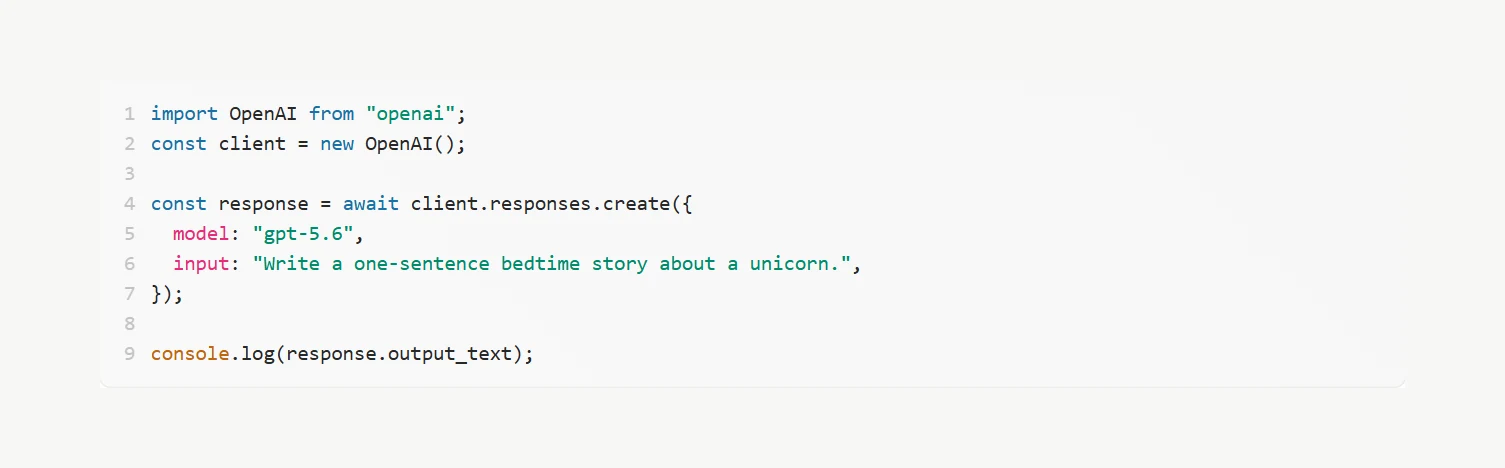
Official OpenAI API JavaScript quickstart example creating a response and printing its output text.

The official OpenAI quickstart reduces a first Responses API call to a client, a model, an input, and inspected output.

Interface reference · OpenAI API quickstart ↗ · Captured August 2, 2026

Working standard

What good use looks like.

  • Version the eval set with the feature.
  • Set storage and retention deliberately.
  • Canary pinned configurations.

API data is not used for training by default unless the customer opts in, but abuse-monitoring logs and feature-specific application state may still be retained; endpoint eligibility differs for Zero Data Retention, residency, background mode, files, audio, video, search, and other tools. Keep keys server-side, separate projects, minimize and classify data, set store deliberately, pin and evaluate models, authorize tools outside the model, moderate inputs and outputs, log request IDs without content, and require approval for consequential actions.

Official references

Check the current product documentation.

Features, plan limits, availability, and data controls change. These official pages are the starting points used for this collection.