What should a dental practice website include?
One page per treatment, the team, the practice’s location and hours, and a way to ask for an appointment from every page. Patients usually arrive with one question — “do they do implants?”, “is whitening painful?” — so a page that answers exactly that question does more than a general services list.
A treatment page works best when it covers what the treatment is, who it suits, how many visits it takes, what recovery is like and what to do next. Real photos of the dentists and rooms matter more on a dental site than on most: a nervous patient wants to know who they will meet before they arrive.
How should patients book appointments online?
Use a request form confirmed by your front desk, unless your practice software can show the real calendar. Showing open slots that are not truly open is worse than showing none: the patient books, then gets a call to move it.
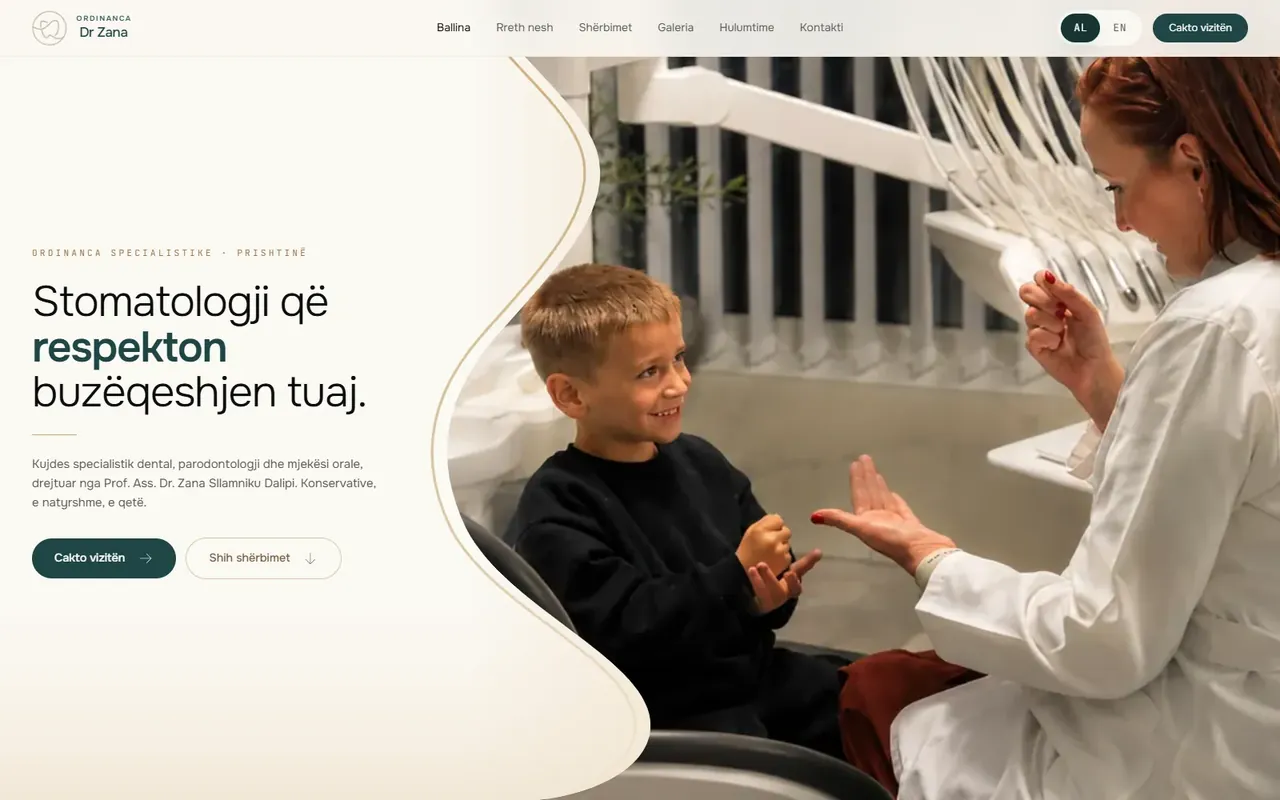
If your practice-management software offers online booking, the website links to it or embeds it, so there is only one calendar. When we built online booking for Rent a Car Mars, the rule was the same: one definition of availability, used by the public site and the staff back office, so the two can never disagree. Dr. Zana Clinic takes the conversational route: its “Cakto vizitën” (book a visit) button leads to a contact page with a WhatsApp message already written and the clinic’s phone numbers.
How fast should a dental website be?
Its main content should appear well within 2.5 seconds on a phone, with nothing jumping as it loads. Those are Google’s Core Web Vitals limits: Largest Contentful Paint under 2.5 seconds, layout shift under 0.1 and interaction delay under 200 milliseconds, measured on real visits.
The Dr. Zana Clinic homepage paints its main content in 0.86 seconds in Lighthouse’s desktop test, even with a scroll-driven 3D tooth video, because the video only loads after the rest of the page is ready and every photo is served as a sized WebP file.
How do patients find a dentist on Google and AI assistants?
Through a Google Business Profile that matches the website, treatment pages that answer real questions in plain text, and structured data describing the practice. AI assistants such as ChatGPT and Gemini lean on the same signals: they can only recommend a practice they can read and verify.
Structured data has to use types Google accepts. On a psychologist’s site we built, a single unsupported type made Google’s validator reject the whole business description; switching to accepted types took it to zero errors. For a dental practice, Dentist is the accepted type, and Dr. Zana Clinic’s site uses it.
Does a dental website need more than one language?
If your patients speak more than one language, yes — with a separate address for each language, not a translate button. Search engines index each language version on its own, and a patient searching in English should land on English.
Dr. Zana Clinic’s site is in Albanian at the root address and in English under /en/, with each page linked to its translation so Google shows the right one.
What about patient privacy?
Ask for a name, a contact and a preferred time — never medical history — in a web form. Health information is a special category of personal data under the GDPR, and Kosovo’s data-protection law follows the same model. Clinical details belong in the consultation, not in an email inbox.
Add no tracking the practice does not use, ask for consent before any optional cookies, and load embedded maps only after the visitor agrees.