In short
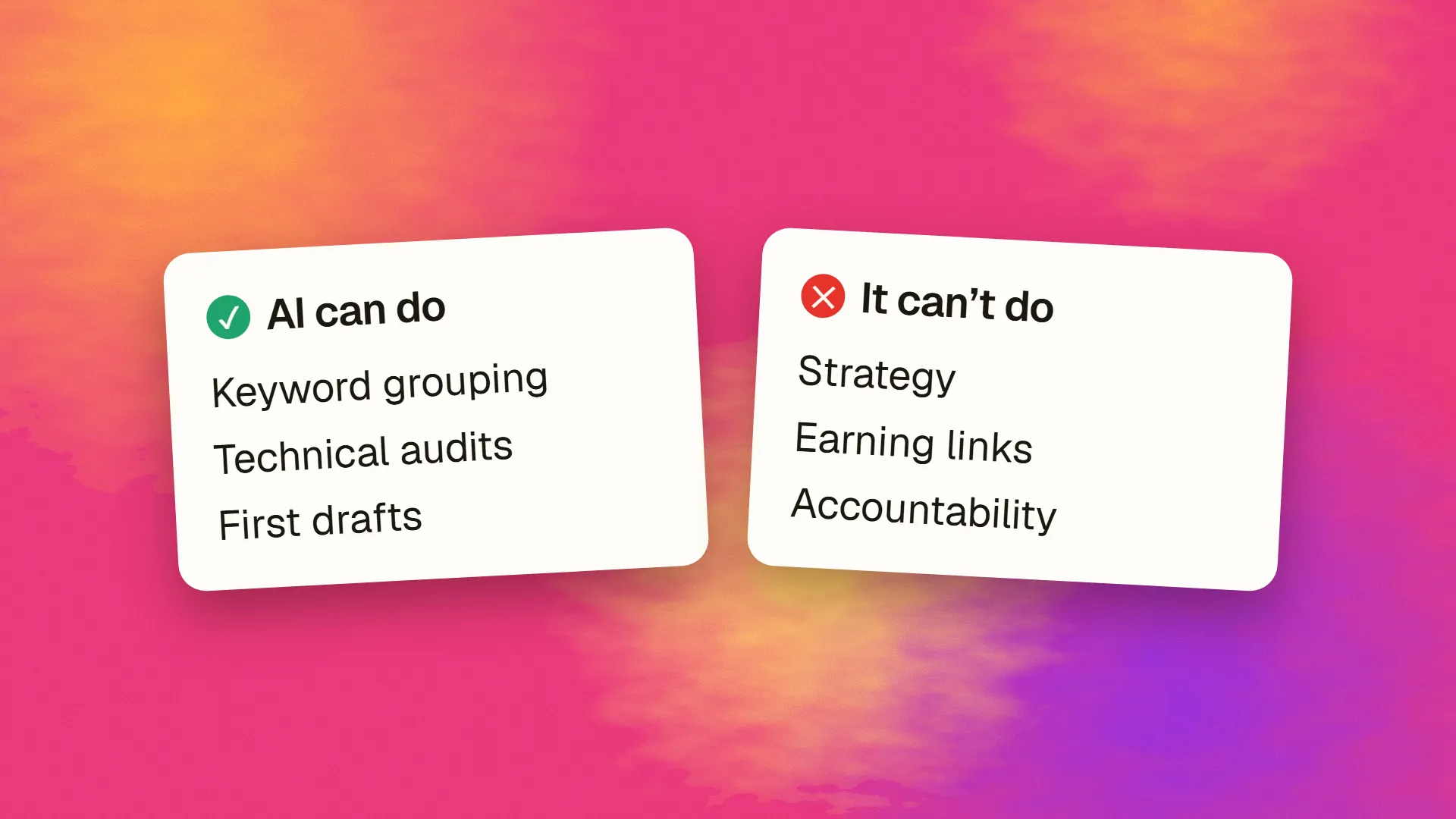
AI can replace the mechanical parts of SEO: keyword grouping, technical audits, first drafts, metadata, schema, reporting. It cannot replace strategy, original expertise, relationships that earn links, judgement about what to publish, or accountability when rankings fall, and it produces confident errors that someone must catch. A small business with a capable person can now do most routine SEO with AI assistance; an agency earns its fee in 2026 through expertise, original content, authority-building and results, not through tasks a model does in seconds.
What AI does well
A great deal of what SEO agencies billed for a decade ago is now a prompt away:
Research and grouping. Clustering a thousand keywords by intent, spotting the questions a topic raises, finding gaps against competitors' pages. AI tools do this quickly and reasonably, provided someone checks the volumes and the intent judgements.
Technical auditing. Crawlers have long automated the detection of broken links, missing titles, duplicate content and slow pages; AI now explains the findings and prioritises them.
Drafting. Outlines, first drafts, metadata, alt text, FAQ candidates, structured data. The raw material for pages, produced in minutes.
Analysis. Reading Search Console exports, spotting pages that lost traffic, suggesting which titles to rewrite, summarising what changed after a core update.
Reporting. Turning data into a readable monthly summary, which for many agencies was a substantial share of the retainer.
An owner or marketer with a few hours a week and a good model can now do the routine work that a modest SEO retainer used to cover, and do it faster.
What AI gets wrong
It invents. Statistics, sources, ranking factors, Google policies. An AI-produced audit or article carries claims that must be verified, and the ones that are wrong are stated as confidently as the ones that are right.
It produces the average. Content drafted from a prompt is a competent summary of what already ranks, which is exactly the content that does not rank because it adds nothing. AI is a way to write faster, not a source of what to say.
It cannot see your business. It does not know your customers, your margins, your capacity, or what you can credibly claim, and its strategy suggestions are generic in proportion.
It cannot earn links. Links come from relationships, from original work worth citing, and from being known. A model can draft an outreach email; it cannot be the reason anyone links.
It scales mistakes. The same tool that writes one good page writes five hundred mediocre ones, and volume without judgement is the pattern Google penalises.
It is not accountable. When rankings fall, a model does not diagnose, take responsibility, or fix it. A person does.
What still needs a person
Deciding which questions the business should own and in what order. Bringing first-hand expertise, data and opinion to the pages, which is what makes them citable. Judging what a client can credibly publish. Building the relationships and doing the work that earns links and mentions. Reading a site's history and market well enough to know why it is where it is. Catching the errors in everything the tools produce. And standing behind the outcome.
These were always the expensive part of good SEO, and the agencies that did them were always distinguishable from the ones that sold reports. AI has made the difference visible.
Technical audits
First drafts and metadata
Schema and reporting
Original expertise
Relationships that earn links
Checking confident errors
Accountability when rankings fall
Doing it yourself with AI
A business with one capable person can now run a sound programme: use AI to group keywords and draft, have the person who knows the subject supply the substance and check every claim, run the technical basics with a crawler and an AI explanation, and review Search Console monthly with AI help reading the data. The bottleneck becomes expertise and time, not tooling. What this arrangement usually lacks is authority-building and an outside view, which is where an occasional expert engagement, rather than a permanent retainer, fits.
What an agency should look like now
One that uses AI heavily and says so, and charges for what the tools cannot do: strategy grounded in the client's business, content with original expertise and data, digital PR and relationship work, technical implementation beyond the audit, and honest accountability for results. Its reports should be short and about outcomes. Its content should carry named authors and verified facts. Its retainer should be justified by hours of judgement, not hours of production.
An agency whose offer is still keyword reports, AI-drafted articles at volume and monthly dashboards is selling what its clients could do themselves for the cost of a subscription, and its clients are working that out.
The honest answer
AI has replaced the SEO agency that did mechanical work and has not replaced the one that did thinking. For a small business, the first kind is no longer worth paying for, and the second kind is worth more than before, because the advantage now lies entirely in expertise, originality and authority, which is where the good agencies always lived. If you would like a view on which parts of your SEO to bring in-house with AI and which to buy, book a call; we will tell you plainly, including where the answer is to do it yourself.
Common questions
Can I do SEO myself with AI tools?
Much of it, yes: keyword research and grouping, technical audits with a crawler and an AI explaining the findings, drafting pages and metadata, and reading Search Console data. What you must supply is subject expertise, verification of every claim the tools make, and judgement about what to publish. Authority-building and an outside strategic view are the parts most likely to justify occasional expert help.
Will AI make SEO agencies obsolete?
It has made the agencies that sold mechanical work obsolete: keyword reports, drafted articles at volume, and dashboards are now a subscription away. Agencies that provide strategy grounded in the client's business, original expert content, link-earning relationships and accountability for results remain valuable, and their advantage has grown because those are the things that now decide rankings.
Is AI-generated SEO content good enough to rank?
Not on its own. Drafted content summarises what already ranks and adds nothing, and Google's systems reward original expertise, data and experience. AI is effective as a drafting and editing tool when a person with knowledge decides what the page contributes and checks every fact. Published unedited at volume, it is the pattern Google penalises.
What should an SEO agency do that AI cannot?
Decide which questions the business should own and why, bring first-hand expertise and data to the content, build the relationships that earn links and mentions, judge what the client can credibly claim, implement technical fixes beyond the audit, catch the errors in AI output, and take responsibility for results. Those were always the valuable parts of the work.
How has AI changed SEO pricing?
The cost of production has collapsed, so retainers built on reporting, drafting and audits are hard to justify, and clients increasingly bring that work in-house. Fees are shifting toward strategy, original content, authority-building and outcomes, often as projects or smaller expert engagements rather than large monthly retainers for volume.