In short
Claude Code and Codex now offer similar things: a CLI, IDE extensions, desktop and web use, subagents, and project instruction files. Codex has the wider entry range, with limited use on free and $8 plans, and an open-source CLI. Claude Code starts on the $20 Pro plan. Model quality shifts with each release, so run both on a real task from your repository before paying for a higher tier.
How this comparison works
No comparison in this category stays accurate for long, and many are written by someone with a stake in the result. So this one sticks to what the vendors publish, checked on 4 November 2026, and does not name a winner. Benchmark scores change with each model release. Your own test is worth more.
Side by side
| Claude Code | Codex | |
|---|---|---|
| Lowest paid plan | Claude Pro, $20/month ($17 annually) | ChatGPT Go, $8/month; Plus, $20/month |
| Free use | Not on the Free plan | Quick tasks on ChatGPT Free |
| Higher plans | Max $100; Ultra $200 | Pro $100, $200 or $500 |
| Teams | From $20/seat annually; premium seats $100 | Business, $20/user annually |
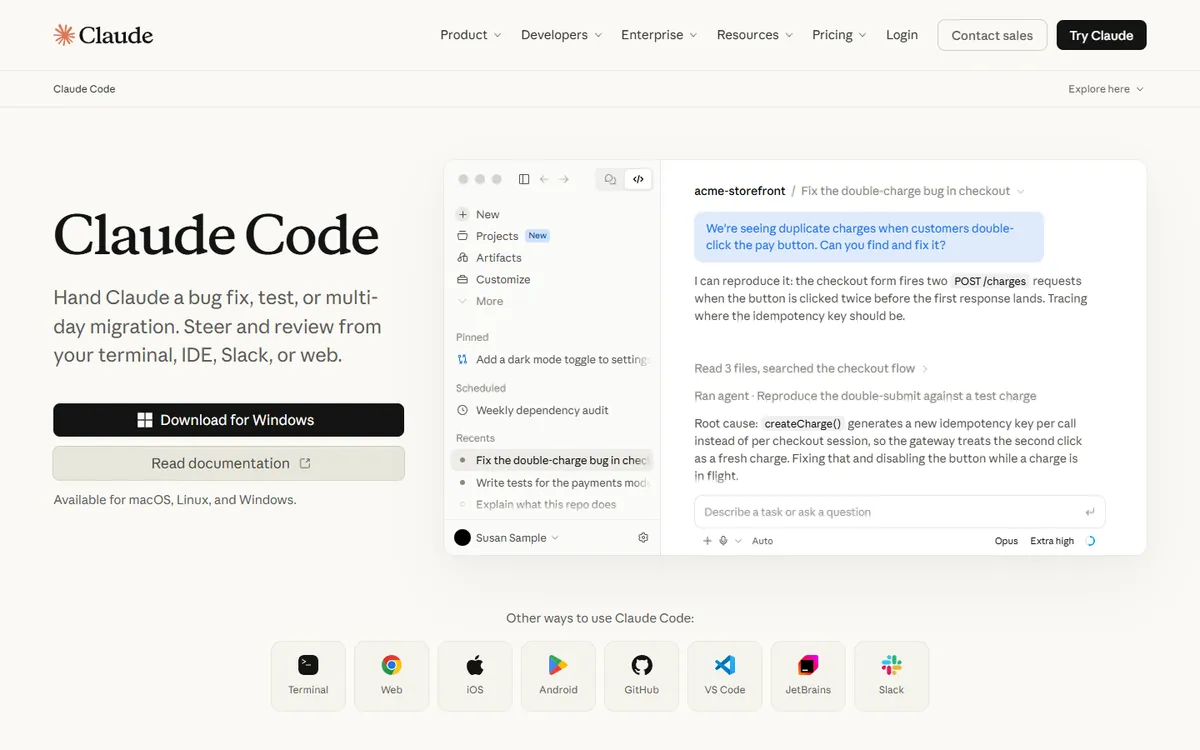
| Where it runs | Terminal, VS Code, JetBrains, desktop, web, mobile | CLI, IDE extension, ChatGPT desktop, web and mobile, cloud |
| Pay by API key | Yes | Yes, but no cloud features such as GitHub code review |
| Instructions file | CLAUDE.md, or reads AGENTS.md | AGENTS.md |
| Licence | Proprietary | CLI is Apache-2.0 |
Sources: Claude pricing, Claude Code overview, Codex pricing, and the Codex repository.
Where they differ in practice
Models. Claude Code uses Anthropic's models by default, though the CLI and IDE extensions also support third-party providers, which generally means routes to Claude through cloud platforms. Codex uses OpenAI's models. If your team prefers one model family's output on your codebase, that may settle it. We have a separate guide on using other models in these tools.
Limits. OpenAI publishes rough figures per five-hour window, and they vary hugely by model: on Plus, its estimate ranges from 5–45 messages for its top model to 350–3,000 for its lightest. Weekly limits may also apply, and cloud tasks can use more than local ones. Both vendors' allowances depend on your usage, so treat any stated number as a guide.
Customisation. Claude Code documents CLAUDE.md files, skills, hooks, MCP and subagents, plus scheduled tasks. Codex's docs list subagents, rules, permission profiles and sandboxing. Both support the wider ecosystem, including MCP, so check for the specific integration you need instead of assuming.
Security model. Both can edit files and run commands, so permissions matter. Read each tool's sandbox and permission documentation, and do not run either with broad access on a machine holding production credentials. See how to handle secrets and API keys.
Open source. If you want to read or adapt the client, the Codex CLI's Apache-2.0 licence is a real difference. The models themselves are closed on both sides.
Your subscription may decide it
Many people already pay for one of these chat products. If your team has ChatGPT Business, Codex is already included, and the same goes for Claude Team plans with Claude Code. Start with the one you have. A second $20 plan is also cheap enough to trial properly for a month, and some developers keep both, using one to review the other's work.
Run a one-afternoon test
A fair trial takes a few hours and tells you far more than any comparison article:
- Pick three real tasks: a bug with a known cause, a small feature, and a refactor touching several files.
- Use the same starting commit for each tool, in separate branches or worktrees.
- Add one shared AGENTS.md so both receive the same conventions. Claude Code can read it in place of a CLAUDE.md.
- Give the same prompt, without coaching one tool more than the other.
- Score the results on tests passing, how much of the diff you would keep, how many corrections it needed, how much of your allowance it used, and the time it took.
- Read the code. Passing tests is not enough, as our piece on AI-generated code explains.
Repeat when a major model ships, since the balance can shift between releases.
Which should you choose?
- You want to start for free or very cheaply: Codex, as it is available on Free and Go, though with limits.
- You already pay for ChatGPT or Claude: start with the one included in your plan.
- You need an open-source client: Codex CLI.
- You rely on specific hooks or integrations: check both sets of docs; do not assume.
- You code all day: test both on your own repository, then pick by output and allowance rather than headline price.
Whichever you choose, the tool matters less than the habits around it: small tasks, clear instructions, real tests and careful review. Keep your instructions in a portable file and your workflow stays easy to move, so this does not have to be a permanent decision.
If you want help building an AI-assisted development process that holds up in production, book a call.
Common questions
Is Claude Code better than Codex?
There is no lasting answer. Results shift with each model release and vary by language, codebase and task. The two tools now have similar features, so test both on your own repository with the same tasks and judge the code you would actually keep.
Is Codex free?
ChatGPT Free includes Codex for quick tasks, with limits and a lighter model. Fuller access comes with paid plans, starting with Go at $8 a month and Plus at $20, according to OpenAI's pricing page. API-key use is billed separately.
Can I use Claude Code and Codex on the same project?
Yes. They work on ordinary files and Git repositories. Keep shared conventions in AGENTS.md, which Codex reads and Claude Code can read too, and use separate branches or worktrees so that they do not overwrite each other's work.
Do I need a subscription to use them?
Not necessarily. Both support API-key use billed at API rates, although Codex cloud features such as GitHub code review are not available that way. Subscriptions are often better value for heavy use, and API billing can suit occasional use.