In short
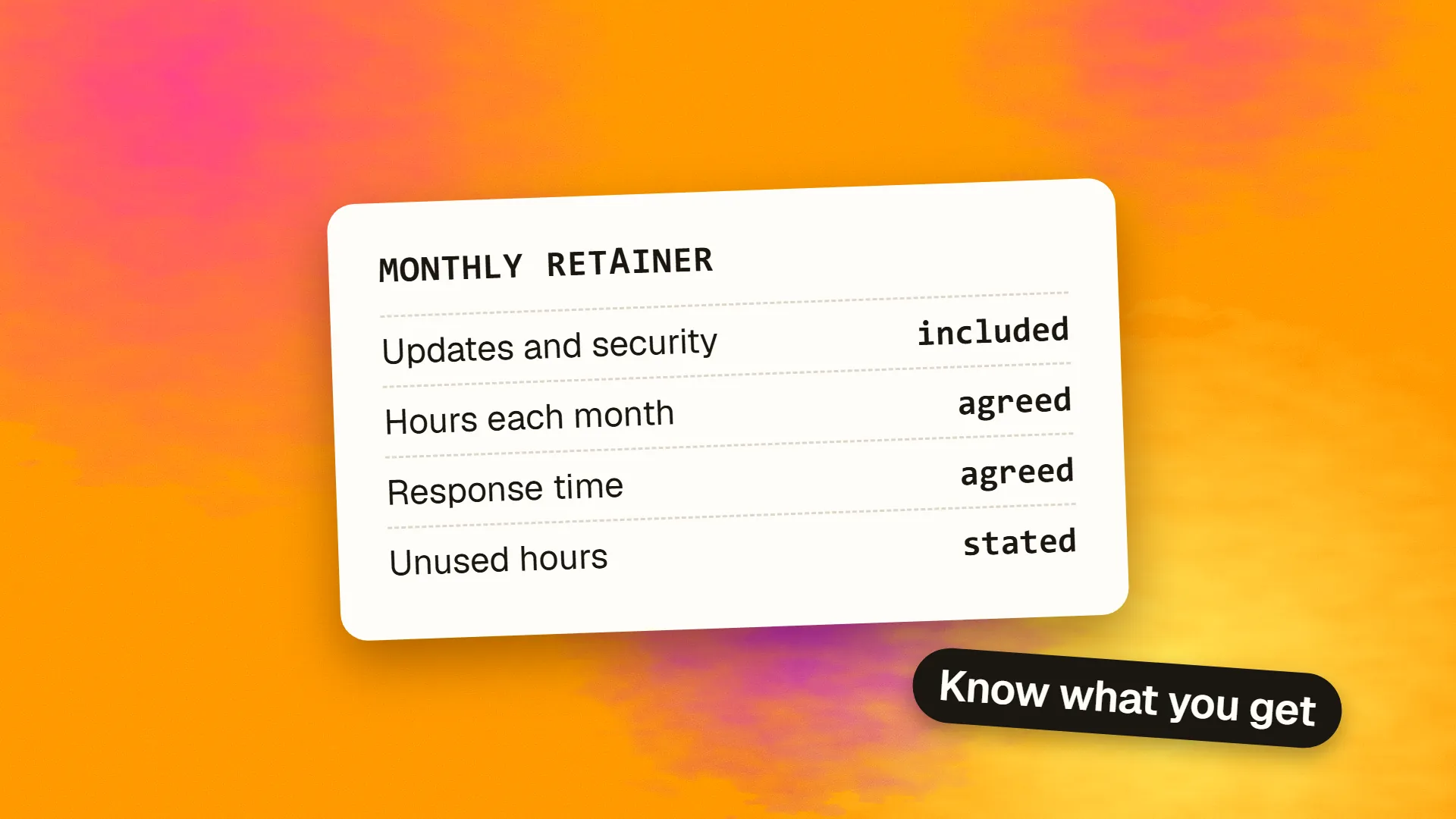
A retainer should state what work is covered, how many hours or what outcomes you get, response times, what happens to unused hours, who does the work, what reports you receive, and how either side can leave. It should separate routine maintenance from improvement work. Check it quarterly: if you aren't using the hours or can't see results, change it or end it.
What a retainer is for
A retainer is a recurring agreement: you pay a set amount each month, and a supplier reserves capacity for you. It makes sense when you have a steady flow of work that isn't enough for a full-time hire. If you only need occasional help, paying by the job is probably cheaper. For a wider view, see agency or in-house.
The ten things to specify
1. Scope of work. List what's covered. Separate the two main types:
- Care: updates, monitoring, backups and security patches. What website maintenance should include has a full list.
- Growth: design changes, new features, content and conversion work.
Mixing them under “support” is how disappointment starts. The maintenance can use up every hour, while your improvements never happen.
Monitoring
Backups
Security
New features
Content
Testing
2. Capacity or outcomes. State the hours per month, or the specific deliverables. See the comparison below.
3. Response and fix times. Say how quickly they'll acknowledge and resolve issues, by severity. “Site down” and “change this headline” shouldn't share a queue.
4. Unused hours. Do they roll over, and for how long, or are they lost? Many agencies limit rollover, because reserved capacity has a real cost. A limited rollover, say up to one month, is a common compromise. Either way, it should be in writing.
5. Overage. What happens when you need more? Agree a rate and require approval before extra hours get charged.
6. Who does the work. Will you have a named person or team, or whoever's free? Continuity is much of what you're paying for.
7. Reporting. Ask for a monthly summary of hours used, what was done and what's next. A short email is fine, as long as you can match it to the invoice.
8. Access and ownership. Your code, domain, hosting and analytics should stay in your own accounts. See who owns your website code, domain and design.
9. Minimum term and notice. Three months is a common starting point, with a 30-day notice period afterwards, although this varies. Avoid long automatic renewals.
10. Offboarding. Say what you'll get when it ends: credentials, documentation and a proper handover.
Hours or outcomes?
| Hour-based | Outcome-based | |
|---|---|---|
| You buy | A block of time | Defined results or deliverables |
| Best for | Varied, unpredictable requests | Well-defined, repeatable work |
| Main risk | Paying for time rather than value | Disputes over what counts as done |
| Who carries efficiency | You pay either way | The supplier benefits by being quicker |
Hours are simple and flexible, and they're common for web work. Outcome-based retainers can align incentives better, especially now that AI tools are making some tasks much faster. Be wary of promised outcomes that aren't under the supplier's control, such as “number one on Google”. Nobody can honestly guarantee that.
What should usually be out of scope
- Large new features. Anything bigger than a few days should get its own estimate.
- Emergency work caused by others, such as a third party's changes. Say how it's charged.
- Third-party licences and hosting fees, unless clearly included.
- Unlimited anything. “Unlimited revisions” or “unlimited support” almost always has a limit somewhere, and it's better to know where that limit is.
How to tell if it's working
Review the retainer every quarter, using a few plain questions:
- Are the hours being used? If you've left hours unused for months, reduce it.
- Is the work connected to a goal? You should be able to name what improved. For example, conversion rate or uptime.
- Do issues get fixed within the agreed times? Check the record, not your impression.
- Do you understand what you're paying for? If reports are vague, ask for more detail.
- Would you notice if it stopped? That question is often the most revealing one.
Keep a short priority list that both sides can see. Most retainers go wrong because nobody is deciding what comes next, so hours fill up with small requests. A simple approach is to agree priorities at the start of each month, with one person on your side responsible for them.
Warning signs
- Invoices arrive, but you can't see what changed
- Everything needs a separate quote, despite the retainer
- You can't get hold of the people who built your site
- The agency holds your domain or hosting login
- Your supplier is reluctant to give you access or documentation
- The retainer renews automatically with a long notice period
When to change or end it
Move to a smaller maintenance-only plan if your site is stable and you've no real improvement plans. Move to a larger one, or hire, if you're regularly going over your hours. End it if you can't describe its value after asking for clarity. Leave politely and carefully: secure your accounts first, then give notice.
A good supplier will tell you when you're paying for more than you need. If you'd like to discuss what level of ongoing support makes sense for your site, book a call.
Common questions
How much should a website retainer cost?
It depends on the hours, skills and response times involved. Compare using a clear rate and scope, rather than a headline number. For a simple site, basic maintenance may be enough, and the cost should reflect only the time that's really needed.
Do unused retainer hours roll over?
It depends on your contract. Many suppliers limit rollover, since capacity was reserved for you and can't be recovered. A short rollover period, such as one month, is a common compromise. Make sure the rule is written down.
Do I need a retainer for my website?
Not necessarily. A small, stable site may just need a maintenance plan or occasional work paid by the job. A retainer makes sense when you have steady work each month and value priority and continuity from the same team.
What is the difference between a retainer and a maintenance plan?
A maintenance plan generally covers routine upkeep such as updates, backups and monitoring. A retainer usually reserves broader capacity, and may include improvements, design and development. Many agreements combine both, so check exactly what's included.