In short
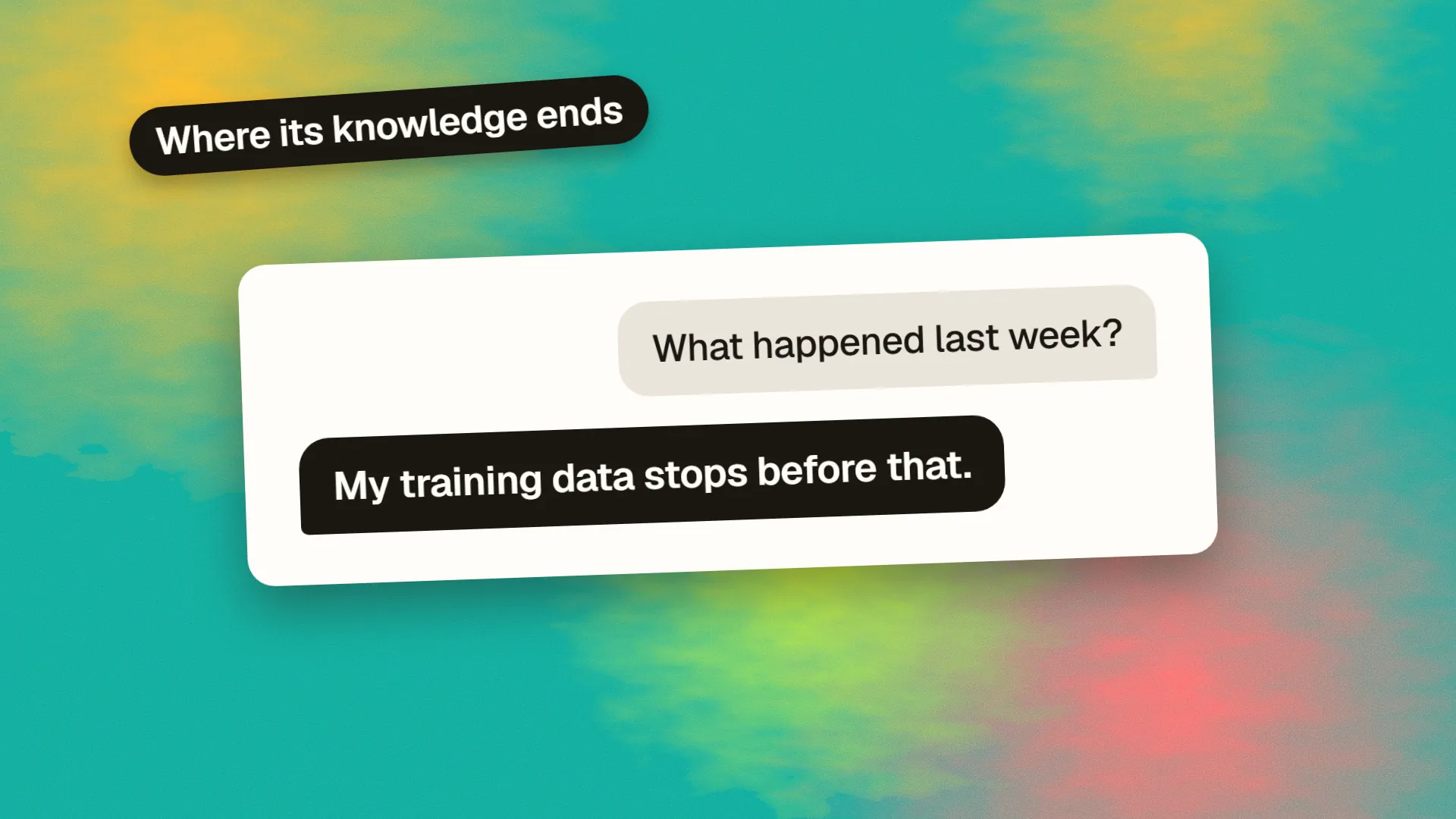
A knowledge cutoff is the point in time up to which a language model's training data extends; the model has no information about anything after it. Cutoffs typically sit several months to over a year before a model's release, and models asked about later events often answer from stale data or invent rather than declining. Products that need current information supply it through retrieval, web search or tool calls at request time, and instruct the model to rely on that rather than on its training. Knowing a model's cutoff is essential for any use involving prices, versions, regulations, news or the product's own recent changes.
What it is
A language model learns from a fixed body of text assembled before training begins. Training takes months, evaluation and safety work take more, and the model is released after that. The knowledge cutoff is the date the training data ends. A model with a cutoff of early 2025 has read nothing published after it: no news, no product releases, no price changes, no new laws, no new versions of the libraries it was trained to write code for.
Providers publish cutoffs for their models, with varying precision. The cutoff is a property of the model version; a newer version of the same product has a later cutoff, and updating the model in a product is how the baseline knowledge moves forward.
The lag
The gap between cutoff and release has ranged from a few months to more than a year, and the gap between cutoff and the moment a user asks a question grows every day the model is in use. A model released in mid-2025 with a late-2024 cutoff, used in 2026, is answering from information over a year old. For stable knowledge, history, mathematics, established science, language, this does not matter. For anything that changes, it matters constantly.
How models behave at the edge
Asked about something after the cutoff, a model may say it does not have information past its cutoff, which is the honest response and the one providers train toward. But it may also answer from the last thing it knew, presenting a superseded version or price as current, or produce a plausible answer that is a hallucination of what probably happened. Models are also uncertain about their own cutoff, since the date is not something they were trained to know precisely, and about which of their knowledge is near the edge, where coverage thins before the cutoff itself.
The effective cutoff, the date up to which the model's knowledge is reliable, is usually earlier than the stated one, because recent events are under-represented in training data relative to how they will eventually be covered.
Filling the gap
A model cannot be updated at request time, but its context can. The standard patterns:
Retrieval. Store current documents, product data, policies and prices in a searchable index and insert the relevant pieces into the prompt for each request. This is retrieval-augmented generation, and it makes the model's answer as current as the index.
Web search and browsing. Let the model, or the application, search the live web and read pages before answering. This is how consumer assistants answer questions about recent events, and it is available through provider APIs and tool frameworks.
Tool calls. Give the model functions that fetch live data: the current price, the order status, today's date, the latest version number. The model calls them rather than guessing.
System prompt facts. For small amounts of stable-but-recent information, state it in the instructions: the current product version, the pricing, the date.
Instruct reliance. Tell the model to prefer supplied information over its training knowledge and to say when it lacks current data, and evaluate that it does.
Product design consequences
Any feature touching prices, availability, versions, regulations, schedules, news or the product's own recent behaviour needs a live source of truth and must not rely on the model's memory. The model's training knowledge is useful for reasoning, language and general context; the facts come from elsewhere.
Tell the model today's date in every request; models otherwise assume it is near their cutoff and get durations and "recent" wrong. Version documentation and data so the model can be given the right edition. Plan for model upgrades as the way the baseline moves, and re-run evaluations when the model changes, since a new cutoff changes what it knows and what it assumes. And disclose to users what the assistant can and cannot know, since a confident answer about last week's change to a policy is exactly where the residual risk lives.
A short example
A support assistant for a software product is asked about a setting that was renamed in last month's release. Left to its training, the model describes the old name and location confidently and wrongly. Given the current documentation through retrieval, with an instruction to answer from it, it describes the new one and cites the page. The model did not get smarter; the product stopped asking it to remember.
The practical rule
Treat the model as an expert who fell asleep on the cutoff date: excellent on everything before it, unaware of everything after, and inclined to answer as if no time has passed. Wake it with the current facts on every request, and never let it guess the ones that matter. If you are building a feature that depends on current information and want the retrieval and tool design reviewed, book a call.
Common questions
What does knowledge cutoff mean for ChatGPT or Claude?
The date up to which the model's training data extends; it has no built-in knowledge of anything after it. Consumer assistants often fill the gap with web search or browsing, and the API model on its own does not. Providers publish cutoffs per model version, and a newer version has a later cutoff.
Why do AI models have a knowledge cutoff?
Because training uses a fixed dataset assembled before training starts, and training, evaluation and release take months. The model learns from that snapshot and cannot absorb new information afterwards without retraining. Current information is supplied at request time through retrieval, search or tool calls instead.
Does an AI model know its own knowledge cutoff?
Only approximately. Models are told their cutoff in instructions or infer it from training data, and they are often wrong by months. Their knowledge also thins before the stated cutoff, since recent events are under-represented in training text. Products should state the date and supply current facts rather than relying on the model's sense of time.
How do you get current information from a language model?
By supplying it in the request: retrieve relevant documents and data from an up-to-date index, let the model search the web or read pages, give it tool functions that fetch live values such as prices and statuses, and state key facts and today's date in the system prompt. Instruct it to rely on supplied information over its training and to say when it lacks current data.
What happens if you ask an AI about events after its cutoff?
Ideally it says it has no information past its cutoff. Often it answers from the last thing it knew, presenting outdated versions or prices as current, or invents a plausible answer. Products that need current answers must supply the information at request time and instruct the model to prefer it, because the model cannot tell recent from stale on its own.
