In short
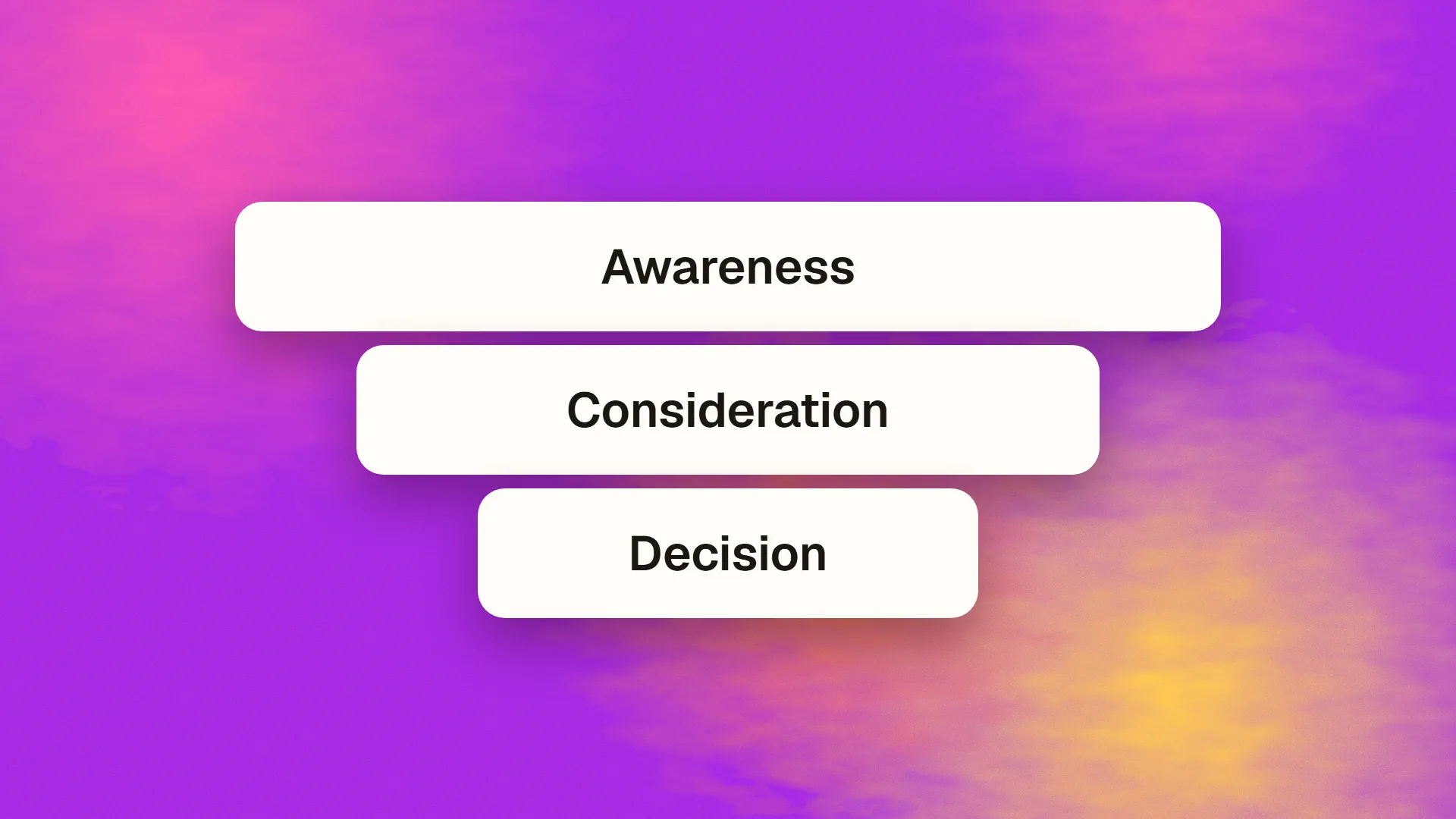
A marketing funnel is a model that divides the path from first contact to purchase into stages, most commonly awareness, consideration and decision, with numbers attached to each so you can see where prospects drop out. On a website the stages correspond roughly to informational content, comparison and service pages, and the enquiry or checkout step. The model is useful for locating the weakest stage and choosing what to fix; it is misleading if taken literally, because real buyers loop, skip stages and arrive from several directions at once.
The model
A marketing funnel describes the narrowing sequence between everyone who could become a customer and the people who do. The name comes from the shape: wide at the top, where many people are vaguely aware of you, narrow at the bottom, where a few buy. It dates from the 1890s AIDA model (attention, interest, desire, action) and has been relabelled many times since. The current standard three-stage version is:
- Top of funnel: awareness. The prospect has a problem and does not know you exist. They are searching general questions, reading, watching.
- Middle of funnel: consideration. They know solutions exist and are comparing. They read comparisons, pricing, reviews and case studies.
- Bottom of funnel: decision. They have shortlisted and are ready to act. They look for a price, a demo, a phone number, a form.
Some versions add retention and advocacy after purchase, which turns the funnel into a loop or a bow-tie. That addition matters for subscription businesses, where churn decides the economics.
What each stage looks like on a website
The funnel is abstract until you map it to pages, and the mapping is what makes it useful.
| Stage | Visitor question | Pages that answer it | Measure |
|---|---|---|---|
| Awareness | What is this problem, how do others solve it? | Guides, explainers, question articles | Organic sessions, new users |
| Consideration | Is this the right kind of solution, and is this the right provider? | Service pages, comparisons, case studies, pricing | Service-page views, returning visitors, time on page |
| Decision | How do I start? | Contact, quote, booking, checkout | Enquiries, purchases, conversion rate |
A content programme that only produces top-of-funnel articles fills the top and starves the middle; a site with nothing but service pages has no top at all and depends on paid or referral traffic to fill it. The topic cluster approach is one way of building both together.
Measuring it
The funnel earns its keep when every stage has a number. In practice that means:
- Define the bottom conversion precisely, and make sure analytics records it as an event.
- Define a middle-stage signal: a view of a service or pricing page, a case-study read, a second visit within a week.
- Count the top: sessions, or better, new users from search and referral.
- Divide down: middle over top, bottom over middle. These stage rates are more informative than the overall conversion rate because they say where the loss is.
A site with a strong top and a weak middle-to-bottom rate has a persuasion or friction problem: the pages people compare on are not doing their job. A site with a weak top has a visibility problem. The fix is different, and the funnel is what tells you which you have. Brand search is a useful cross-check on the top: it rises when awareness genuinely grows.
Where the model breaks
Real buyers do not descend in order. A referral from a friend arrives at the decision stage without passing through the top. A reader of one article leaves for six months and returns via a paid ad. A visitor compares you on a third-party review site your analytics never sees. Attribution tools try to reconstruct this and never fully succeed; a large part of any funnel's top is invisible.
The funnel also implies a single path, when most services have several: search, referral, social, partnerships, events. Each has its own stage rates. A blended funnel can hide that one channel converts at three times the rate of another.
And it assumes the stages are sequential when the middle and the bottom frequently collapse into one visit. A prospect arriving from a recommendation may read the case study and submit the form in four minutes. Design decision pages assuming that visitor exists.
Using it without overdoing it
For a small business the funnel is a thinking tool, not a dashboard. Three habits capture most of its value:
- Check that every stage has at least one page. Many sites have a homepage and a contact form and nothing that answers the questions a prospect asks before they are ready to contact anyone.
- Know the stage rates, roughly. Once a quarter is enough. Watch for a stage that changes.
- Match the ask to the stage. A reader of an awareness article is not ready for a sales call; a newsletter or a related guide is the appropriate next step. A visitor on the pricing page is; a call to action that offers a conversation belongs there.
The funnel becomes a liability when it is treated as a target rather than a diagnostic: when teams chase top-of-funnel volume because it is the easiest number to grow, or when the stage definitions are adjusted until the rates look healthy. The numbers are only useful if they are allowed to look bad.
If you would like help working out which stage of your funnel is leaking, book a call.
Common questions
What are the stages of a marketing funnel?
The common three-stage version is awareness, consideration and decision, often abbreviated to top, middle and bottom of funnel. Older models use attention, interest, desire and action (AIDA), and modern versions sometimes add retention and advocacy after purchase.
What is the difference between a marketing funnel and a sales funnel?
They describe the same journey from different ends. A marketing funnel covers how prospects become aware and interested; a sales funnel covers how qualified leads become customers. On a small business website the two overlap almost completely.
How do you measure a marketing funnel on a website?
Define the final conversion as an analytics event, define a middle-stage signal such as a service-page view, count top-of-funnel sessions, and calculate the rate between each pair of stages. The stage with the lowest rate is where to focus.
Is the marketing funnel outdated?
As a literal description of behaviour, yes: buyers loop, skip stages and arrive from many directions. As a diagnostic for locating where prospects drop out, it remains useful. Use it to find leaks, not to script the customer.
What content belongs at each funnel stage?
Awareness: guides and question-answering articles. Consideration: service pages, comparisons, case studies, pricing. Decision: contact, quote, booking and checkout pages with clear next steps.