In short
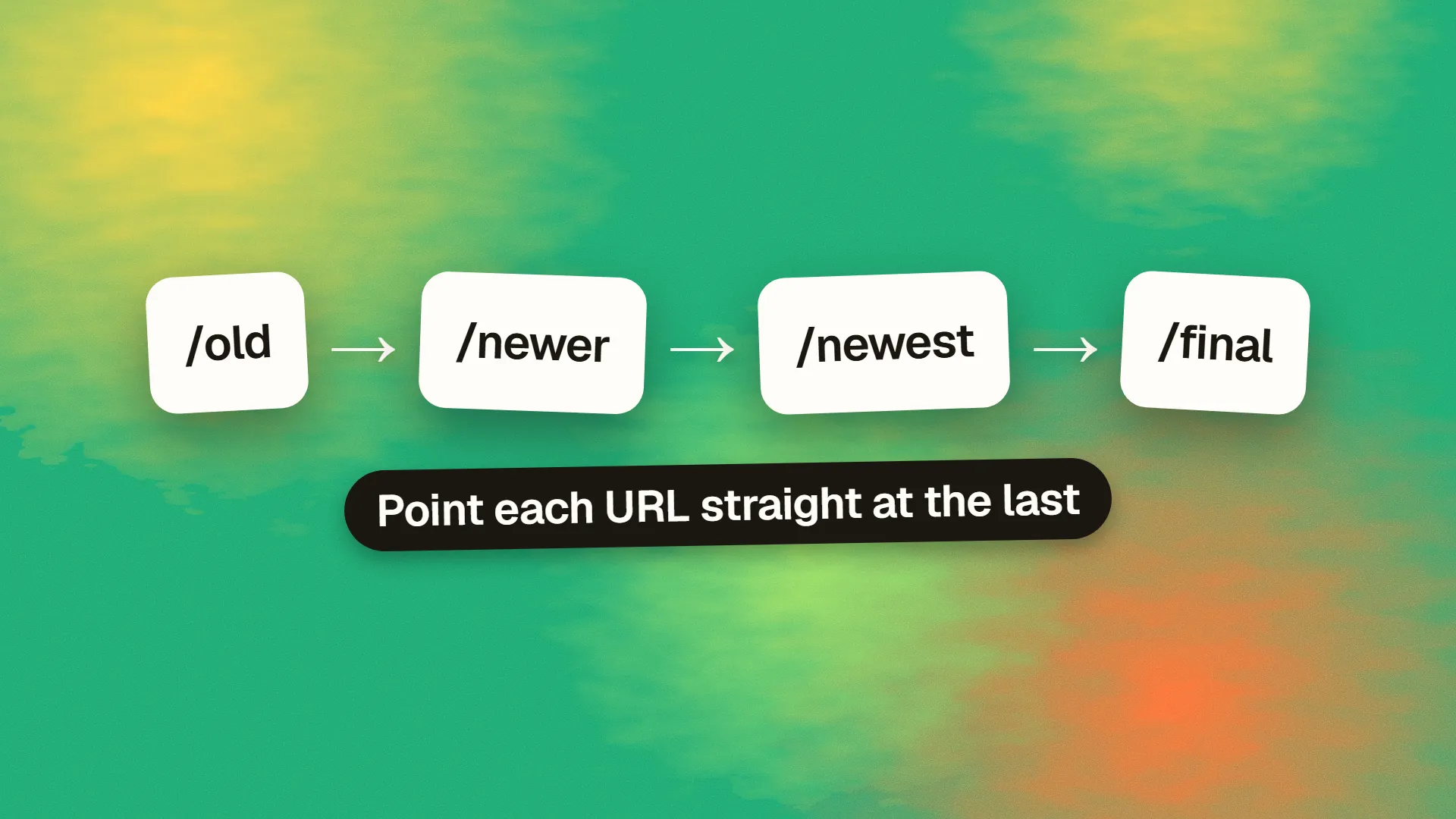
A redirect chain is a sequence in which a URL redirects to a second URL that redirects to a third, and so on, before a final page loads; a redirect loop is the same thing with no end. Chains form when redirects are added on top of old ones during migrations, HTTPS moves and restructures. Each hop adds latency for visitors, consumes crawl effort, and Google follows only a limited number of hops before giving up, so long chains can leave old URLs unreachable. Find them with a crawler, then rewrite every redirect to point directly at its final destination.
How chains form
Nobody creates a redirect chain on purpose. They accrete. A page moves in 2019 and a redirect is added. The site moves to HTTPS in 2021 and every HTTP URL redirects to its HTTPS twin, including the old page's, which then redirects again. A restructure in 2023 moves the section, and the 2019 destination now redirects onward. Add a www-to-non-www rule and a trailing-slash rule, and a link from an old article can pass through four or five redirects before landing.
Each one was correct when added. Together they are a chain, and the site has hundreds of them.
What it costs
Speed. Each hop is a round trip: the browser requests the URL, receives a redirect, requests the next, receives another. On a mobile connection each hop can add a few hundred milliseconds, so a four-hop chain delays the page by a second before a byte of content arrives, which lands on time to first byte and Largest Contentful Paint.
Crawl. Googlebot follows redirects, but each hop is a fetch it must schedule, and Google has said it follows up to about ten hops in one session before abandoning the chain; long chains mean the destination may not be reached, and the crawl effort spent on hops is not spent on pages.
Signals. Google states that redirects pass full signals regardless of type, and the old belief that each hop leaks a fixed percentage is no longer accurate. But a chain that Google abandons passes nothing, and a chain that includes a temporary redirect or a redirect to a different protocol introduces ambiguity about which URL is canonical.
Fragility. Every hop is a rule that can break. A chain that depends on five configurations in three places fails when any one is changed.
Loops. A chain that closes on itself, A to B to A, never resolves; browsers stop with an error and Google records the URL as unreachable.
Finding them
A site crawler such as Screaming Frog, Sitebulb or the crawling tools inside the major SEO suites reports redirect chains and loops directly: crawl the site, including old URLs from the sitemap history, server logs and Search Console, and read the redirect report, which lists each chain with its hops and final status. Search Console's Pages report flags URLs with redirect errors. For a single URL, a redirect checker or a curl -IL request shows every hop.
The chains that matter most are the ones on URLs that still receive traffic or links: old pages linked from other sites, URLs in printed material, addresses in email archives. Server logs show which old URLs are still being requested.
Collapsing them
For every chain, rewrite the first redirect to point straight at the final destination, and do the same for every intermediate URL, so that any URL in the chain reaches the end in one hop. In practice that means editing the redirect rules at the server, the CDN or the CMS's redirect manager, and consolidating the layers: protocol and host redirects in one place, page-level redirects in another, in the right order so a URL is normalised once and then redirected once.
The order of rules matters. If the HTTPS redirect runs before the page redirect, an HTTP request to an old page hops twice; if the page rule can match both protocols and send directly to the final HTTPS URL, it hops once. Most servers and CDNs allow this with a small amount of care.
After collapsing, recrawl to confirm every old URL resolves in a single 301 to a 200, and update internal links so the site's own pages never point at redirected URLs at all.
Preventing new ones
During any migration or redesign, build the redirect map against the final URLs, not the current ones, and update existing redirects to the new destinations rather than adding a layer on top. Keep one authoritative list of redirects rather than rules scattered across .htaccess, the CMS and the CDN. Update internal links to new URLs rather than relying on redirects. And run the chain report after every structural change, because that is exactly when chains appear.
The practical view
Redirect chains are a maintenance debt: invisible to the owner, paid by every visitor and every crawl. A site that has been through two or three migrations almost certainly has them, and collapsing them is a contained job with a measurable effect on load time for the URLs that still matter. If you would like a chain report run and the rules consolidated, book a call.
Common questions
How many redirects is too many?
More than one. Every URL that redirects should reach its final page in a single hop. Google follows up to roughly ten hops before abandoning a chain, but each hop adds latency for visitors and crawl effort for Google, and chains of three or more are worth collapsing on any URL that still receives traffic or links.
Do redirect chains hurt SEO?
They slow page loads, which affects Core Web Vitals; they consume crawl effort; long chains may be abandoned by Google so the destination is never reached; and loops make URLs unreachable entirely. Google says signals pass fully through redirects it completes, so the main costs are speed, crawl and the risk of chains that are too long or broken.
How do I find redirect chains on my website?
Crawl the site with a tool such as Screaming Frog or Sitebulb, including old URLs from server logs, the sitemap history and Search Console, and read the redirect chain report, which lists each chain with its hops. For a single URL, a redirect checker or curl with the -IL flags shows every hop and status code.
How do I fix a redirect chain?
Rewrite the first redirect, and every intermediate one, to point directly at the final destination, so each URL in the chain resolves in one hop. Consolidate protocol, host and page-level rules so a request is normalised and redirected once, in the right order, and update internal links so they never point at redirected URLs. Recrawl to confirm.
What is a redirect loop?
A chain that never ends: URL A redirects to B and B redirects back to A, or a longer cycle. Browsers detect it and show an error, and Google records the URL as unreachable. Loops usually come from conflicting rules in different places, such as a CMS redirect and a server rule pointing at each other, and are fixed by removing one of them.
