In short
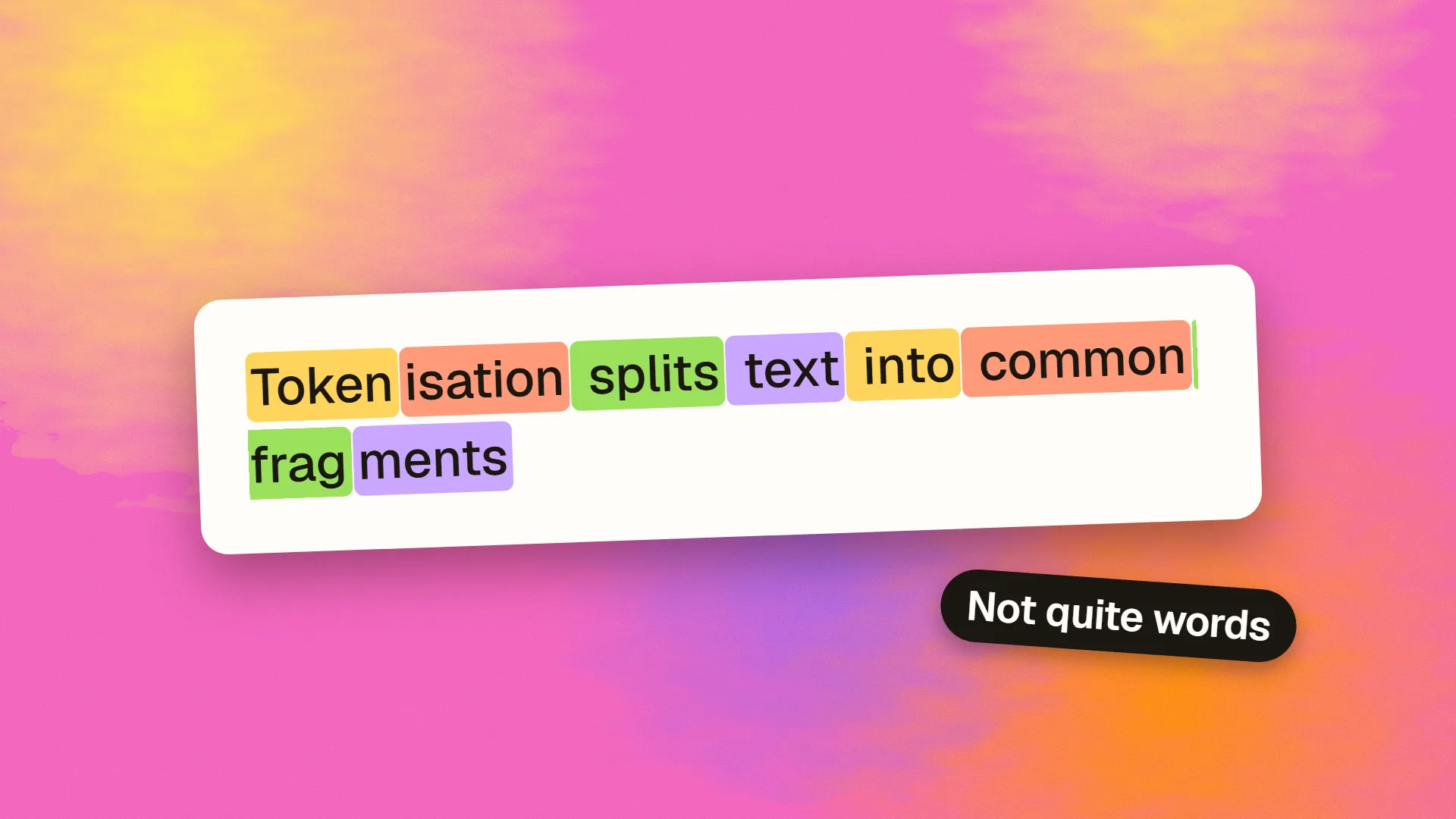
A token is the basic unit of text a large language model processes: a chunk produced by a tokeniser that splits text into common fragments, so that frequent words are one token and rarer words are several. In English, one token is about four characters or three-quarters of a word, so 1,000 tokens is roughly 750 words. Models are priced per token in and out, their context windows are measured in tokens, and their speed is tokens per second, which makes token counts the unit of cost and capacity for anything built on an LLM. Other languages, code and numbers often use more tokens per word.
What a token is
Before a model reads text, a tokeniser breaks it into pieces from a fixed vocabulary of tens of thousands of fragments learned from training data. Common English words are single tokens; less common words are split into two or more; punctuation, spaces and parts of numbers are tokens of their own. "The" is one token. "Tokenisation" might be three. A model reads the sequence of token IDs, predicts the next token, and its output is assembled from tokens the same way.
The scheme, usually byte-pair encoding or a variant, balances vocabulary size against sequence length: too few tokens and every word is many pieces; too many and the vocabulary is unmanageable. The practical result is that tokens do not map cleanly to words, characters or syllables, and every provider's tokeniser differs slightly.
The rules of thumb
For ordinary English prose: about four characters per token, about 0.75 words per token, so 100 tokens is roughly 75 words and 1,000 tokens roughly 750. A page of this article is around 1,000 tokens.
For other languages the ratio is worse, sometimes much worse: languages with non-Latin scripts, accents or long compound words can use two to four times as many tokens for the same meaning, which means higher cost and less fitting in the context. Code is token-heavy because of symbols and indentation. Numbers are split into small pieces, which is one reason models handle arithmetic awkwardly. JSON and XML carry overhead from their punctuation.
Providers publish tokeniser tools that count exactly, and libraries such as tiktoken do it in code.
Why tokens are the unit of everything
Pricing. API models charge per million tokens, with separate rates for input (what you send, including the system prompt, conversation history and retrieved documents) and output (what the model generates), and output typically costing several times more. A feature's running cost is its token volume multiplied by those rates.
Context windows. A model can attend to a fixed maximum number of tokens at once, its context window, which the prompt, the history, any documents and the answer all share. Everything is measured in tokens because that is what the window holds.
Speed. Models generate output token by token, and their speed is quoted in tokens per second; a 300-word answer is around 400 tokens, and its latency is the time to produce them.
Limits. Maximum output length, rate limits and quotas are set in tokens.
Practical consequences
System prompts cost tokens on every call; a 2,000-token instruction block sent with every request is a fixed overhead that dominates short interactions. Conversation history grows with each turn and must be trimmed or summarised, or the cost per message rises and the window fills. Retrieved documents in a RAG pipeline should be chunked and selected by relevance, since sending everything is expensive and dilutes attention. Multilingual products should budget for higher token counts. And the model's occasional oddness with spelling, counting letters and arithmetic is largely a tokenisation artefact: it never sees the letters.
A worked example
A support assistant is built with a 1,500-token system prompt describing the product and its tone. Each user message averages 60 tokens and each answer 200. The application sends the last ten turns as history. By the tenth message, a single request carries the system prompt, around 2,600 tokens of history and the new message, close to 4,200 input tokens, to produce 200 output tokens. Over a session of twenty messages the input side is roughly twenty times the output side in volume, and at typical rates it is the larger part of the bill even though output tokens cost more each. Trimming the system prompt to 600 tokens and the history to the last four turns cuts the input per request by more than half without changing what the user sees. That arithmetic, repeated across thousands of sessions, is where the cost of an AI feature is decided.
Tokens and quality
Token limits shape answers as well as bills. A model asked for a long response with little room left in the window truncates mid-sentence. A document chunked without regard to token boundaries splits a paragraph across chunks and loses its sense. A prompt padded to the limit crowds out the model's attention. Working in tokens, rather than words or pages, keeps these problems visible.
Counting and reducing
Count with the provider's tokeniser before estimating costs; word counts mislead by 30% or more. Reduce by tightening system prompts, trimming or summarising history, sending only relevant document chunks, asking for concise output where appropriate, using smaller models for simple tasks, and caching repeated prefixes where the provider supports prompt caching, which charges reused tokens at a fraction of the rate. For most products the largest saving is in what is sent, not what is generated.
Tokens are the accounting unit of working with language models, and a product team that thinks in them from the start avoids the surprise when the invoice arrives. If you would like a feature's token budget modelled before it ships, book a call.
Common questions
How many words is 1,000 tokens?
About 750 words of ordinary English, since a token is roughly four characters or three-quarters of a word. The ratio is worse for other languages, code and numbers, which use more tokens per word. Use the provider's tokeniser to count exactly, as word counts can be off by 30% or more.
Why do LLMs use tokens instead of words?
Because a fixed vocabulary of word fragments handles any text, including rare words, misspellings, names, code and other languages, without needing an entry for every possible word. The tokeniser splits text into common pieces learned from training data, balancing vocabulary size against sequence length. Words would leave the model unable to represent anything outside its list.
How are tokens priced?
Per million tokens, with separate rates for input, which includes the system prompt, conversation history and any documents sent, and for output, which the model generates and which usually costs several times more per token. Prompt caching, where offered, charges reused input at a reduced rate.
Do other languages use more tokens than English?
Usually, often substantially. Tokenisers are trained mostly on English, so languages with non-Latin scripts, accented characters or long compound words are split into more pieces, sometimes two to four times as many tokens for the same meaning. That raises cost and consumes more of the context window for multilingual products.
How do I reduce token usage?
Shorten system prompts, trim or summarise conversation history, send only the relevant chunks of retrieved documents, ask for concise answers where they suffice, route simple tasks to smaller models, and use prompt caching for repeated prefixes. Input tokens usually dominate cost, so reducing what is sent saves more than limiting output.
