In short
UTM parameters are five optional query-string tags, utm_source, utm_medium, utm_campaign, utm_term and utm_content, appended to a URL so that analytics tools attribute the resulting visit to a specific source, channel and campaign instead of guessing from the referrer. Use them on every link you control that points at your site from elsewhere: emails, social posts, ads, documents, QR codes and partner placements. Keep values lowercase and consistent through a shared naming sheet, never use them on internal links, and expect them to be the difference between a channel that gets credit and one that shows up as direct.
What they are
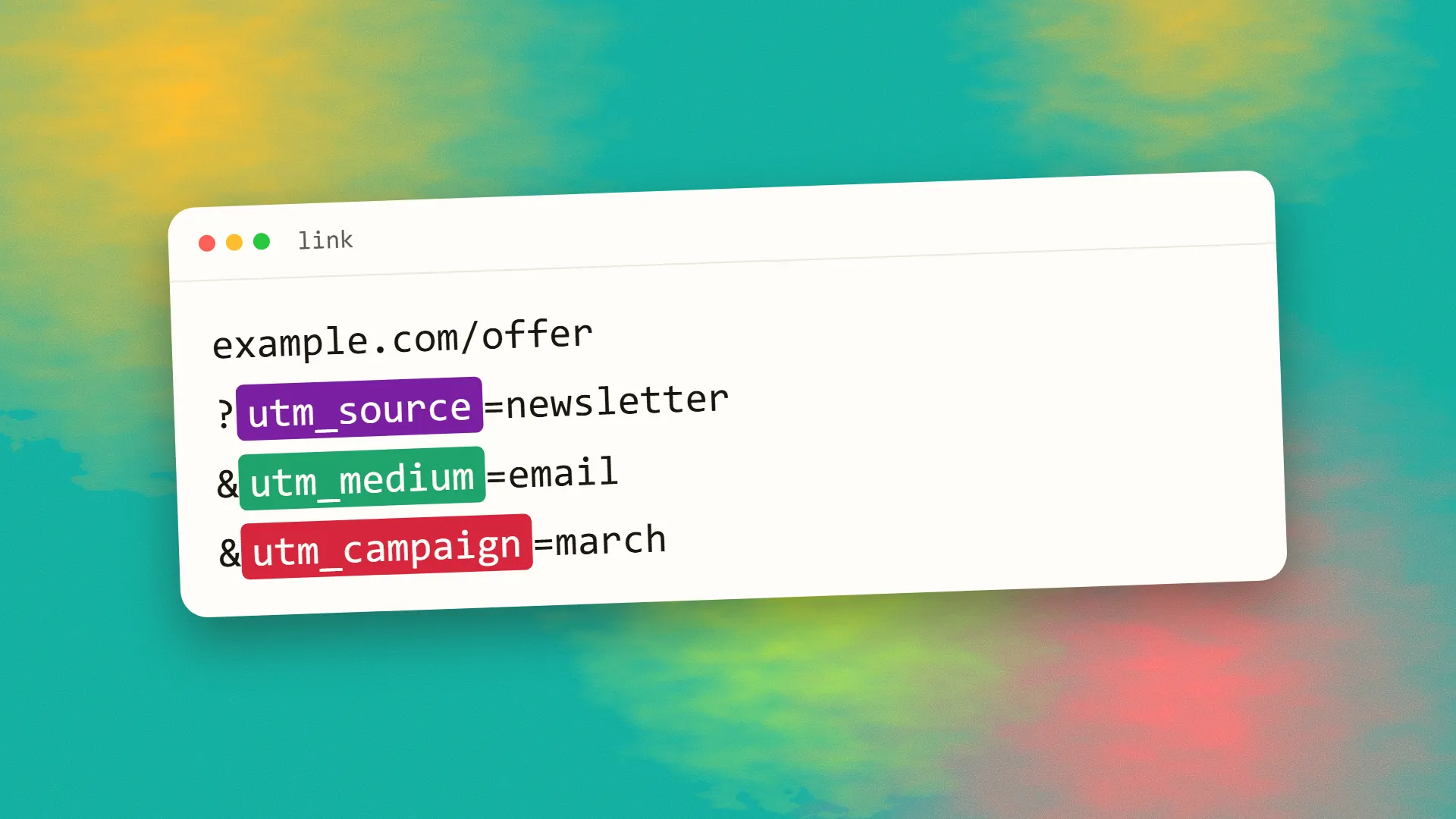
A UTM parameter is a key-value pair added to the end of a URL after a question mark:
https://example.com/pricing/?utm_source=newsletter&utm_medium=email&utm_campaign=spring-launchThe page loads exactly as it would without them; the parameters are read by the analytics script and recorded against the session. The name comes from Urchin Tracking Module, the software Google bought in 2005 that became Google Analytics, and the convention is now supported by every analytics platform.
They exist because analytics otherwise infers a visit's origin from the referrer header, which is often missing or uninformative: clicks from email clients, apps, documents and many other places arrive with no referrer and are filed as direct. A UTM tag replaces the inference with a declaration.
| Part of the URL | What it records |
|---|---|
utm_source=newsletter | Where the link was placed |
utm_medium=email | The channel |
utm_campaign=spring-launch | The specific campaign |
The five parameters
utm_source (required): where the link was placed. newsletter, linkedin, google, partner-name, print-brochure.
utm_medium (required): the channel or type. email, social, cpc for paid search, display, referral, qr, print. Analytics platforms use medium to assign the visit to a channel group, so it should use conventional values.
utm_campaign (required): the specific campaign or initiative. spring-launch, webinar-june, annual-report-2026.
utm_term: the keyword, for paid search, or a further subdivision.
utm_content: which of several links in the same placement, such as header-button versus footer-link in one email, or variant A versus B of an ad.
The first three identify the visit's origin; the last two distinguish within it.
A naming convention
UTMs are only useful if the same thing is always tagged the same way. Newsletter, newsletter and Newsletter-Email are three sources in the report. The convention that works:
- All lowercase, always.
- Hyphens between words, no spaces, no special characters.
- A fixed list of allowed values for source and medium, using the platform's standard medium names so channel grouping works.
- Campaign names that include the date or period:
spring-launch-2026. - A shared spreadsheet or a builder tool that everyone uses, listing every campaign's parameters, so nobody invents a new spelling.
- One person who owns the list.
Without this, six months of tagging produces a report with forty variants of the same channel and no way to combine them.
Building them
Google's Campaign URL Builder and its equivalents produce the URL from form fields; most email and social tools add UTMs automatically with configurable defaults; ad platforms can append them through tracking templates, with Google Ads also using its own auto-tagging. For print and offline, generate the tagged URL, then shorten it with a service that preserves the parameters or encode it in a QR code, since nobody types a UTM.
The mistakes
Internal links. Tagging a link from one page of your site to another starts a new session with a new source in most analytics tools, overwriting the real origin and inflating session counts. Never put UTMs on internal links; use event tracking for internal promotions.
Inconsistent values, as above.
Tagging organic social profile links so that all your social traffic appears as one campaign forever, obscuring the real posts.
Using utm_source for the channel and utm_medium for the platform, reversed, which breaks channel grouping. Source is where; medium is what kind.
Personal data in parameters. Never put an email address, name or customer ID in a UTM; it lands in analytics as personal data and in every log along the way.
Leaving them visible in shared URLs. People copy tagged URLs from an email into a social post, and the social traffic is attributed to the email. Not fully avoidable; canonical tags keep the SEO side clean.
Expecting them on search or referral traffic. Organic search and links from other sites are attributed from the referrer; UTMs are for links you control.
SEO and canonicals
A tagged URL is a distinct URL to a crawler. If tagged links are shared publicly and get indexed, the site has duplicates. A canonical tag on every page pointing at the clean URL resolves this, and Google generally handles common tracking parameters sensibly, but the canonical is the safeguard.
What good looks like
Every email, social post, ad, document and offline link tagged from a shared list; the analytics channel report showing each channel and campaign as its own line with sensible names; direct traffic reduced to what is genuinely unattributable; and a monthly look at which campaigns produced not just visits but conversions, which is the analytics question that matters. It is an hour to set up the convention and a habit to keep it. If your reports are full of near-duplicate sources, book a call; the cleanup is a spreadsheet and a rule.
Common questions
What are the 5 UTM parameters?
utm_source, where the link was placed, such as newsletter or linkedin; utm_medium, the channel type, such as email, social or cpc; utm_campaign, the specific campaign; utm_term, the keyword or a subdivision; and utm_content, which of several links or variants in the same placement. Source, medium and campaign are the essential three.
Do UTM parameters affect SEO?
Not if handled sensibly. A tagged URL is technically a different URL, so if tagged links are indexed the site has duplicates; a canonical tag pointing at the clean URL resolves that, and Google generally recognises tracking parameters. Never use UTMs on internal links, and keep canonicals on every page.
Should I use UTM parameters on internal links?
No. In most analytics tools a UTM-tagged internal link starts a new session with a new source, overwriting the visitor's real origin and inflating session counts. Track internal promotions with event tracking instead, and reserve UTMs for links from outside your site.
Why is my UTM data messy in Google Analytics?
Almost always inconsistent values: the same source written with different capitalisation, spacing or wording, or source and medium reversed, producing many variants of one channel. Adopt a convention of lowercase, hyphenated values from a fixed list, use a shared builder or sheet, and assign one owner to the list.
Are UTM parameters case sensitive?
Yes, in Google Analytics and most tools: Newsletter and newsletter are recorded as different sources. Use lowercase for every value, always, and enforce it through a shared builder so that nobody creates variants.