In short
Plain language is writing designed so that the intended reader can find what they need, understand it on the first reading, and act on it: the main point first, everyday words in place of jargon, short sentences with one idea each, the active voice, direct address, and structure through headings and lists. It is a legal requirement for public communication in several countries and a standard for accessible content. On the web it outperforms formal prose on comprehension, conversion and search, because people read on screens quickly and partially, and it is not the same as dumbing down: precision and plainness reinforce each other.
The definition
The International Plain Language Federation's definition is the one most guides adopt: a communication is in plain language if its wording, structure and design are so clear that the intended readers can easily find what they need, understand what they find, and use that information. The emphasis is on the reader, not the text. A document is plain for its audience, and a page for structural engineers is plain if structural engineers understand it at once.
The movement has a long history in government and law: the US Plain Writing Act of 2010, the UK's Plain English Campaign since 1979, the European Commission's guidance, and style guides from GOV.UK and others that are among the best writing references on the web. It has become a standard in accessibility work, since WCAG's guidance on reading level and the needs of readers with cognitive and learning differences point the same way.
The principles
Lead with the point. Say the conclusion, the answer or the action first. Background follows for those who want it.
Use the reader's words. The terms your audience uses, not the terms your organisation uses internally. If a technical term is necessary, define it once.
Short sentences, one idea each. Around 15 to 20 words on average, with variation. A sentence that needs a semicolon usually wants to be two.
Active voice and a clear actor. "We will refund you within five days" rather than "Refunds will be processed within five days."
Address the reader. "You" and "we" rather than "the customer" and "the company".
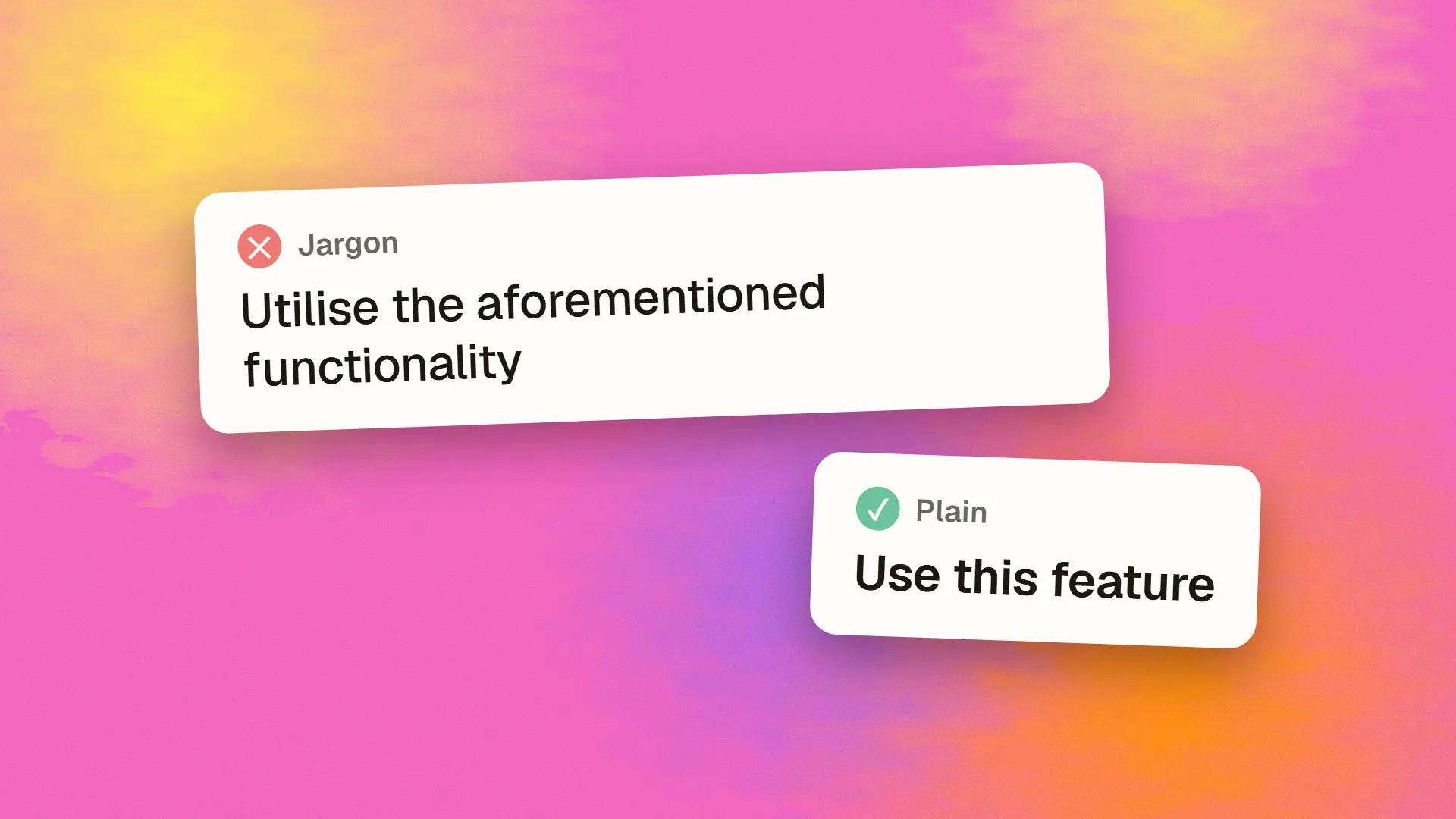
Concrete over abstract. "Sign the form and post it to us" rather than "complete the required documentation and return it to the appropriate department".
Cut what does nothing. Fillers, hedges, doubled words, throat-clearing openers, and every sentence that exists because the writer felt a section should be longer.
Structure for scanning. Informative headings, short paragraphs, lists for lists, tables for comparisons. Most web reading is scanning, and structure is what makes scanning succeed.
Consistent terms. One name for each thing. Variation for elegance confuses.
Why it outperforms formal prose on the web
People read screens faster and less completely than paper, on phones, with divided attention. Text that requires rereading is text that is abandoned. Studies of government and commercial sites rewritten in plain language consistently report higher task completion, fewer support enquiries and higher satisfaction, and the effect holds for expert readers, who prefer plain text outside their specialism and even within it. On commercial sites the same rewrite shows up as conversion and as fewer support tickets.
It also serves search. Featured snippets and AI answers extract direct, plainly stated passages; a page that says the answer in its first sentence in the words people search with is the page that gets quoted. Plain language is, incidentally, the content style that answer engines reward.
The objections
"It sounds unprofessional." Formal prose signals effort and distance; plain prose signals confidence and respect. The best-regarded institutions, from central banks to major law firms, have moved toward plainness in public communication precisely because it reads as competent.
"It loses precision." The opposite, usually. Formal writing hides imprecision behind abstraction; plain writing has to say who does what, which forces the writer to know. Where a precise technical term is needed, plain language keeps it and explains it.
"Our audience is expert." Experts are busy and read more than anyone. They want the point first too.
"It is condescending." Only when it explains what the reader knows. Plainness is calibrated to the audience; simplicity below their level is a different mistake.
A rewriting method
- Write down who the reader is and what they need to do after reading.
- Find the point of the page and move it to the first paragraph.
- Read each sentence aloud; split any you cannot say in one breath.
- Replace every internal or formal term with the reader's word, or define it.
- Turn passives into actives and name the actor.
- Delete every word that does not change the meaning.
- Add headings that state what each section says, and lists where the text lists.
- Run a readability score as a check on sentence length, then ignore the number.
- Give it to someone from the audience and watch them read it.
The last step is the real test, and it finds what the rest miss.
The practical standard
A page is plain when a reader from the audience can say what it is about after the first paragraph, find the answer to their question from the headings, and act without asking anyone. That standard applies to marketing copy, interface text, documentation, legal notices and error messages alike, and it is achievable for all of them. If you would like a site's key pages rewritten to it, or a style guide that keeps future pages there, book a call.
Common questions
What is plain language in simple terms?
Writing that the intended reader can understand the first time and act on: the main point first, everyday words in place of jargon, short sentences with one idea each, active voice, direct address, and clear structure with headings and lists. It is defined by the reader's experience, not by any fixed rule about words.
Is plain language the same as dumbing down?
No. Plain language is calibrated to the audience: a page for engineers is plain if engineers understand it at once, technical terms included. Dumbing down removes precision and explains what the reader already knows. Plain writing usually increases precision, because saying who does what forces the writer to be clear about it.
Why does plain language matter for websites?
People read screens quickly and partially, often on phones with divided attention, so text that needs rereading is abandoned. Plain-language rewrites consistently raise task completion, conversions and satisfaction and reduce support enquiries. Plainly stated answers are also what featured snippets and AI assistants extract.
What are the main rules of plain language?
Put the point first; use the words your readers use and define necessary terms; keep sentences short with one idea each; write in the active voice with a named actor; address the reader as you; prefer concrete to abstract; cut words that add nothing; structure with informative headings and lists; and use one consistent term for each thing.
Is plain language a legal requirement?
In several contexts. The US Plain Writing Act requires federal agencies to use it in public documents; the UK, EU and other governments have plain-language standards; consumer and financial regulation in many countries requires clear terms; and accessibility standards expect readable content. For most businesses it is a quality practice rather than a legal one.