In short
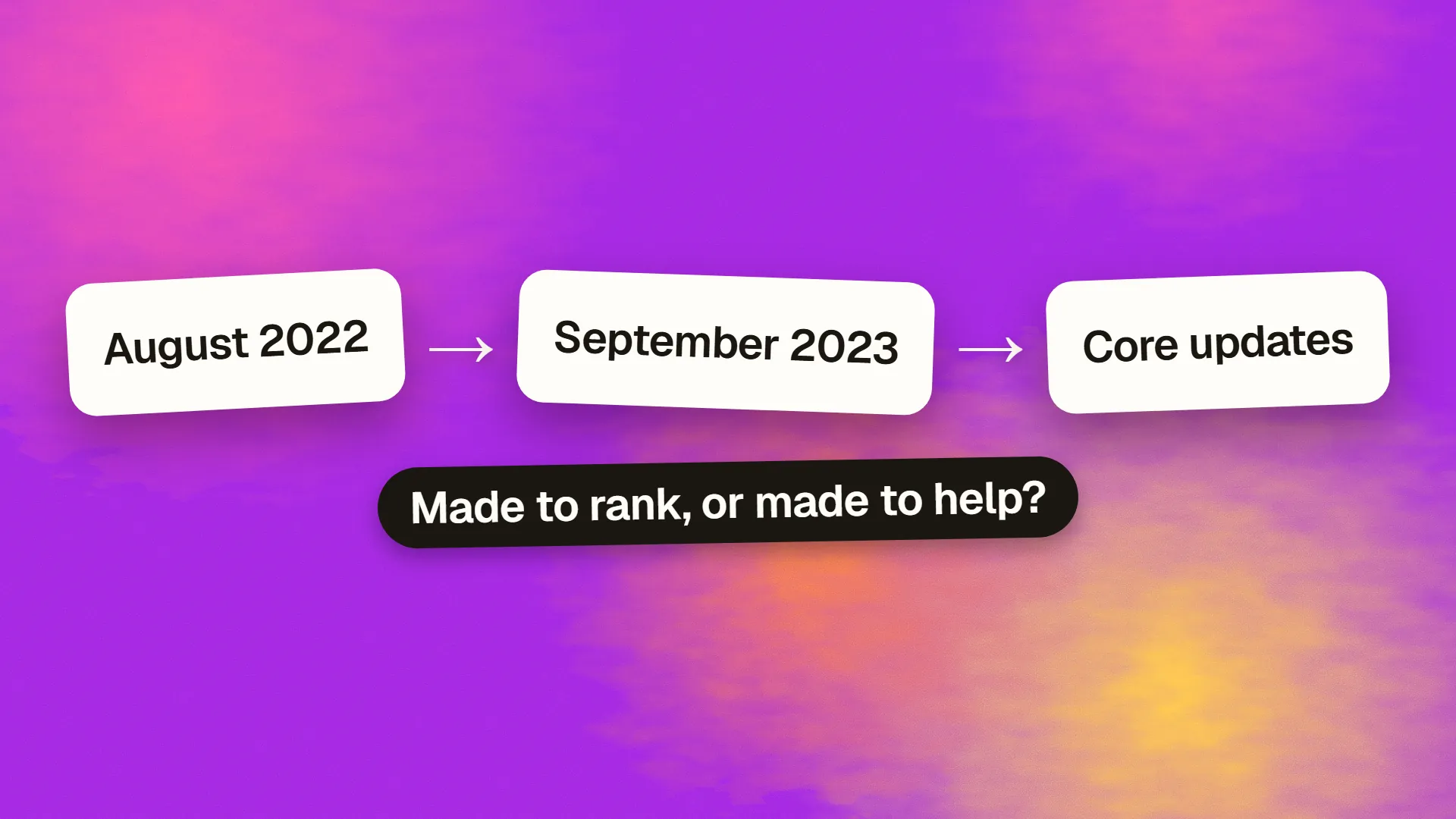
The helpful content system was a Google ranking signal introduced in August 2022 that used a machine-learned classifier to identify sites with large amounts of content created primarily to rank in search rather than to help people, and demoted those sites across the board; its September 2023 update caused major traffic losses for many affiliate, aggregator and AI-scaled sites. In March 2024 Google retired it as a separate system and incorporated its signals into the core ranking updates, where they remain. Its guidance still defines what Google means by helpful: first-hand expertise, a primary purpose beyond ranking, and content that leaves the reader satisfied.
The history
In August 2022 Google launched what it called the helpful content update: a new site-wide signal produced by a classifier trained to recognise content that seemed to be written for search engines first. The announcement was unusually plain: content made primarily for ranking, that summarised what others had said without adding value, that chased trending topics outside the site's expertise, or that promised answers it did not deliver, would be demoted, and the demotion would apply to the whole site, not just the offending pages.
The first update had modest effects. The September 2023 update did not: it removed a large share of traffic from many affiliate review sites, content farms, sites built on AI-generated volume, and some legitimate publishers whose sites carried a lot of thin filler alongside good work. Sites reported losses of 50% to 90%, and few recovered quickly. In March 2024, alongside a large core update, Google announced the helpful content system was no longer a separate system; its signals had been incorporated into the core ranking systems, which is where they now live. The name has gone; the assessment has not.
What it looked for
Google never published the classifier's features, but its guidance and the pattern of affected sites make the signals clear enough:
A primary purpose of ranking. Content that exists because a keyword tool suggested it, covering topics with no connection to the site's expertise or audience.
No first-hand value. Summaries of what already ranked, reviews of products never used, guides written from other guides. This is the E in E-E-A-T, experience, applied at scale.
Volume without substance. Large numbers of pages produced by automation or by writers with no expertise, each adequate and none useful, which is the pattern later named scaled content abuse in the spam policies.
Unsatisfying answers. Pages that make the reader search again, padded to a word count, withholding the answer, promising what they do not provide.
Mixed sites. A site with a genuine core and a large penumbra of search-bait was judged as a whole, which is why the site-wide nature of the signal mattered: the filler dragged the good pages down.
The self-assessment
Google's guidance offered questions a site owner could ask, and they remain the clearest statement of the standard: Do you have an existing or intended audience for your business or site who would find the content useful if they came to you directly? Does the content demonstrate first-hand expertise and depth of knowledge? Does your site have a primary purpose or focus? After reading, will someone leave feeling they have learned enough to achieve their goal? Are you producing lots of content on many topics hoping some will perform? Are you writing to a word count because you heard Google prefers it? Did you decide to enter a niche without real expertise because you wanted the traffic? Does your content promise an answer to a question that has no answer?
A site that answers those honestly knows which side of the line it is on.
Who was hit, and who was not
Affiliate sites reviewing products in every category, aggregators rewriting others' content, sites scaled with AI or cheap freelancers into thousands of thin pages, "best X" listicles with no testing, and general-interest sites chasing every trend. Some legitimate small publishers were caught, usually those whose good content sat among a much larger volume of filler, and some of those recovered after removing it.
Sites with a clear subject, named experts, first-hand content and no filler were largely unaffected or gained, because the demotion of competitors lifted them.
Aggregators
Volume with no first-hand value
Named experts
First-hand content
Recovery
Google said recovery required removing or improving unhelpful content across the site and then waiting for the classifier to reassess over months. In practice, recovery was slow and partial: sites that cut their filler by half or more, rewrote their core pages with genuine expertise, and narrowed their focus saw improvements over subsequent core updates; sites that tweaked pages without changing what the site fundamentally was did not. The lesson was that the signal measured the site's nature, and the nature had to change.
What it means now
The system's absorption into the core updates means every core update carries the assessment. The questions above are the standard, the content that gets cited by AI assistants is the content that passes them, and the sites that treat publishing as answering questions from real expertise are the ones the standard was designed to reward. If you would like a site assessed against the self-assessment questions honestly, with the filler identified, book a call; it is the audit most sites have not done.
Common questions
Does the helpful content update still exist?
Not as a separate system. Google retired the standalone helpful content system in March 2024 and incorporated its signals into the core ranking systems, so every core update now carries the assessment of whether a site's content exists to help people or to rank. The guidance and self-assessment questions remain current.
What did the helpful content system penalise?
Sites with large amounts of content created primarily for search rankings: summaries of what already ranked without first-hand value, reviews of products never used, topics outside the site's expertise chosen for traffic, pages padded to word counts, and content scaled with automation or cheap writing. The signal was site-wide, so filler dragged down a site's good pages too.
How do I know if my site was affected by the helpful content update?
Compare traffic in Search Console against the update dates, particularly September 2023 and the March 2024 core update. A broad drop across most pages, rather than a few, matched to those dates, suggests the site-wide classifier. Then apply Google's self-assessment questions honestly to the site's content as a whole.
How do you recover from a helpful content penalty?
Remove or substantially improve the unhelpful content across the whole site, not just a few pages; narrow the site's focus to subjects it has real expertise in; add first-hand experience, named authors and original information to the core pages; and wait for subsequent core updates to reassess, which takes months. Sites that changed their nature recovered; sites that tweaked pages did not.
Is AI-generated content considered unhelpful content?
Not because it is AI-generated; Google judges content on whether it helps people and demonstrates expertise, however it was produced. AI-generated content scaled into thousands of generic pages without human expertise or first-hand value is exactly what the system targeted, and it is now covered by the scaled content abuse spam policy as well.