In short
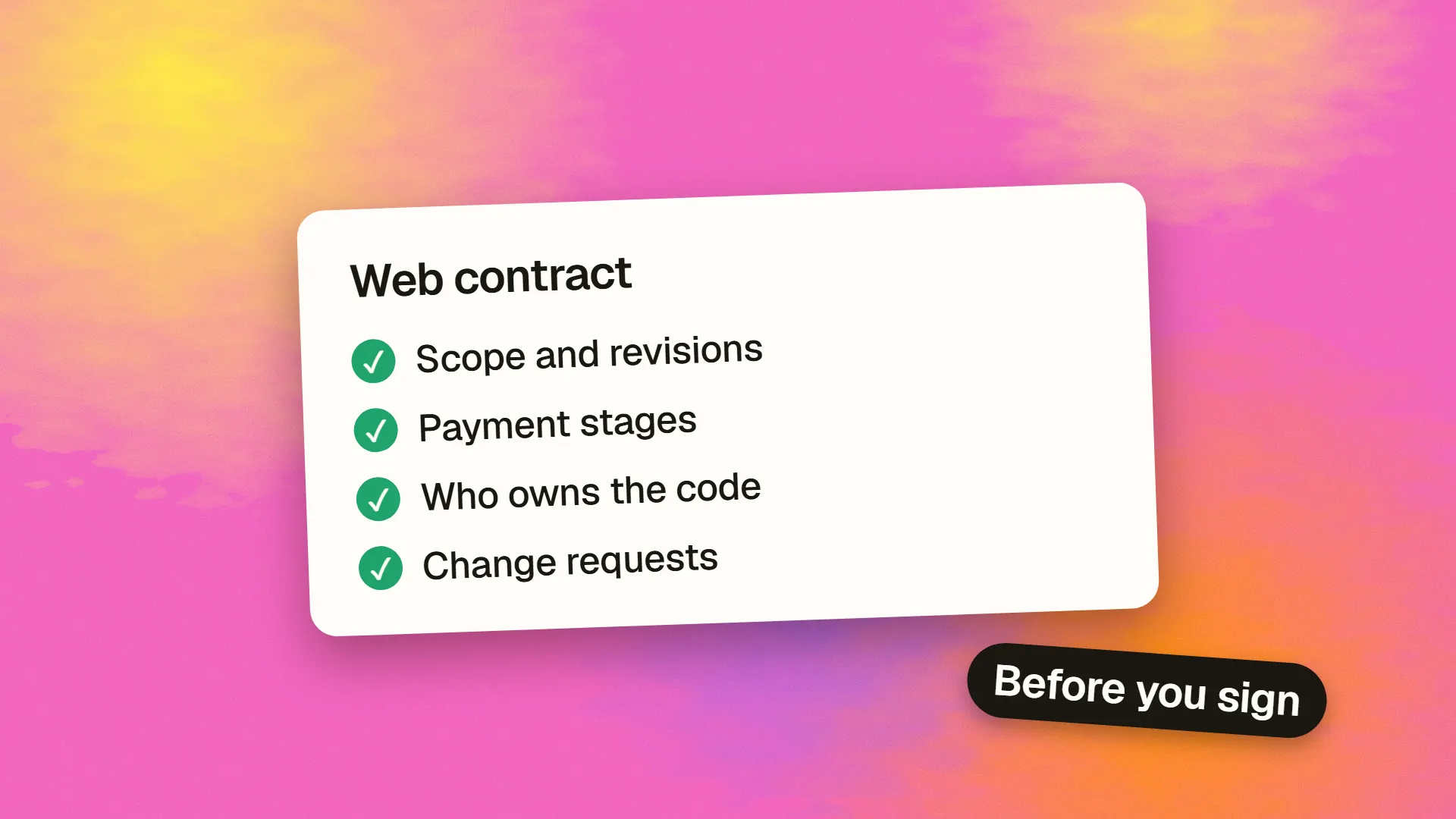
A web contract should cover scope and deliverables, price and payment schedule, a change process, timeline and client responsibilities, acceptance criteria, intellectual property, third-party licences, hosting and access, warranties and support, confidentiality and data protection, liability limits, and termination. The two clauses most often missing or vague are who owns the work and how a project ends.
A note before we begin
This is practical guidance, not legal advice. Laws differ by country, and for anything of real value, you should have a lawyer review the final agreement. Knowing what should be in a contract will make that conversation shorter and cheaper.
The clauses that matter
1. Scope and deliverables. List what you will receive: pages, features, integrations, browsers and devices supported, content responsibilities. Say what is excluded too, because “out of scope” prevents more arguments than “in scope”. Attach the proposal or specification, and state which document wins if they conflict.
2. Price and payment schedule. State the total or the rates, what is excluded (such as licences and hosting), the currency, tax, payment terms and any late-payment consequences. A typical structure ties payments to milestones rather than dates, so money and progress stay aligned. Our guide to fixed price or time and materials helps you decide on the model.
3. Change process. Describe how a change is requested, estimated, approved and paid for. It should need written approval, even if only by email. Without this clause, scope creep is a matter of memory and goodwill.
4. Timeline and client responsibilities. Most delays come from waiting on content, feedback or access. So the contract should say what the client must supply and by when, how long reviews can take, and what happens to dates and fees if those slip. A clause saying that silence after a set period counts as approval needs careful thought from both sides.
5. Acceptance. Define “finished”. Specify a review period, how issues are reported and fixed, and what counts as a defect rather than a new request. Tie the final payment to this. Without it, a project can drift forever or be declared finished too early.
6. Intellectual property. This is the clause people regret skipping. In many jurisdictions, a contractor may own the copyright unless the contract says otherwise, so do not assume that paying for work means owning it. State clearly who owns the code, designs and content, and when ownership transfers, which is commonly on full payment. See who owns website code, domain and design.
7. Third-party and pre-existing materials. Studios often reuse their own frameworks and tools. That's reasonable, but the contract should give you a licence to keep using them, with no time limit, if they end up in your product. List paid fonts, themes, stock photos and plugins too, and say who holds each licence. Also consider AI-generated work: ask how it is used and what your supplier promises about it.
8. Accounts and access. Domain names, hosting, analytics, code repositories and app store accounts should be registered in your organisation's name, or be transferred at the end. A supplier holding your domain is one of the hardest situations to fix, so address this explicitly.
9. Warranties and support. Say how long defects will be fixed for free after launch, and what's excluded, such as changes by others or new browser versions. Then state what support costs after that period, or point to a separate retainer. Don't rely on verbal assurances.
10. Confidentiality and data protection. If the supplier can access personal data, you may need a formal agreement covering it. Read what a DPA is and when you need one. Also cover security expectations, and who to notify after an incident, and how quickly.
11. Liability. Most contracts limit total liability, frequently to the fees paid, and exclude indirect losses. Check whether the limit fits the risk. A cap equal to a small fee may be inadequate on a system that handles payments. Limits often carve out serious matters, such as confidentiality breaches and deliberate wrongdoing, so read that wording.
12. Termination. Say how either party can end the agreement, the notice period, payment for work done, and what you get at the end. A clean exit should include the code, designs, credentials and documentation. How to hand a project over lists what a useful handover looks like.
Smaller clauses worth including
- Governing law and jurisdiction, especially across borders.
- Dispute resolution, such as a step of escalation or mediation before court.
- Subcontracting, including whether your supplier may use others without telling you.
- Portfolio rights, so you decide whether the work can be shown publicly.
- Non-solicitation, if the agency wants to stop you hiring its staff.
- Force majeure, covering events beyond anyone's control.
Red flags
| You see | Why it matters |
|---|---|
| “Agency retains all rights”, with no licence | You may not be able to change or move your own site |
| Vague scope such as “a modern website” | Any disagreement is unresolvable |
| Domain or hosting in the supplier's name | Leaving becomes very difficult |
| Full payment in advance | You have little leverage if things go badly |
| Automatic renewal with long notice | Fees continue long after you stop using the service |
| No termination clause | You have no clean way out |
Keep it usable
A contract that nobody reads does not help. Keep the commercial terms short and clear, attach the detail, and walk through it with the people doing the work, rather than leaving it to the two people who signed. If a term seems strange, ask about it. A reasonable supplier will explain why it exists and may well change it.
Also, keep a dated record of changes. Short email confirmations are often enough to show what was agreed at each step.
If you are planning a project and want to see how we structure the work, book a call. You can also start with what your web agency needs before the project starts.
Common questions
Do I need a contract for a small website project?
Yes, though it can be short. Even a simple signed proposal should state the scope, price, payment schedule, ownership and what happens at the end. Most small project disputes come from assumptions that were never written down.
Who owns a website after it is built?
It depends on your contract and local law. Do not assume payment transfers ownership. Your agreement should state who owns the code, designs and content, when ownership transfers, and what licences cover any reused or third-party materials.
What is a normal payment schedule for a web project?
Payments are commonly split across milestones, such as a deposit, design approval, and launch or acceptance. The exact split is a negotiation. The principle is that payments and delivered progress should stay roughly in step for both sides.
Should a lawyer review a web development contract?
For larger projects, or anything involving sensitive data or a critical system, yes. For smaller work, a reputable template and a careful read may be enough. A lawyer's review costs little compared with a dispute over ownership or liability.