In short
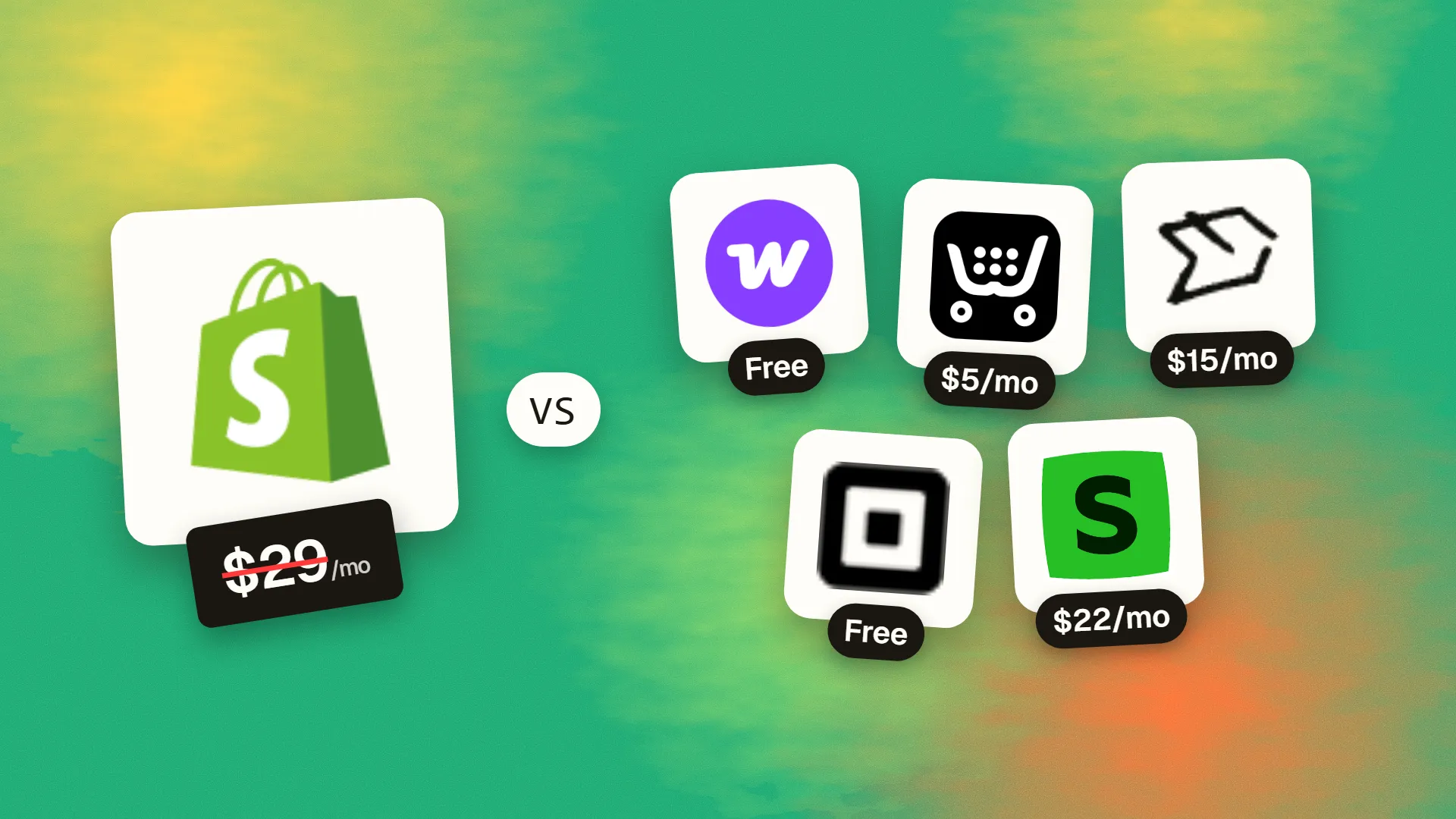
The best cheaper alternatives to Shopify in 2026 are WooCommerce (free), Ecwid (from $5/month), Big Cartel (from $15/month), Square Online (free) and Sellfy (from $22/month). Shopify itself starts at $29 a month, so most teams can cut the cost substantially without losing the features they actually use.
Shopify is the most popular hosted e-commerce platform in the world, and for good reason: it is reliable, fast to set up and has an enormous app ecosystem. But the headline price is only the start. In 2026 Basic costs $39/month ($29 on annual billing), Grow $105 ($79) and Advanced $399 ($299). Online card payments through Shopify Payments cost 2.9% + 30¢ on Basic in the US, and if you use a third-party payment provider instead, Shopify adds an extra 2% on Basic, 1% on Grow or 0.6% on Advanced on every order — on top of your provider's own fees. Then come paid apps, which many stores rely on for reviews, subscriptions, upsells and email.
For a small store doing $5,000 a month in sales, Shopify Basic plus a few apps can easily reach $1,500–2,000 a year before card fees. The five platforms below can cut that significantly, depending on what you sell.
 Shopifyvs
 WooCommerce
 Ecwid
 Big Cartel
 Square Online
 Sellfy
What Shopify actually costs in 2026
| Plan | Monthly billing | Annual billing (per month) | Online card rate (US) | 3rd-party gateway fee |
|---|---|---|---|---|
| Starter | $5 | — | 5% | — |
| Basic | $39 | $29 | 2.9% + 30¢ | 2% |
| Grow | $105 | $79 | 2.7% + 30¢ | 1% |
| Advanced | $399 | $299 | 2.5% + 30¢ | 0.6% |
| Plus | from $2,300 | — | Negotiated | Negotiated |
International cards add about 1% more. Most stores also spend $20–200/month on apps and possibly $100–400 once on a premium theme. The current tiers are listed on Shopify's official pricing page.
The 5 cheaper alternatives at a glance
| Tool | Starts at | Model | Best for |
|---|---|---|---|
| Shopify | $29/mo | subscription | The benchmark |
| WooCommerce | Free tier | open source | Stores that want full control and no platform fees |
| Ecwid | $5/mo | subscription | Adding a shop to an existing site |
| Big Cartel | $15/mo | subscription | Small creative shops |
| Square Online | Free tier | free | Restaurants and retailers already using Square POS |
| Sellfy | $22/mo | subscription | Creators selling digital products or merch |
How we picked these alternatives
We compared total cost of ownership for a small store (monthly fee, transaction fees and essential add-ons), plus ease of setup, payment options, product limits and growth potential. Prices checked 27 October 2026.
1. WooCommerce
Price: Free WordPress plugin. A realistic starter store costs about $150–500 a year (hosting $5–35/month, optional premium theme $49–149/year, paid extensions $50–200/year each). No platform transaction fees. See WooCommerce's official pricing page for current plans.
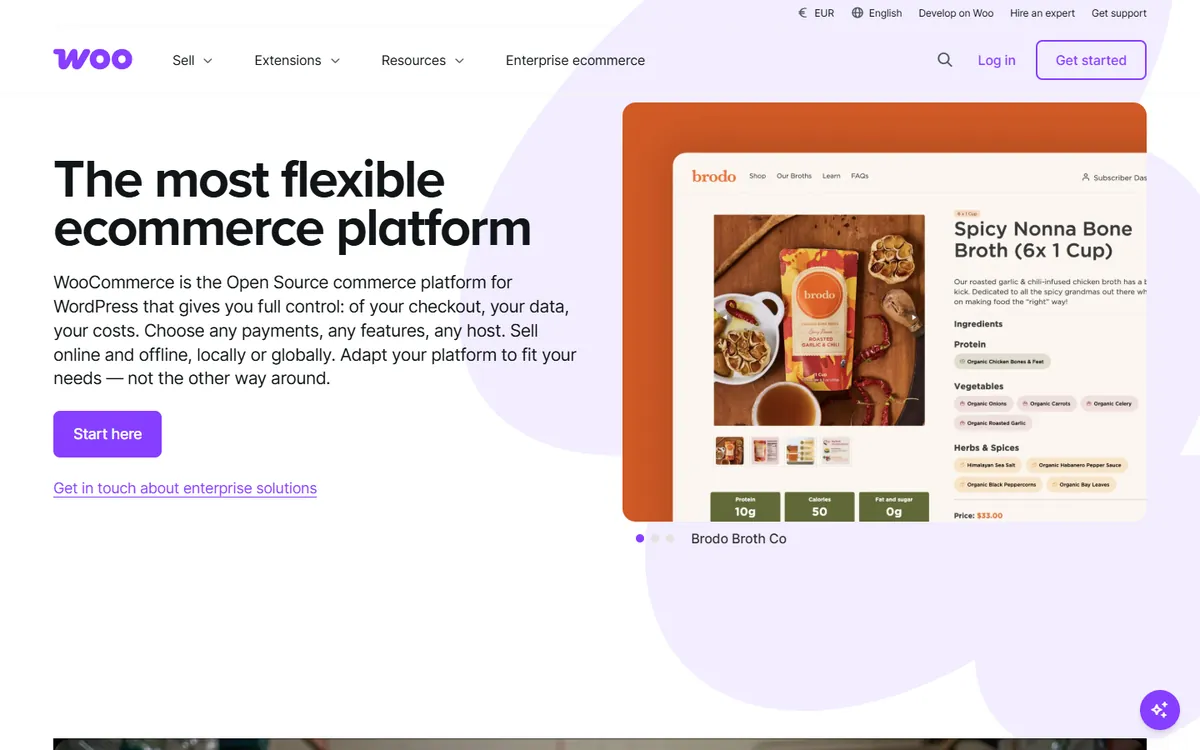
WooCommerce is an open-source e-commerce plugin for WordPress, owned by Automattic (the company behind WordPress.com). It powers millions of online stores — more than any other single platform by number of sites — and it is the main alternative for businesses that want to own their store rather than rent it from Shopify.
WooCommerce cost breakdown
| Item | Typical cost | Notes |
|---|---|---|
| WooCommerce plugin | Free | Products, cart, checkout, orders, coupons, taxes, shipping zones |
| Hosting | $5–35/mo | Managed WooCommerce hosting at the higher end gives better speed and support |
| Domain + SSL | ~$15/yr + free SSL | Most hosts include SSL certificates |
| Theme | Free or $49–149/yr | Storefront, Astra, Kadence, Blocksy and others |
| Extensions | $0–200/yr each | Subscriptions, bookings, memberships, B2B pricing, product add-ons |
| Payments | Provider fees only | Stripe, PayPal, Square, Mollie, Klarna and more — no platform surcharge |
What you get
- Complete ownership of your store, customer data and code — you can move hosts at any time.
- Any payment gateway with no extra platform fee, unlike Shopify's 0.6–2% surcharge for third-party processors.
- Thousands of extensions for subscriptions, bookings, memberships, wholesale pricing, product bundles and marketplaces.
- WordPress's content and SEO strength — blogs, landing pages and rich product content in the same site.
- Unlimited products, variations and categories without plan limits.
- Full checkout customisation with blocks or code.
- A huge developer community, so help is easy to find.
Where it falls short
- You manage hosting, updates, backups and security — or pay someone to.
- Costs creep up if you buy many premium extensions.
- Performance depends on your host and how well the site is built.
Good to know
For a store doing $60,000 a year that uses its own payment provider, avoiding Shopify Basic's 2% third-party surcharge alone saves $1,200 a year.
Who it's best for
Stores that want control, content-led SEO and no platform fees, especially with a developer or agency available. Skip it if nobody can look after a WordPress site.
2. Ecwid
Price: Starter $5/month; Venture $35 ($29 annual); Business $65 ($49 annual); Unlimited $149 ($119 annual). The free plan closed to new sign-ups in 2025. See Ecwid's official pricing page for current plans.
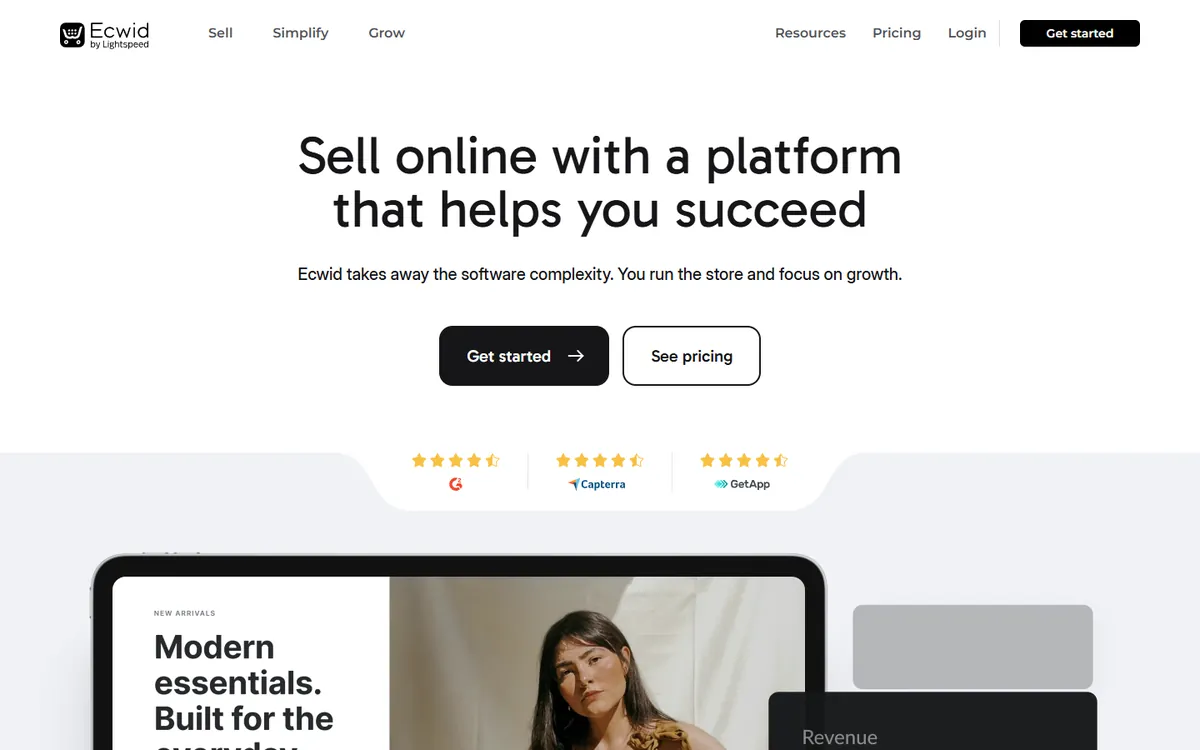
Ecwid ("e-commerce widget"), now owned by Lightspeed, takes a different approach from Shopify: instead of building a new website around a store, it adds a store to the website you already have. Paste a snippet into WordPress, Wix, Squarespace, Joomla or a custom site and the catalogue, cart and checkout appear — and the same catalogue can sell on social media and marketplaces.
Ecwid pricing in detail
| Plan | Monthly | Annual (per month) | Highlights |
|---|---|---|---|
| Starter | $5 | — | Instant site, sell on social media and mobile |
| Venture | $35 | $29 | Embed on any site, marketplaces, abandoned-cart emails, product filters |
| Business | $65 | $49 | More products, staff accounts, wholesale pricing groups, product variations |
| Unlimited | $149 | $119 | Unlimited products, POS integrations, priority support, app for your store |
Prices were raised in March 2026 according to several sources.
What you get
- Embed a store anywhere — keep your existing website and add selling.
- Sell on Instagram, Facebook, TikTok, Google Shopping and marketplaces from one catalogue.
- No Ecwid transaction fees on any plan.
- Abandoned-cart recovery, discounts and gift cards.
- POS integrations with Square, Clover and Lightspeed for in-person sales.
- Multi-language storefronts that adapt to visitors' languages.
Where it falls short
- Product limits on lower tiers.
- Less design flexibility than a full Shopify theme.
- The free plan is gone for new users.
Good to know
If you already pay for a website, Ecwid Venture at $29 a month often costs less than rebuilding everything on Shopify.
Who it's best for
Businesses with an existing website that want to add a shop. Skip it if you want a fully custom standalone storefront.
3. Big Cartel
Price: Gold plan free or trial (up to 5 products); Platinum $15/month (50 products); Diamond $30/month (500 products). No Big Cartel transaction fees. See Big Cartel's official pricing page for current plans.
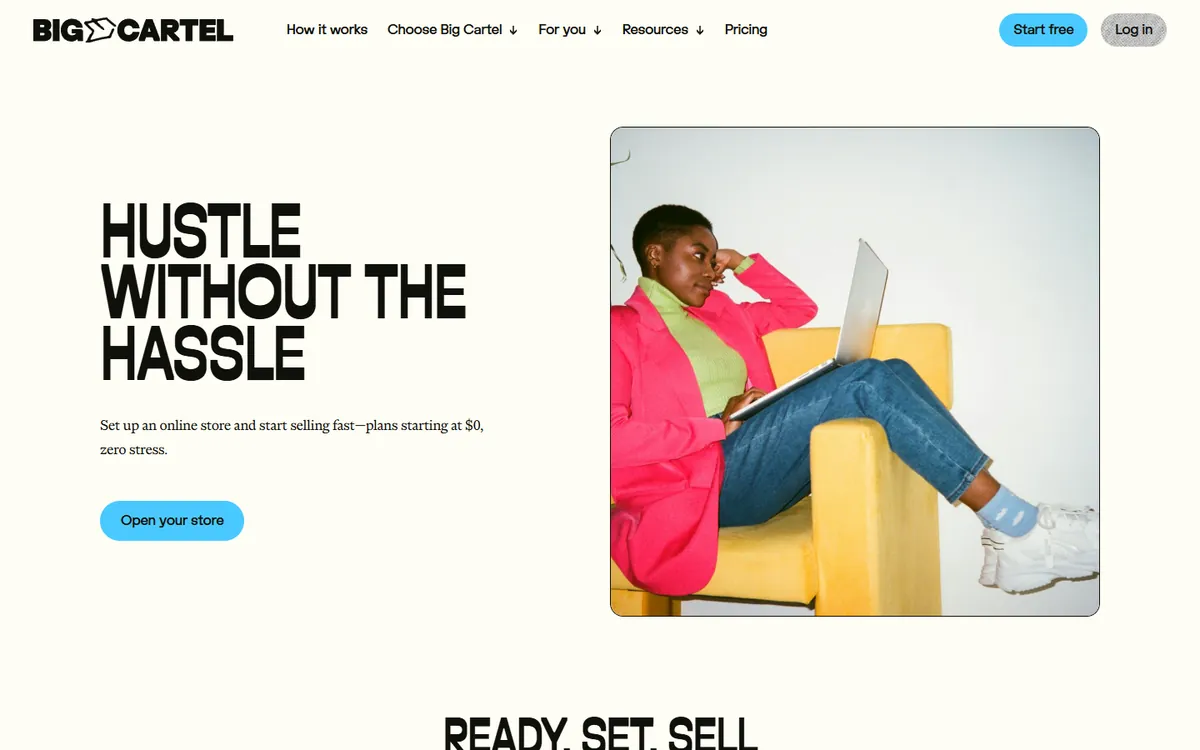
Big Cartel was founded in 2005 to help independent artists sell their work online. It has stayed deliberately small and simple: a handful of beautiful themes, straightforward pricing and no transaction fees, aimed at illustrators, bands, print-makers, clothing designers and small craft brands.
Big Cartel pricing in detail
| Plan | Price | Products | Highlights |
|---|---|---|---|
| Gold | Free (or short trial, depending on current terms) | 5 | Custom domain, free themes, Stripe and PayPal |
| Platinum | $15/mo | 50 | Inventory tracking, discounts, bulk editing |
| Diamond | $30/mo | 500 | All features, more product images |
What you get
- Quick setup — a store can be live in an afternoon.
- Artist-friendly themes that you can customise with code if you want.
- Inventory tracking, discount codes and shipping settings.
- Stripe, PayPal and in-person selling through compatible apps.
- No Big Cartel transaction fees — you pay only card processing.
- Sell at events with mobile apps.
Where it falls short
- Product caps — 500 products maximum.
- Small app ecosystem and limited marketing features.
- Basic SEO controls compared with Shopify or WooCommerce.
Good to know
Big Cartel Diamond at $30 a month costs about the same as Shopify Basic on annual billing, but without Shopify's third-party gateway fee — and Platinum at $15 is half the price.
Who it's best for
Independent artists, bands and makers with small catalogues. Skip it if you plan to sell more than 500 products.
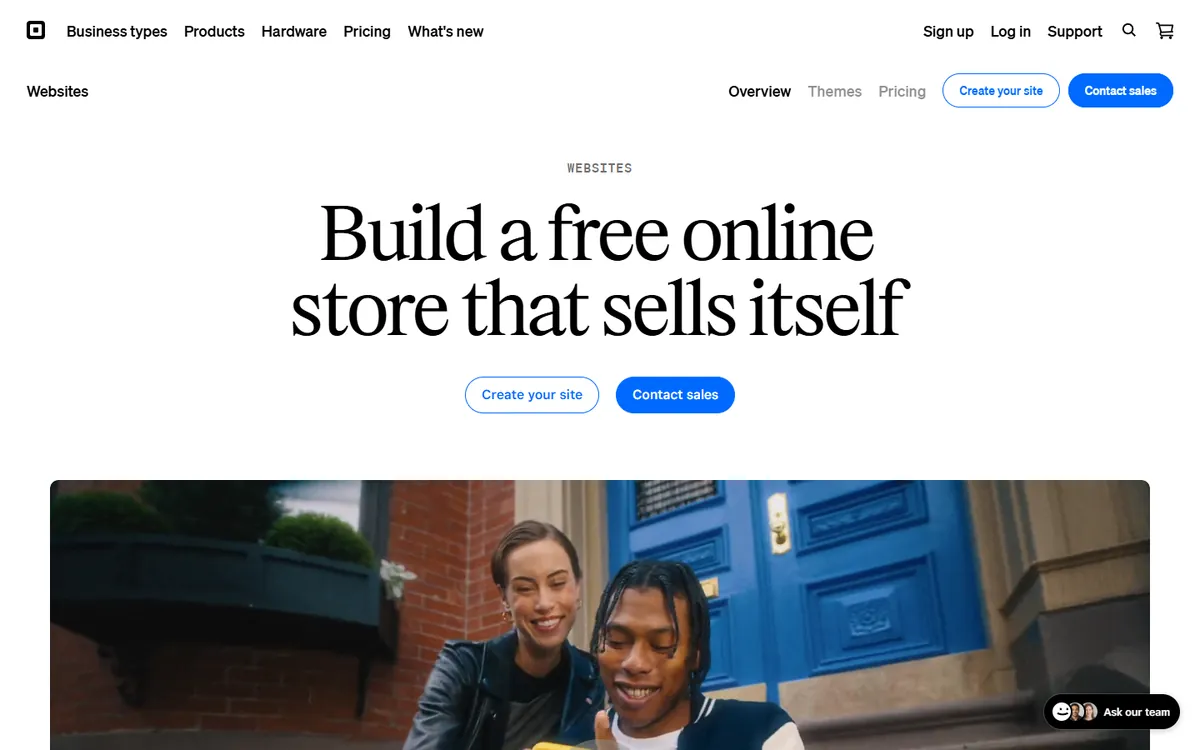
4. Square Online
Price: Free plan ($0/month, online card rate 3.3% + 30¢); Plus $49/month; Premium $149/month (2.9% + 30¢). See Square Online's official pricing page for current plans.
Square, the payments company behind the white card readers seen in cafés worldwide, offers Square Online as part of its commerce platform. Its biggest strength is that the online store, in-person point of sale, inventory and payments all live in one system — and you can start for nothing per month.
Square pricing in detail
| Plan | Monthly | Online card rate | In-person card rate | Highlights |
|---|---|---|---|---|
| Free | $0 | 3.3% + 30¢ | 2.6% + 15¢ | Online store, POS, pickup and delivery |
| Plus | $49 | 2.9% + 30¢ | 2.5% + 15¢ | Advanced inventory, more site features |
| Premium | $149 | 2.9% + 30¢ | 2.4% + 15¢ | Lowest rates, priority support |
Keyed-in card payments cost 3.5% + 15¢ on all plans. Square overhauled these plans in October 2025.
What you get
- A free online store with no monthly fee.
- Inventory synced between your shop counter and your website.
- Pickup, local delivery and shipping options.
- Restaurant ordering features, including menus and order-ahead.
- Instagram and social selling.
- Square's hardware and POS for in-person sales.
Where it falls short
- Higher online card rate on the free plan.
- You must use Square for payments.
- Fewer design and app options than Shopify.
Good to know
For a café that already uses Square at the counter, adding Square Online costs nothing extra per month.
Who it's best for
Restaurants, cafés and retailers already using Square in person. Skip it if you sell mainly online to international customers.
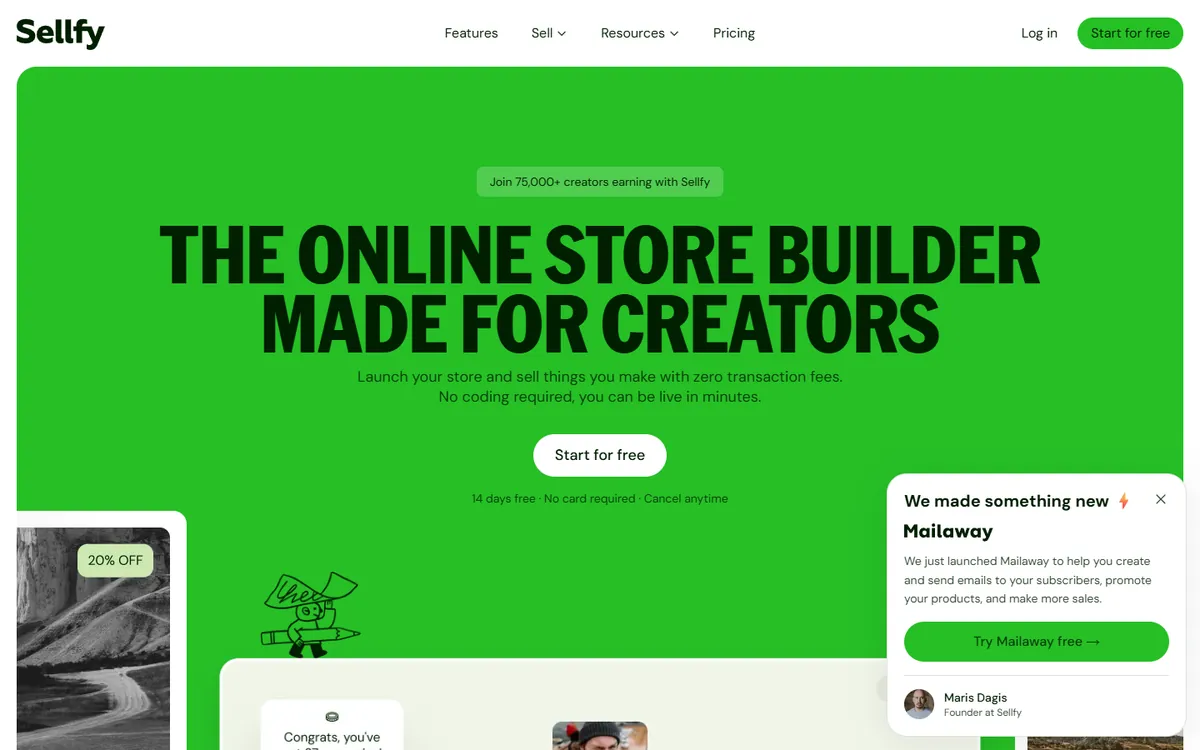
5. Sellfy
Price: Starter $22/month annual ($29 monthly) up to $10,000 in sales per year; Business $59 ($79) up to $50,000. 0% transaction fees. See Sellfy's official pricing page for current plans.
Sellfy is an e-commerce platform built for creators — musicians, illustrators, educators, YouTubers and designers — who sell digital products, subscriptions and merch to an existing audience. Instead of a full catalogue store, it focuses on getting a creator selling quickly, with built-in email marketing and print-on-demand.
Sellfy pricing in detail
| Plan | Annual (per month) | Monthly | Annual sales cap | Highlights |
|---|---|---|---|---|
| Starter | $22 | $29 | $10,000 | Digital and physical products, subscriptions, print-on-demand |
| Business | $59 | $79 | $50,000 | Email marketing credits, cart abandonment, product upselling |
| Premium | Higher | Higher | Higher | More email credits, priority support |
All plans charge 0% Sellfy transaction fees; payment provider fees still apply.
What you get
- Sell digital downloads (ebooks, presets, music, templates) with secure delivery.
- Subscriptions for memberships and recurring content.
- Print-on-demand merch — t-shirts, mugs and posters produced and shipped for you.
- Built-in email marketing to your customers.
- Embed buy buttons on any website, YouTube description or link-in-bio page.
- Discount codes, upsells and cart abandonment emails.
Where it falls short
- Annual sales caps force upgrades as you grow.
- Not built for large physical catalogues or complex shipping.
Good to know
Creators selling under $10,000 a year can run a complete store, merch line and email list for $22 a month.
Who it's best for
Creators selling digital products, memberships or merch. Skip it if you sell thousands of physical products.
What a small store pays per year
Assumes $60,000 in annual online sales, US cards.
| Option | Platform fee/yr | Typical card fees | Notes |
|---|---|---|---|
| Shopify Basic (annual) | $348 | ~$1,740 + 30¢/order | Plus apps; +2% if not using Shopify Payments |
| WooCommerce | ~$150–500 | ~$1,740 + 30¢/order (Stripe) | Hosting and extensions |
| Ecwid Venture (annual) | $348 | Provider fees only | Embeds anywhere |
| Big Cartel Diamond | $360 | Provider fees only | 500-product limit |
| Square Online Free | $0 | ~$1,980 + 30¢/order | Higher free-plan rate |
| Sellfy Business (annual) | $708 | Provider fees only | Capped at $50k sales — this store would need a higher plan |
On a small store, the platform fee is often less important than card fees and apps. The biggest saving usually comes from avoiding paid apps and Shopify's third-party gateway surcharge.
How to switch without losing your work
- Export products, customers and orders from Shopify as CSV files.
- Keep the same URLs where possible, or set up 301 redirects for every product and collection page to protect your SEO.
- Recreate essential apps (reviews, email, subscriptions) with native features or plugins.
- Test checkout end-to-end with real payments before switching your domain.
- Run both stores briefly and switch DNS during a quiet sales period.
Which one should you choose?
- You want full control, content SEO and no platform fees, and you have technical help: WooCommerce.
- You already have a website and just want to add a shop: Ecwid.
- You are an artist or maker with a small catalogue: Big Cartel.
- You run a café, restaurant or retail shop using Square in person: Square Online.
- You sell digital downloads, subscriptions or merch to your audience: Sellfy.
Hidden costs and gotchas
- App subscriptions. On Shopify, apps are often the biggest hidden cost. On WooCommerce, premium extensions play the same role. Audit them quarterly.
- Payment fees. Card processing usually costs more than the platform. Compare rates for your country and average order value.
- Themes. Premium themes cost $100–400 once on Shopify and $49–149 a year on WooCommerce.
- Maintenance. Self-hosted WooCommerce needs updates, backups and security monitoring — either your time or an agency retainer.
- Sales caps. Sellfy and some Ecwid and Big Cartel tiers limit annual sales or product counts. Check the cap against your growth plans.
Our verdict
WooCommerce offers the lowest long-run cost and the most control for stores with technical help. Ecwid is best for adding a shop to an existing website, Big Cartel for artists, Square Online for businesses already using Square, and Sellfy for creators selling digital products. If you stay with Shopify, use Shopify Payments to avoid the extra gateway fee and audit your apps every quarter.
More cheaper alternatives: see our breakdowns of the cheaper options to Squarespace, Webflow and Mailchimp.
Related reading: Is Shopify Good for SEO?, Is WordPress Still Worth Using in 2026? and How Much Does a Custom Website Cost in 2026?.
Planning a switch, or not sure which tool fits the way your team works? Book a free call and we will look at your stack with you.
Prices are US list prices in USD unless marked, checked on 27 October 2026. "Annual" means the per-month price when billed yearly. Vendors change pricing often, so confirm on the vendor's site before buying. Product names and logos are trademarks of their respective owners and are used here for identification only.
Common questions
Is WooCommerce cheaper than Shopify?
Usually yes for small and mid-size stores, because there is no platform fee or gateway surcharge. But you pay for hosting and possibly extensions and maintenance.
Which Shopify alternative has no transaction fees?
WooCommerce, Ecwid, Big Cartel and Sellfy charge no platform transaction fees; you only pay your payment provider.
What is the cheapest way to sell online?
Square Online's free plan and Big Cartel's free tier cost nothing per month, though card fees still apply.
Can I migrate from Shopify without losing SEO?
Yes, if you keep URLs or set up 301 redirects, migrate meta titles and descriptions, and resubmit your sitemap.
When is Shopify still worth it?
If you sell at scale, need a large app ecosystem, want POS and online in one place, or do not want to manage hosting, Shopify's convenience can justify the cost.