In short
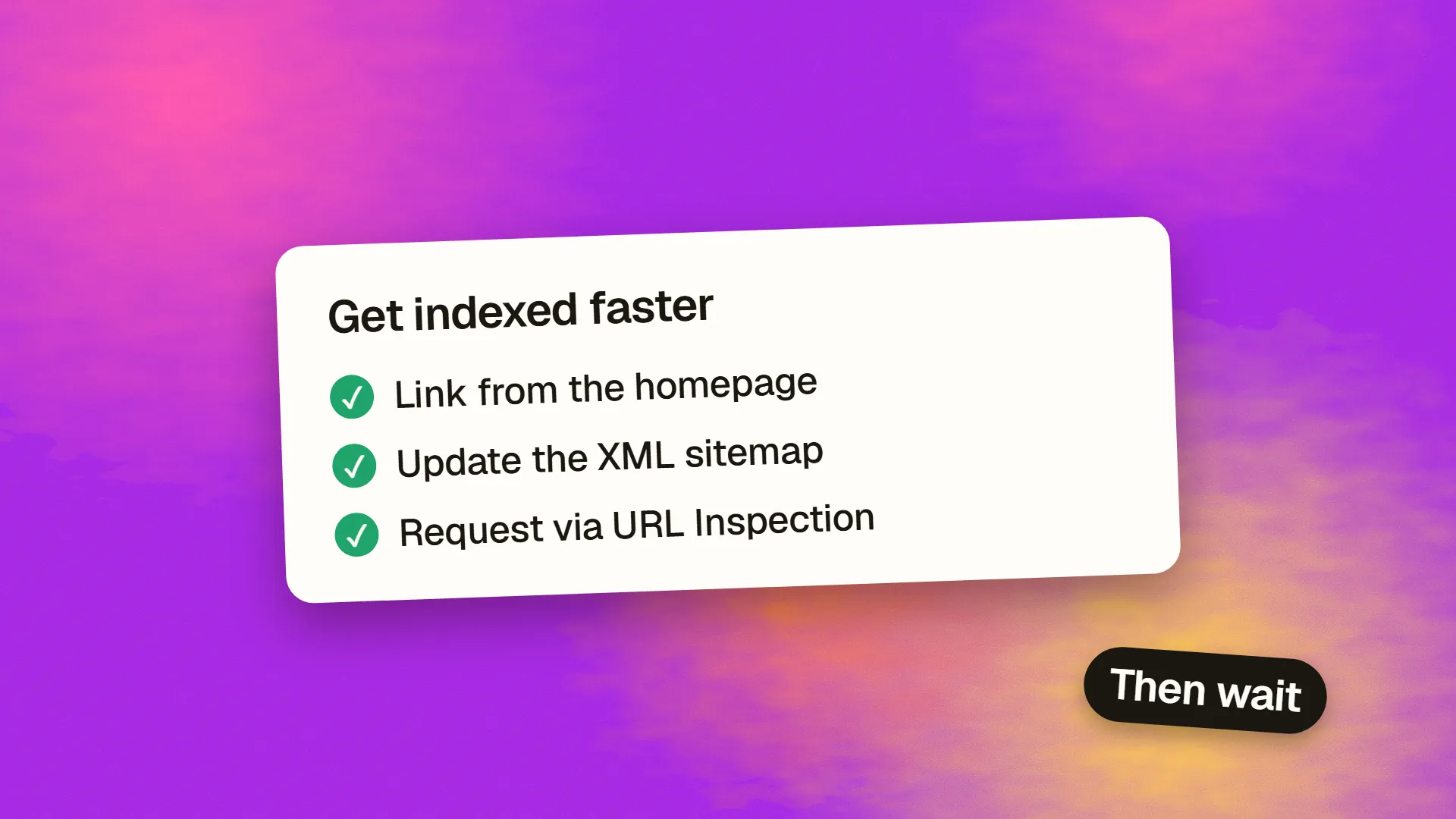
To get a page indexed faster: link to it from pages Google already crawls often, especially the homepage; include it in an up-to-date XML sitemap and resubmit the sitemap; request indexing through Search Console's URL Inspection tool; make sure it returns 200, is not blocked or noindexed, and renders its content in HTML; and make it substantive enough to be worth keeping. On an established site this gets a page indexed in hours to a couple of days. Nothing accelerates indexing of a page Google has judged thin or duplicate, and requesting indexing repeatedly does not help.
How a page gets indexed
Four stages, each with its own delay:
- Discovery. Google learns the URL exists, through a link from a page it crawls, a sitemap, or a direct request.
- Scheduling. Google decides when to fetch it, based on how important the site and the URL seem and how much crawling the site can bear.
- Crawling and rendering. Googlebot fetches the page and processes its content.
- Indexing. Google decides whether the page is worth adding, and adds it.
A page on an established, frequently crawled site, linked from the homepage, with a sitemap entry and a request, moves through all four in hours. A page on a new or rarely crawled site, linked from nowhere, with no sitemap, can wait weeks at stage one and then be declined at stage four.
The levers that work
Internal links from crawled pages. The strongest lever. Googlebot follows links from pages it already visits, and it visits the homepage and other prominent pages most. A link from the homepage, the navigation, or a recently indexed hub page gets a new URL discovered on the next crawl of that page, which for active sites is daily or faster. A page linked only from a deep archive waits until that archive is next crawled. This is also why orphan pages, linked from nothing, are the slowest to index and the first to be dropped.
The sitemap. Add the URL to the XML sitemap with an accurate lastmod, and resubmit or ping the sitemap. Google reads sitemaps regularly and treats new entries as discovery. Sitemaps that list every URL with a fake current timestamp are ignored for this purpose; the modification date has to mean something.
Search Console's URL Inspection request. Inspect the URL, then request indexing. This queues the page for a priority crawl and typically results in indexing within a day, often within hours, for pages that would have been indexed anyway. It is limited to a small number of requests per property per day; use it for the pages that matter. Requesting again before the first request has been processed does nothing.
Fetchability. The page must return 200, not be blocked by robots.txt, carry no noindex, not canonicalise elsewhere, load quickly, and deliver its content in the HTML rather than only after JavaScript. Any of these failing stops the process at stage three.
Being worth keeping. Original content of reasonable length, not a near-duplicate of another page, with a clear title and topic. Google increasingly declines pages it judges to add nothing, and no lever moves a page it has declined except improving it.
Site crawl health. A site that is fast, returns few errors and has no crawl traps gets crawled more, and new pages on it are reached sooner. On large sites this is crawl budget; on small sites it is simply not wasting Googlebot's visits.
Other engines
Bing, Yandex and others support IndexNow, a protocol in which the site notifies participating engines instantly when a URL is added or changed. Many CMSs and CDNs support it with a setting. Google does not participate, but Bing feeds ChatGPT's search, so IndexNow is worth enabling for AI visibility.
What does nothing
Submitting the URL to third-party "indexing services", which mostly create spam links or ping the same tools you can use directly. Repeated URL Inspection requests for the same page. Adding the page to social media in the hope Google will follow the link; social links are mostly nofollow and are not a discovery mechanism Google relies on. Changing the sitemap's timestamps without changing the pages. Fetching the page yourself.
When the page is found and still not indexed
Search Console's Pages report will show the URL as "Discovered, currently not indexed", meaning Google knows it exists and has not chosen to fetch it, or "Crawled, currently not indexed", meaning it fetched and declined. The first often resolves with more internal links and a request; the second is a quality judgement, and the fix is editorial: make the page substantively better or consolidate it with the page it overlaps. A new site sees more of both, because Google crawls unknown sites cautiously.
The practical sequence for a new page
- Publish it with a clear title, real content, and correct technical settings.
- Link it from the homepage or a prominent hub, and from two or three related pages.
- Update the sitemap with an accurate modification date and resubmit.
- Request indexing through URL Inspection.
- Enable IndexNow for the other engines.
- Check the Pages report in two days; act on the reason it gives if the page is excluded.
On a healthy site this is hours. If it is routinely days or weeks, the site has a crawl or quality problem worth diagnosing, and book a call if you would like it looked at.
Common questions
How long does it take Google to index a new page?
On an established, frequently crawled site with the page linked from the homepage, in a sitemap and requested through Search Console, typically hours to two days. On a new or rarely crawled site with no links to the page, days to weeks, and pages judged thin or duplicate may never be indexed regardless of how they were submitted.
Does requesting indexing in Search Console work?
Yes, for pages that would be indexed anyway: the URL Inspection request queues a priority crawl and usually results in indexing within a day. It is limited to a small number of requests per day, does not override quality judgements, and repeating the request before the first is processed does nothing.
Why is my page 'discovered, currently not indexed'?
Google knows the URL exists, usually from the sitemap, but has not scheduled a crawl, typically because the site is crawled cautiously or the page has few internal links signalling importance. Link it from the homepage or a prominent page, request indexing through URL Inspection, and make sure the site is fast and returns no errors.
Does a sitemap speed up indexing?
It helps discovery: Google reads sitemaps regularly and treats new entries with accurate modification dates as URLs to crawl. It does not force indexing, and sitemaps whose dates are all set to the current time are ignored for freshness. Combine it with internal links, which remain the strongest signal that a page matters.
Does IndexNow work with Google?
No. IndexNow instantly notifies Bing, Yandex and other participating engines of new or changed URLs, and Google does not participate. It is still worth enabling, because Bing's index feeds ChatGPT search and Microsoft Copilot, and it costs nothing; for Google, use internal links, the sitemap and URL Inspection.
