In short
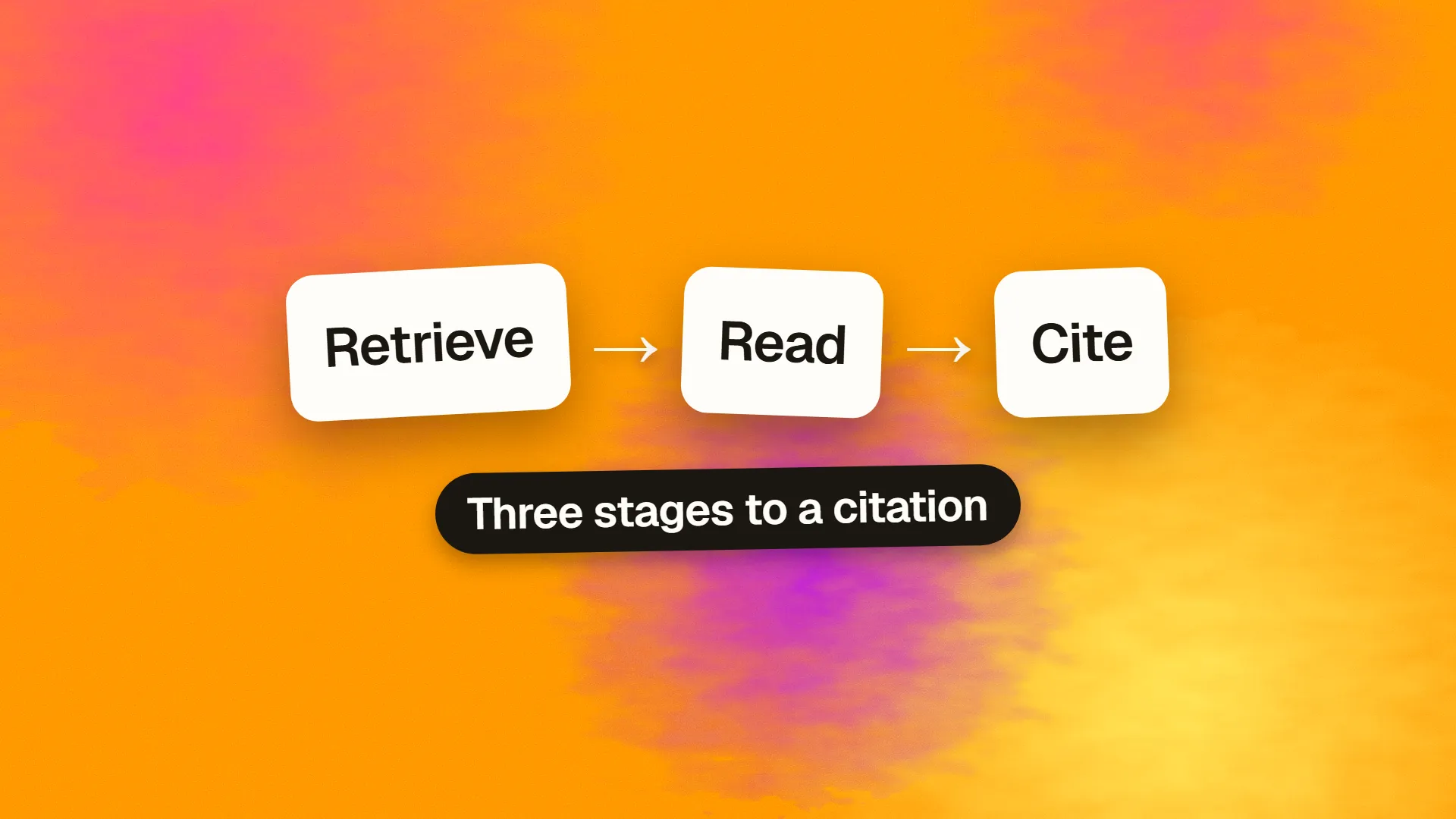
AI assistants with web access answer in three stages: they retrieve a set of candidate pages from a search index (Bing for ChatGPT, its own index plus search APIs for Perplexity, Google for Gemini), fetch and read those pages, then generate an answer citing the passages that most directly and credibly answer the question. Being cited therefore requires being indexed and ranking reasonably for the query, being fetchable without JavaScript, and containing a clear, self-contained passage that answers the specific question, on a page and site that look authoritative. Assistants favour recent, specific, well-structured sources over long generic ones.
The pipeline
When an assistant answers a question it cannot answer from training alone, it does something close to what a diligent researcher does, compressed into seconds.
Retrieve. It turns the question into one or more search queries and gets back a ranked list of candidate pages from an index. ChatGPT's search has used Microsoft Bing's index alongside OpenAI's own crawling; Perplexity maintains its own index and has drawn on Bing and other search APIs; Gemini and Google's AI Mode use Google; Claude uses its own web search. The candidate set is small, typically a handful to a few dozen pages.
Read. It fetches those pages and extracts their content, or works from an indexed copy. This is where a page that renders only through JavaScript, blocks the assistant's crawler, or hides its answer behind interaction drops out; the assistant reads HTML, not a rendered app.
Select and cite. The model reads the passages, identifies the ones that answer the question directly and consistently with each other, composes an answer, and attaches citations to the sources it drew on. Passages that state a fact plainly, with the terms of the question in them, are far likelier to be used than passages that circle the point.
Each stage has its own criteria, and being cited means passing all three.
What retrieval selects for
Ordinary search ranking, in whichever index the assistant uses. For ChatGPT that makes Bing rankings matter in a way they have not for twenty years. For Gemini, Google rankings. The queries the assistant generates are often longer and more specific than a typed search, which favours pages that target specific questions over pages that target broad head terms.
What reading selects for
Fetchability. The page must be reachable by the assistant's crawler (OAI-SearchBot, PerplexityBot, ClaudeBot, Google's agents), must not be blocked in robots.txt, and must deliver its content in the HTML. It should load quickly, since assistants time out on slow fetches. And the content must be extractable: clean markup with headings, not text embedded in images or hidden behind tabs.
What citation selects for
This is the stage most sites lose at, and it is about the writing.
A direct answer in a self-contained passage. A paragraph that answers the question fully, in the question's own words, that can be lifted out and still make sense. Assistants quote passages, not pages; the passage has to stand on its own.
Specificity. Numbers, names, dates, conditions. "Between 4 and 12 months, depending on competition" gets cited; "it depends on many factors" does not.
Structure that matches questions. Headings phrased as the questions people ask, with the answer immediately beneath. The layout that wins featured snippets wins citations for the same reason.
Consistency with other sources. Assistants weigh agreement. A claim that several credible pages support is stated confidently and cited; an outlier is hedged or dropped. Original data can be the exception, when it is clearly sourced and the page is credible.
Credibility signals. A named author, a real organisation, dates, sources, a site that is clearly about the subject. The E-E-A-T picture, read by a model in seconds.
Recency. Assistants prefer recent pages for anything that could have changed, and dates on the page help them judge.
Brevity of the relevant part. A 600-word page that answers one question can be cited whole; a 6,000-word page is mined for the one passage that fits, and only if the passage is findable.
How ChatGPT and Perplexity differ
Perplexity is built around citation: every answer lists its sources prominently, it retrieves more candidates, favours recent and specific pages, and its users click sources at a higher rate. ChatGPT's search cites more selectively and blends retrieved content with what the model already knows, so a page may inform an answer without being named. Gemini and AI Overviews draw from Google's index and cite in a format that looks like a results panel. The page qualities that win in all of them are the same; the difference is mostly in how visibly the citation appears and how much traffic it sends.
What to measure
Ask the assistants your customers' questions and note who is cited. Track referral traffic from chatgpt.com, perplexity.ai and the others in analytics. Watch branded search volume, which rises when a brand is named in answers even when nobody clicks. And review the pages that are being cited to learn what they did right, then apply it to the ones that are not.
The practical programme
Be indexed in Bing and Google. Allow the search crawlers. Serve content in HTML. For each question you want to own, write a page or section that answers it directly in the first paragraph, with specifics, under a heading that matches the question, on a page with an author, a date and sources. Keep it current. This is the GEO programme in one paragraph, and it is not different from good writing for people; assistants are simply less patient readers. If you would like to know which of your pages are being cited and which are being passed over, book a call.
Common questions
How does ChatGPT decide which sources to use?
It retrieves candidate pages from a search index, largely Bing's, supplemented by OpenAI's own crawling; fetches and reads them; and cites the passages that answer the question most directly and consistently with other sources. Pages that rank in Bing, are fetchable without JavaScript, and contain a clear self-contained answer with specifics and credibility signals are the ones it cites.
How do I get my website cited by ChatGPT or Perplexity?
Be indexed and rank reasonably in Bing and Google; allow OAI-SearchBot, PerplexityBot and similar crawlers; deliver content in the HTML; and for each target question, write a passage that answers it directly and specifically under a heading phrased as the question, on a page with a named author, a date and sources. Keep it current, since assistants favour recent pages.
Does ranking on Google help you get cited by AI assistants?
For Gemini and Google's AI Overviews, directly, since they use Google's index. For ChatGPT, indirectly: it retrieves from Bing, and pages that rank well in Google usually rank well in Bing, though not always. For Perplexity, its own index plus search APIs. In every case ranking gets a page into the candidate set; the writing decides whether it is cited.
Why does Perplexity cite more sources than ChatGPT?
Perplexity is designed around citation: it retrieves more candidates, lists every source prominently, and favours recent, specific pages, and its users click sources more often. ChatGPT's search cites more selectively and blends retrieved content with the model's existing knowledge, so a page can inform an answer without being named.
Can I see which AI assistants are citing my site?
Partly. Referral traffic from chatgpt.com, perplexity.ai, copilot.microsoft.com and similar domains appears in analytics when users click citations. Asking the assistants your customers' questions and noting the cited sources shows citation directly. Rising branded search volume is an indirect sign of being named in answers without clicks.
