In short
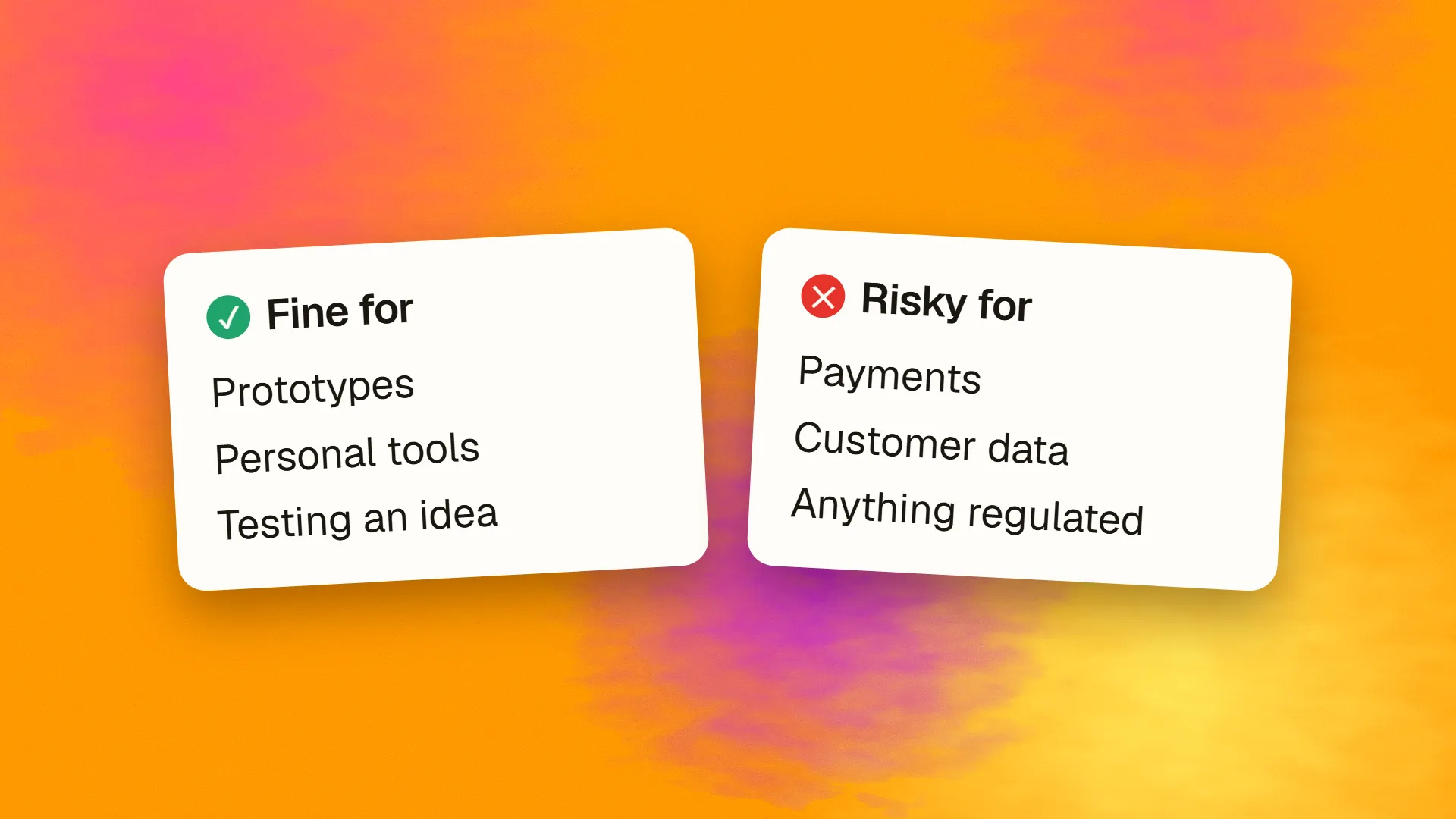
Vibe coding is not bad in itself; it is bad when applied to the wrong risk. Accepting generated code you have not read is fine for prototypes and personal tools. It is risky for apps handling customer data, payments or anything hard to reverse. Veracode's October 2026 tests found 38% of AI coding tasks still produced vulnerable code, so production work needs review and testing.
First, what people mean by it
Vibe coding originally meant building with AI while not really reading the code: you describe, accept, run and paste back any errors. Today, people use the phrase loosely for almost any AI-assisted development, which muddles the debate. A senior engineer who directs an agent and reviews each diff is not doing the same thing as someone who has never opened the files.
So let's use the narrow meaning: shipping code that nobody has read or understood. That is the part worth arguing about.
What the evidence says
Security. Veracode tests AI models on standard coding tasks with known security pitfalls. Its October 2026 update reported an average pass rate of 62%, up from 56%, which it called the largest improvement in the series. Put the other way, about four in ten tasks still produced vulnerable code. Veracode sells security tooling, so weigh its framing accordingly, but its central point is easy to accept: code compiling and running does not make it safe. And these models are improving, so this number should keep moving.
Productivity. The evidence here is messier than either side suggests. METR's 2025 randomised study found experienced open-source developers took 19% longer with AI tools, while they believed they had been faster. Its later follow-up reportedly did not replicate that slowdown, and METR changed its design because many developers no longer wanted to work without AI at all, which skewed its results. Reasonable takeaways are that self-reported speed is unreliable, and that the effect depends heavily on the task and the tool's generation. Neither “10x” nor “it slows you down” is a safe summary.
Real incidents. CVE-2025-48757 described insufficient database access rules in Lovable-generated projects, which allowed unauthenticated reads and writes. The cause was not unusual. It is what happens when a working front end looks finished, while nobody has checked who else can reach the data behind it.
Where it works
- Prototypes and demos. The output's job is to test an idea or communicate one, and then be thrown away.
- Personal tools. One user, no sensitive data, and you would notice if it broke.
- Internal one-offs. A script to clean a spreadsheet, a quick dashboard over non-sensitive data.
- Learning and exploring. Trying an unfamiliar library or sketching several approaches quickly.
- Non-developers solving their own problems. This is a real gain. People who could never commission software can now build small things for themselves.
Where it breaks
- Anything with other people's data. Your duty of care now extends to them, and “the AI wrote it” is no defence.
- Payments and permissions. The failure is silent right up until it is expensive.
- Long-lived products. Each change gets harder as nobody holds a mental model of the system. See technical debt in an MVP.
- Regulated work. Health, finance and legal contexts have requirements around accountability that unread code cannot meet.
- Hard-to-reverse actions. Agents with write access to production have a poor margin for error.
| Ask yourself | Low risk | High risk |
|---|---|---|
| Who uses it? | Only you | Customers or the public |
| What data does it touch? | Nothing sensitive | Personal or financial data |
| What happens if it fails? | You re-run it | Money, data or trust is lost |
| How long will it live? | Days or weeks | Years |
| Who could fix it? | You, or nobody needs to | Somebody will have to, under pressure |
The more answers fall in the right-hand column, the less acceptable unread code becomes.
Nothing sensitive
If it fails, you re-run it
Lives days or weeks
Personal or financial data
Money, data or trust is lost
Lives for years
The honest case in favour
Critics sometimes compare vibe coding with an idealised software process that many teams never achieved. Plenty of human-written production code is unreviewed, untested and poorly understood as well. And an app that exists can test a market, in a way that a specification on a shelf cannot. Dismissing all of this as a toy misses what has really changed: the cost of trying something has dropped sharply.
The honest case against
The cost of trying has dropped, but the cost of being wrong in production has not. The tools make it very easy to reach something that looks finished, so the point at which you should bring in rigour can easily pass unnoticed. That's the actual danger. A prototype gets a few real users, then a payment button, and then customer records, and at no single step did anyone decide to run a production system.
How to use it responsibly
- Decide the risk level at the start, and write it down.
- Set a line for graduating. Real users, personal data or payments mean the code now needs reading, testing and review. Use the vibe-coded app security checklist.
- Keep the code under version control and make sure you can run it outside the builder.
- Give agents the least access possible. Never give them production credentials by default.
- Fix what has already drifted. If you have crossed the line already, here is how to fix a vibe-coded app.
Our view
We use AI tools every day, and we would not give them up. We also think anything heading for a client's production system should be read first. Our position is simple: vibe coding is a good way to find out what to build, and a poor way to be responsible for it.
If your prototype has started acquiring real users, book a call.
Common questions
Is vibe coding bad for beginners?
It can help you build things and stay motivated, but it can also let you skip the understanding that makes you effective. Ask the tool to explain its code, make small changes by hand, and avoid handling other people's data until you understand the risks.
Is vibe coding safe for production?
Not without review. Veracode's October 2026 tests found roughly four in ten AI coding tasks produced vulnerable code. AI-assisted code can be production-ready, but only after somebody who understands it has reviewed and tested it.
Will vibe coding replace developers?
It is changing what developers spend time on, but responsibility for what ships still sits with people. Design decisions, security, debugging and judgement about what to build remain valuable. Small, low-risk software is where the replacement effect is strongest.
Does AI actually make developers faster?
It depends on the task, tool and developer. A 2025 METR randomised study found experienced developers were slower while believing they were faster, while later data has been inconclusive. Measure your own team's results rather than relying on impressions.
