In short
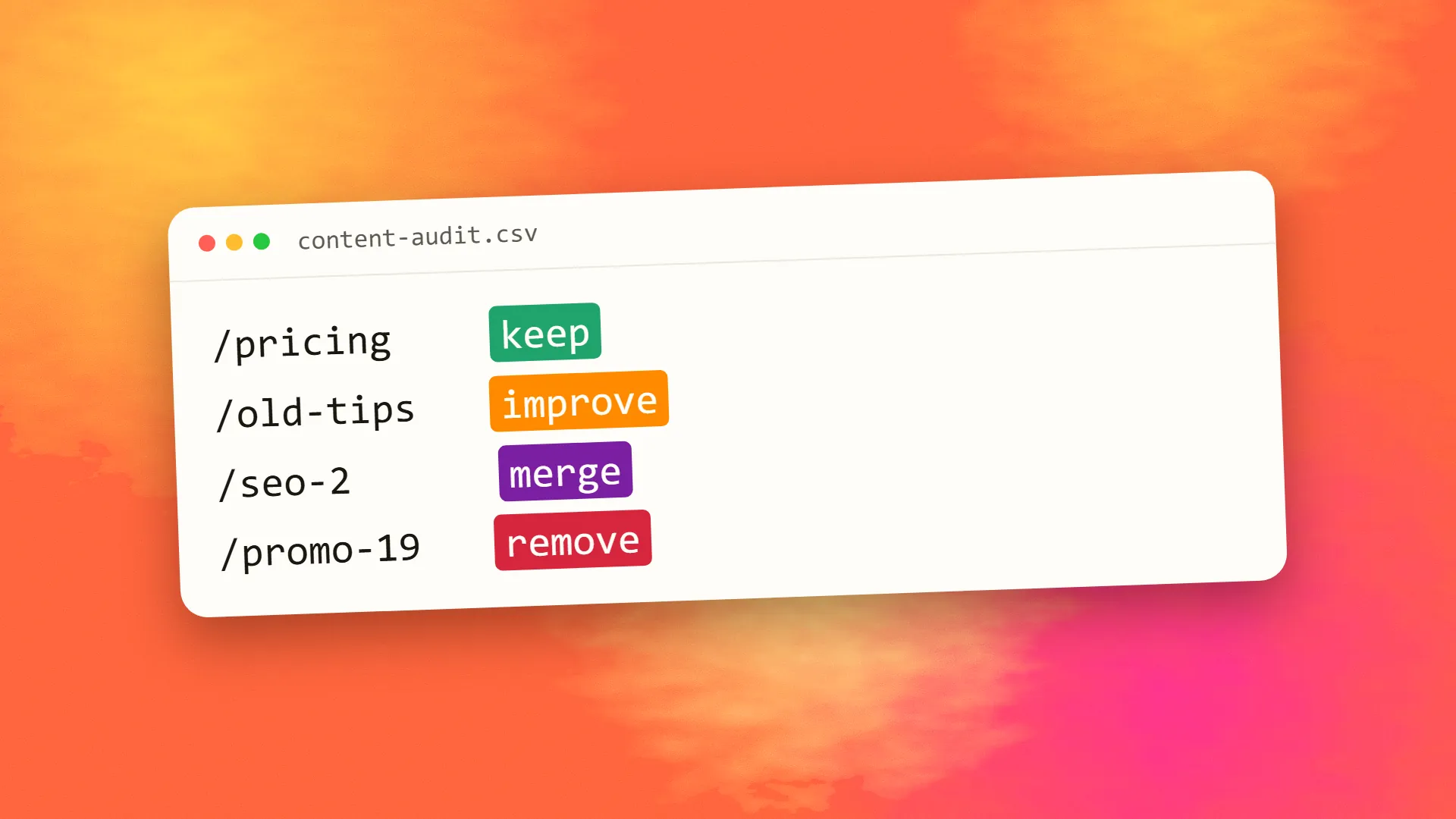
A content audit is a systematic review of every page on a website, combining a crawl-based inventory with performance data from analytics and Search Console and a quality assessment, to decide for each page whether to keep it as is, improve it, merge it with others, redirect it or remove it. Sites need one when they have accumulated years of content, when rankings have declined across many pages, before a migration or redesign, or when they suspect thin and duplicate content is holding the rest down. The output is a spreadsheet with a decision and an owner per URL, executed in prioritised batches with redirects preserving the value of anything removed.
Why sites need one
Content accumulates. A site that has published for five years has hundreds of pages, and nobody has looked at most of them since they went live. Some rank and convert. Many receive no visits. Several cover the same topic and compete with each other. A few are wrong now. Together the weak ones dilute the site's authority, waste crawl, and, since Google's site-wide quality systems, drag down the pages that work. The helpful content assessment judged sites as a whole, and the filler was what many sites were judged on.
An audit replaces the accumulation with a decision per page. It is the single highest-leverage SEO project most established sites have not done, and our own experience with a guides section that had grown to 1,072 templated pages is the case for it: the audit showed that most of them were near-duplicates, and consolidating to 403 was the fix.
When to run one
When the site is more than a couple of years old and has never had one. When organic traffic has declined broadly rather than on a few pages. Before a redesign or migration, so that only content worth migrating is migrated. When several pages compete for the same queries. After a core update hits. And on a schedule afterwards, annually for most sites.
Building the inventory
- Crawl the site to list every indexable URL with its title, headings, word count, status, canonical, internal links in and out, and last modified date. This is the base list.
- Add Search Console data per URL: impressions, clicks and average position over the last twelve months, and the top queries.
- Add analytics data: sessions, engagement, conversions or goal completions per URL over the same period.
- Add backlink data: referring domains per URL, so pages with external links are not removed carelessly.
- Add the sitemap and any CMS export to catch orphan pages the crawl missed.
The result is one row per URL with a dozen columns. For a site of a few hundred pages this is an afternoon; for thousands, a day or two with the right tools.
Assessing each page
Two lenses, performance and quality:
Performance. Does the page get impressions and clicks? Does it rank for anything? Does it convert or lead somewhere? Does anyone link to it? Has it grown or declined? Pages with no impressions, no visits and no links for a year are candidates for removal; pages with impressions but few clicks are candidates for improvement; pages that rank for the same queries as another page are candidates for merging.
Quality. Is it accurate and current? Does it answer its question completely, from real expertise? Is it distinct from the site's other pages? Would it pass the self-assessment questions an honest editor would ask? Is it thin: a few hundred words that say nothing a searcher would want? Quality is read, not computed; sample the pages performance flagged and read enough to judge the pattern.
The decisions
Keep. Performing and good. Leave it, perhaps refresh the date and check the links.
Improve. Good topic, weak execution, or once good and now dated: impressions without clicks, a page that ranks on page two, content that is thin but on a question worth answering. Rewrite, expand, update, add what is missing.
Merge. Several pages on one topic, each mediocre, competing with each other. Combine into one thorough page at the best-performing URL, redirect the rest to it, and update internal links. This is the fix for thin and duplicate content and it usually produces the largest gains.
Redirect. A page with links or traffic but no reason to exist as itself: point it at the closest relevant page.
Remove. No traffic, no links, no value, no relevant page to redirect to. Return 410 or 404 and let it drop. Removing content feels risky; removing content that nothing depends on is not.
Noindex. Pages that must exist for users but should not be in search, such as thin utility pages.
Each decision goes in the spreadsheet with an owner and a priority.
| Decision | When |
|---|---|
| Keep | Performing and good |
| Improve | A good topic, with weak or dated execution |
| Merge | Several mediocre pages competing with each other |
| Redirect | Links or traffic, but no reason to exist as it is |
| Remove | No traffic, links or purpose |
Executing safely
Work in batches, largest expected impact first, typically the merges. For every merge and removal, preserve value: redirect URLs with links or traffic, update internal links to the surviving page, and remove the retired URLs from the sitemap. Keep a record of what was removed and why. Check Search Console over the following weeks for the merged pages' rankings, which usually rise, and for any unexpected drops. Do not remove hundreds of pages in a day without redirects; do remove them in planned batches with them.
The cadence
A full audit annually, and a lighter review quarterly of new content against the same questions, keeps the site from accumulating the problem again. Sites that audit find that their next content decision is often not to write something new but to fix something that exists, which is cheaper and faster to show results. If you would like an audit run with the inventory, the decisions and a batch plan, book a call; on most sites it fits in a couple of weeks.
Common questions
What is included in a content audit?
An inventory of every indexable URL from a crawl, with titles, word counts, internal links and status; performance data per URL from Search Console and analytics, including impressions, clicks, sessions, conversions and backlinks; a quality assessment of accuracy, completeness and distinctness; and a decision per page to keep, improve, merge, redirect, remove or noindex, with an owner and a priority.
How often should you do a content audit?
A full audit annually for most established sites, with a lighter quarterly review of recently published content, and an additional audit before any migration or redesign or after a broad traffic decline. Sites that have never audited should do one now; five years of accumulated content almost always contains pages holding the rest down.
Should I delete old blog posts?
Delete posts with no traffic, no links, no rankings and no relevant page to redirect to; merge posts that cover the same topic into one thorough page with redirects; improve posts on good topics that have gone stale or thin. Age alone is not a reason to delete, and posts with links or traffic should be redirected or updated rather than removed.
Does removing content hurt SEO?
Removing content nothing depends on, with no traffic, links or rankings, does not hurt and often helps, because site-wide quality assessments weigh the whole site. Removing pages that have links or traffic without redirecting them loses that value. Audit first, redirect anything with value to its closest relevant page, and remove in planned batches.
What tools do you need for a content audit?
A site crawler such as Screaming Frog or Sitebulb for the inventory, Google Search Console and your analytics for performance data, a backlink tool for referring domains per URL, and a spreadsheet to combine them and record decisions. Larger sites benefit from a tool that joins these sources automatically; the judgement about quality still requires reading.