In short
A microsite is a small, self-contained website, typically a handful of pages on its own domain or subdomain, built to serve one purpose separately from the main site: a product launch, an event, a campaign, a distinct brand or a different audience. It makes sense when the content genuinely needs its own identity, its own audience or its own technical stack, and when the main site's structure or governance would get in the way. It does not make sense as a way of avoiding the main site's design rules, because the search authority it earns does not transfer back and it becomes one more thing to maintain, secure and eventually retire.
What a microsite is
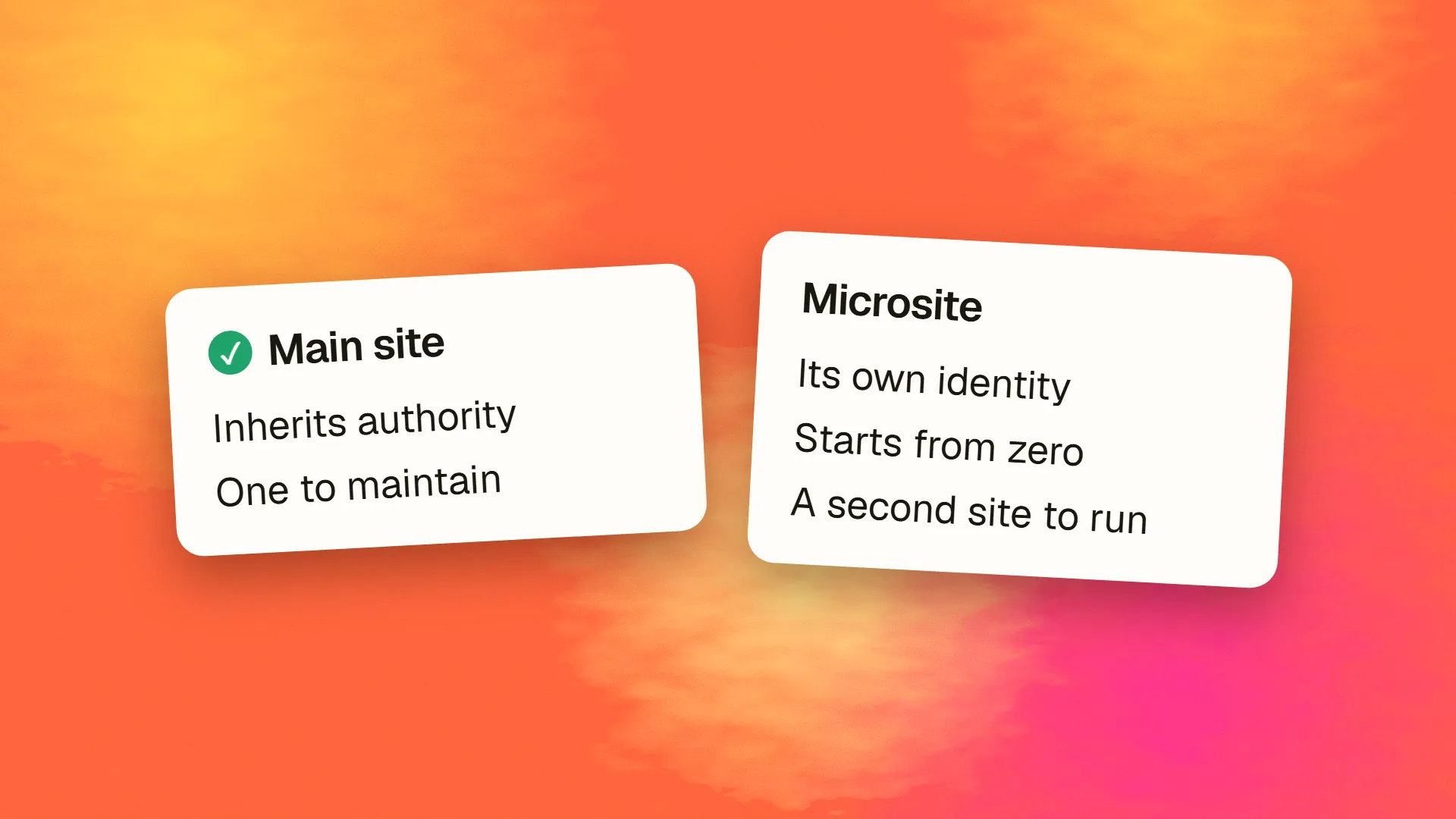
A microsite is a small website that stands apart from an organisation's main site. It usually has its own domain (product-launch.com) or subdomain (launch.company.com), its own design, its own navigation and a narrow purpose. Where a landing page is one page inside the main site, a microsite is a separate site with several pages; where a section of the main site inherits its templates and menu, a microsite starts from a blank page.
example.com/launch/
// inherits authority
launch-example.com/
// starts from zero, runs separately
They were fashionable in the 2000s, when every campaign got its own Flash site. They fell out of favour when search became the main way people found things and every microsite turned out to be an orphan. They persist because there are situations where the separation is genuinely the point.
When a microsite is the right call
A distinct brand or product. A sub-brand aimed at a different audience, with a different tone, may be harmed by sitting under the parent's navigation. A consumer product from a B2B company, an internal venture, a foundation.
An event. A conference or exhibition needs a schedule, speakers, tickets and a venue page, all of which are irrelevant to the parent site the rest of the year and are often run by different people on a different timeline.
A different technical need. An interactive experience, a data visualisation, a tool, a heavy WebGL piece: things that do not fit the main site's stack and that would be slowed by inheriting its scripts and templates.
A partnership or co-branded initiative. When two organisations share a project, neither's site is the natural home and a neutral domain avoids the argument.
In each case the test is the same: would this content be worse on the main site, for the visitor, not for the team? If the honest answer is that the main site's approval process is slow or its design constraining, that is a governance problem, and a microsite is an expensive way to route around it.
The costs
Search authority does not transfer. A new domain starts with no history and no links. Whatever visibility the microsite earns, and campaign sites earn little, stays on that domain. When it is retired the links pointing at it die unless someone redirects them. The same content in a section of the main site inherits the domain's authority from day one. The subdomain-or-subfolder question is the same question at a smaller scale.
A second site to run. Hosting, certificates, updates, analytics, privacy notices, cookie handling, security patches. The microsite built in a hurry for a launch is the one still online three years later on an unpatched platform.
A brand that has to be re-established. Visitors who arrive at the microsite do not know it is yours unless it tells them, and visitors of the main site do not know the microsite exists unless it is linked prominently.
Analytics fragmentation. Two properties, two sets of goals, and a journey that crosses the domain boundary, which breaks session continuity unless cross-domain tracking is configured. UTM parameters on every link between the two are the minimum.
| Option | Best for | Search authority | Maintenance |
|---|---|---|---|
| Landing page on main site | Campaigns, offers | Inherited | None extra |
| Section of main site | Product lines, ongoing programmes | Inherited | Low |
| Subdomain microsite | Events, tools, distinct audiences | Partly separate | Medium |
| Separate-domain microsite | Sub-brands, partnerships | Starts from zero | Full second site |
Questions to ask before building one
- Who is the audience, and would they be confused or put off by the main site?
- What is the lifespan? Anything under a year probably belongs on the main site.
- Who owns it after launch, and what is the plan for retiring it?
- What does it need that the main site cannot provide?
- Will the main site link to it, and will it link back?
If the answers are a distinct audience, a multi-year life, a named owner, a real technical need and links both ways, build it. If the answers are the same audience, a three-month campaign, nobody and none, build a landing page.
Retiring a microsite
Microsites end, and the end is where most of the damage is done. Redirect every URL to the closest equivalent on the main site, keep the domain registered long enough for the redirects to be followed by search engines and by anyone who bookmarked it, and move any content that still has value onto the main site first. A microsite that simply goes dark takes its links, its citations and any goodwill with it.
If you are weighing a microsite against a section of your main site, book a call and we will talk it through.
Common questions
What is the difference between a microsite and a landing page?
A landing page is a single page inside the main site, built for one campaign and one action. A microsite is a separate small website, usually on its own domain or subdomain, with its own design and several pages. Landing pages inherit the main site's authority and maintenance; microsites do not.
Are microsites bad for SEO?
They are not penalised, but they split authority. A new domain starts with no links or history, and whatever it earns does not flow back to the main site. Content that should rank generally belongs on the main domain unless there is a strong reason for separation.
Should a microsite be on a subdomain or a separate domain?
A subdomain keeps a visible link to the parent brand and is easier to manage; a separate domain gives full independence and suits sub-brands and partnerships. Search engines treat subdomains as loosely related to the parent, not as the same site.
What should happen to a microsite when the campaign ends?
Move any content worth keeping to the main site, redirect every URL to the nearest equivalent, keep the domain registered for at least a year so redirects and bookmarks still work, and then let it lapse. Never simply take it offline.
How much does a microsite cost?
It is a small website, so it costs what a small website costs: design, build, hosting, a domain, and ongoing maintenance for as long as it exists. The recurring maintenance is the part most budgets forget.