In short
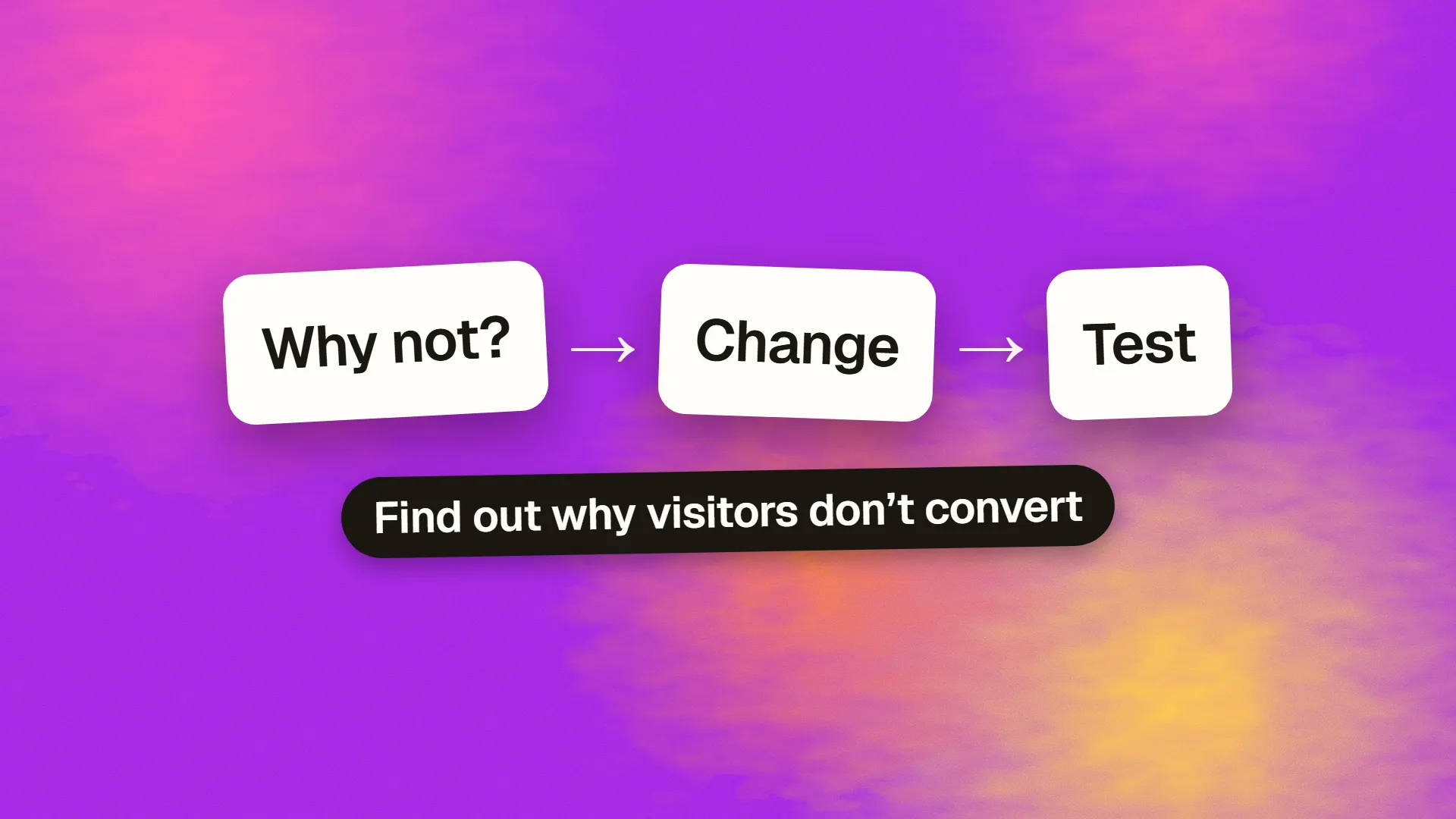
Conversion rate optimization, or CRO, is the structured practice of increasing the percentage of website visitors who complete a defined goal, such as an enquiry, a purchase or a sign-up, by finding out why visitors do not convert and changing the site to remove those reasons. It runs as a loop: gather evidence from analytics, recordings, surveys and user tests; form a hypothesis about what is losing people; make a change; measure whether it worked, ideally with a controlled test. Sites with fewer than a few thousand conversions a year cannot run reliable A/B tests and should instead fix the obvious problems research reveals and measure before and after.
The definition
Conversion rate is the share of visitors who do the thing a page or site exists to make them do: submit the enquiry form, buy, book, sign up, download. Conversion rate optimization is the practice of raising that share. If 2 in 100 visitors enquire and you get it to 3, you have grown enquiries by half without spending anything on traffic. That arithmetic is why CRO exists as a discipline and why it is often the highest-return work a site can do after its basic performance is in order.
The word optimization suggests fine-tuning, and CRO is often sold as a menu of tweaks: button colours, headline variants, urgency badges. Most of that is noise. The work that moves conversion rate is finding out why people leave and fixing it, and the finding-out is the larger part.
The loop
CRO done properly is a cycle with four stages.
Research. Where do visitors drop out, and what do they say? Analytics shows the funnel: which pages lose the most people between arrival and goal. Heatmaps and session recordings show behaviour on those pages. Surveys, support tickets and sales calls give the reasons in the visitors' own words. User tests, where you watch five people try to complete the task, expose the confusions nobody reports.
Hypothesis. A specific, falsifiable statement: visitors abandon the quote form because the phone field is required and they do not want a call, so making it optional will raise completions. A hypothesis that cannot fail is a preference.
Change. Build the variant. Sometimes a copy edit; sometimes a redesigned page; sometimes removing a step from a process.
Measure. With enough traffic, an A/B test that shows the original to half of visitors and the variant to the other half. Without enough, a before-and-after comparison over matched periods, read cautiously.
Then back to research, because the fix usually reveals the next constraint.
The traffic problem
A/B testing is the part of CRO people have heard of, and it is the part most small sites cannot use. To detect a realistic improvement, say from 2 per cent to 2.4 per cent, a test needs tens of thousands of visitors per variant. A site with 3,000 visits a month would take the best part of a year, by which point seasonality and other changes have contaminated the result. There is more on the arithmetic in how long an A/B test should run.
Below that threshold, CRO does not stop; it changes shape. You lean harder on qualitative research, which finds large problems with small samples, and you make changes whose direction is not in doubt: a form that fails silently, a page whose call to action is below where visitors stop scrolling, a checkout that demands an account. You measure before and after, you accept that the measurement is imprecise, and you prioritise the fixes big enough to show through the noise.
| Monthly conversions | What works |
|---|---|
| Under 100 | Qualitative research, fix obvious defects, before/after measurement |
| 100 to 1,000 | Same, plus tests of large changes on high-traffic pages |
| Over 1,000 | Full test programme, sequential tests, smaller refinements become detectable |
What actually moves the number
Across published case studies, the changes with the largest effects are rarely cosmetic:
- Clarity of offer. Visitors who cannot tell what you do or whether it is for them leave. The homepage headline and the first screen of each landing page carry most of this.
- Friction in the conversion step. Fewer form fields, no forced account creation, obvious error messages, visible progress. Forms people finish covers the specifics.
- Trust at the moment of decision. Prices where visitors expect them, real testimonials, a named person, a clear statement of what happens after they click.
- Speed. A page that takes four seconds to become usable loses visitors before it can persuade them.
- Matching the promise. An ad or listing that says one thing and a page that says another. Much wasted traffic is a relevance problem, not a design problem.
Button colour appears in almost no credible account of a large win.
Common mistakes
Optimising the wrong conversion. A newsletter sign-up is not a lead. Define the conversion as the action that produces revenue or the nearest measurable step to it, and set up analytics to record it reliably before anything else.
Testing without research. Guessing variants and running them is slow and usually fruitless. Research narrows the search.
Stopping tests early. A test that looks like a winner on day three is often a loser by day fourteen. Set the sample size before you start and do not peek.
Copying other people's winners. A change that worked on someone else's audience carries no guarantee for yours. Treat published results as hypotheses.
Ignoring the segment. A change that helps mobile visitors and hurts desktop ones may net to zero. Read results by device and by source.
Where CRO sits
CRO overlaps with design, with SEO, and with analytics, and is sometimes treated as a separate specialism with its own agencies. On a small site it is better understood as a habit: every time you touch a page, you know what it is for, you know its current rate, and you check afterwards whether the rate moved. For a benchmark on what rate to expect, see what a good conversion rate is.
If you would like help finding where your site is losing people, book a call.
Common questions
What does CRO stand for?
Conversion rate optimization: the practice of increasing the share of visitors who complete a defined goal on a website, such as enquiring, buying or signing up.
Is CRO the same as A/B testing?
No. A/B testing is one way of measuring whether a change worked. CRO is the whole process of researching why visitors leave, forming hypotheses, making changes and measuring them. Many sites do CRO without ever running a formal A/B test because they lack the traffic.
How much traffic do you need for CRO?
Research-led CRO works at any traffic level. Controlled A/B tests generally need tens of thousands of visitors per variant to detect realistic improvements, so sites below roughly a thousand conversions a month rely more on qualitative research and before-and-after measurement.
What is a good conversion rate?
It depends on the industry and the action being counted. Lead-generation sites often see 2 to 5 per cent form completions; e-commerce is commonly 1 to 3 per cent purchases. Your own trend matters more than the benchmark.
Does CRO affect SEO?
Only indirectly. Changes that improve clarity, speed and trust tend to help both. Conversion rate itself is not a ranking factor, but the research CRO produces often reveals content that does not match what searchers wanted.