In short
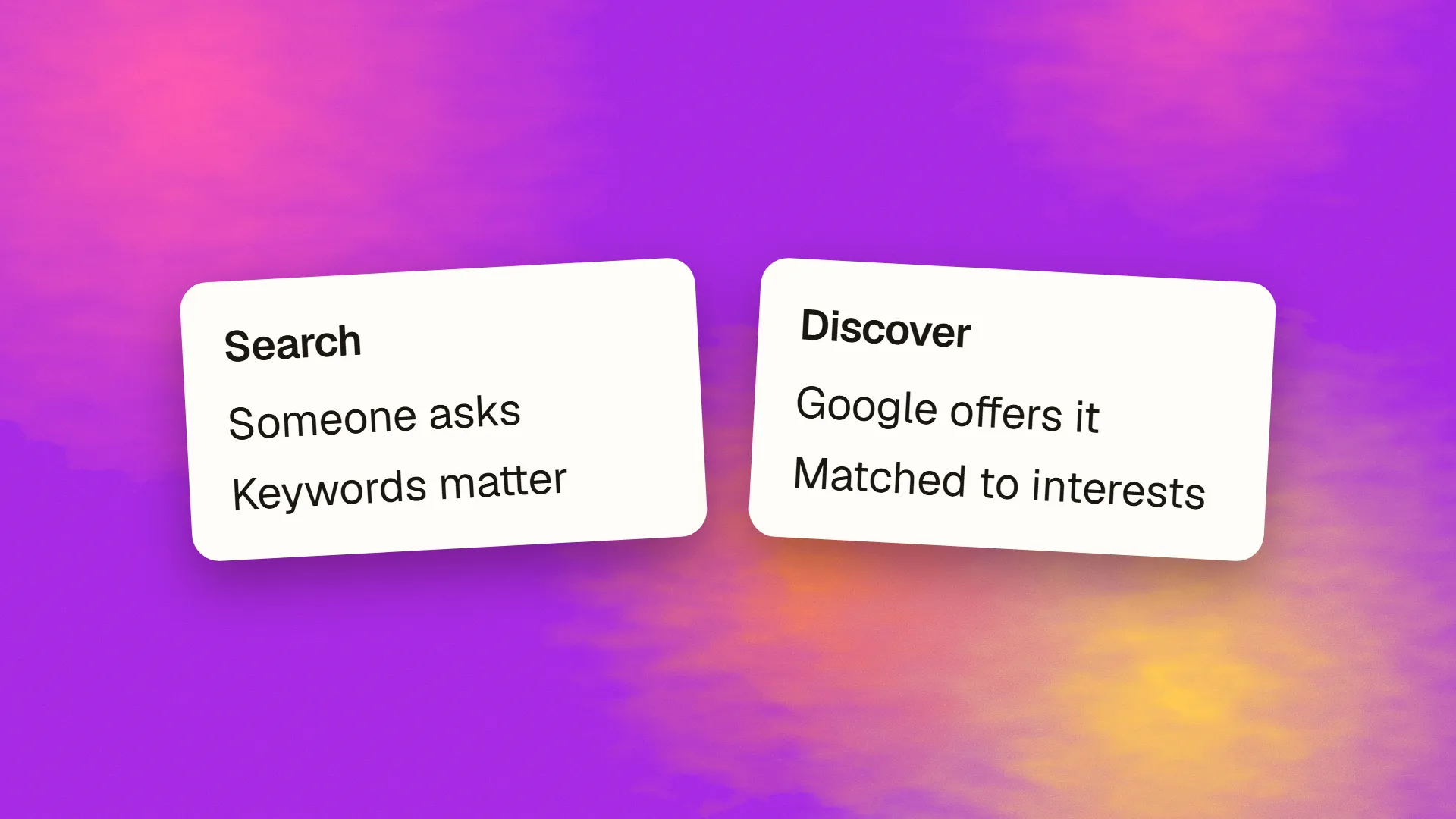
Google Discover is a personalised feed of articles and videos shown on Android home screens, in the Google app and on Google.com on mobile, chosen by Google from recently published content that matches each user's interests, without any search. Content is eligible if it is indexed, follows Google's content policies and meets its page-experience expectations; large, high-quality images and titles that describe the content honestly help substantially. Discover favours timely, engaging content from sites with established E-E-A-T, sends traffic in bursts that are hard to predict, and is reported in its own section of Search Console.
What it is
Swipe left from the home screen of most Android phones, or open the Google app, and a feed of articles appears: news, features, explainers and videos, each with a large image, chosen for that person based on what Google infers they are interested in from their search history, app activity and stated topics. Nobody typed a query. Google decided this person might want to read this.
That is Discover, launched under that name in 2018 and reaching a very large mobile audience. For publishers it is a distinct traffic source, sometimes rivalling search, with different rules and different behaviour.
How content is selected
Google matches content to users by topic, using its understanding of what the page is about and what each user has shown interest in. It favours content that is recent, though evergreen pieces resurface when they match a rising interest; that has engaged readers elsewhere; that comes from sites with a track record of quality on the topic, which is the E-E-A-T assessment applied to a feed; and that meets its page-experience expectations for mobile. It penalises clickbait, misleading titles and images, and content that manipulates emotion or withholds the point, and it excludes content that violates its policies.
There is no way to submit content to Discover and no keyword to target. Eligibility is automatic for indexed pages; selection is Google's.
Keywords matter
Steady traffic
Matched by topic and interests
Traffic arrives in bursts
The requirements
Indexed and eligible. The page must be in Google's index, not blocked or noindexed, and must comply with Discover's content policies, which are stricter than search on sensationalism and misleading presentation.
Large images. Google states that pages with large, compelling images, at least 1,200 pixels wide, are more likely to appear, and that the site must allow Google to display them, either through the max-image-preview:large robots setting or through AMP. Small images or a thumbnail-only preview sharply reduce the chance of inclusion. This is the single most common technical omission.
Honest titles. The title must describe the content; titles that tease, exaggerate or withhold the point are demoted. Discover titles are shown prominently and judged strictly.
Mobile page experience. Fast, stable, usable on a phone, since every Discover click is a mobile click.
Author and publisher clarity. Bylines, dates, an about page, and the signals that show who is behind the content.
What performs
Content that people would read without having searched for it: explainers on topics of current interest, features with a strong angle, guides tied to a season or an event, visually rich pieces, and news. Content answering a narrow how-to query, however useful, rarely appears, because nobody browses for it. The question-led pages that win search are usually not the pages that win Discover, and a publisher can pursue both with different pieces.
Sites that do well are typically publishers and brands with a consistent topic, a regular publishing rhythm, distinctive imagery and a recognised name, which is the description of a site with topical authority in a subject people follow.
The volatility
Discover traffic arrives in bursts. A piece can receive tens of thousands of visits over two days and then nothing; a site can be a fixture in the feed for months and disappear after a core update. Google's changes to the feed's selection are frequent and unannounced. It should be treated as a bonus on top of search and direct traffic, never as a base to plan on, and publishers whose business came to depend on it have been hurt repeatedly.
Measuring it
Search Console has a Discover report, separate from Search, showing impressions, clicks and click-through by page over time, appearing once a site receives Discover traffic. Analytics records Discover visits as Google referrals or direct depending on configuration; the Search Console report is the reliable source. Watch which pieces appear and what they share, since the pattern is the closest thing to a strategy the feed allows.
The practical programme
Set max-image-preview:large site-wide and use large, high-quality images on every article. Write titles that say what the piece is. Keep the site fast on phones. Publish consistently on a defined topic with named authors. Produce some content designed to be interesting rather than to answer a query. Check the Discover report monthly. Then treat whatever comes as a gift and build the search and brand base that does not depend on it. If you would like a site checked for Discover eligibility, the image and title requirements are the quick part, and book a call if you would like it done.
Common questions
How do I get my website on Google Discover?
There is no submission. Pages are eligible automatically if indexed and compliant with Discover's content policies. Improve the chances by allowing large image previews with the max-image-preview:large robots setting and using images at least 1,200 pixels wide, writing honest descriptive titles, keeping the site fast on mobile, showing clear authorship, and publishing engaging content on a consistent topic from a site with an established reputation.
Why is Google Discover traffic so inconsistent?
Because Discover selects content per user by inferred interest and recency, favouring new and timely pieces, and Google changes the feed's selection frequently and without notice. A page can receive a burst of traffic for two days and then none, and a site can drop out after a core update. Treat it as a bonus rather than a base.
What kind of content appears in Google Discover?
Content people would read without searching: explainers on topics of current interest, features with a strong angle, seasonal and event-tied guides, visually rich pieces and news, from sites with a consistent topic, named authors and a recognised name. Narrow how-to pages that win search rarely appear, because nobody browses for them.
Does Google Discover require AMP?
No. AMP was once an advantage for image previews, but any page can qualify by setting max-image-preview:large in its robots meta tag and using large images. Discover now favours fast, stable mobile pages regardless of technology.
How do I see Discover traffic in Search Console?
Through the Discover report in the Performance section, which appears once the site has received Discover impressions. It shows impressions, clicks and click-through rate by page over time, separately from search. Analytics is less reliable for Discover, which it may record as Google referrals or direct visits.