In short
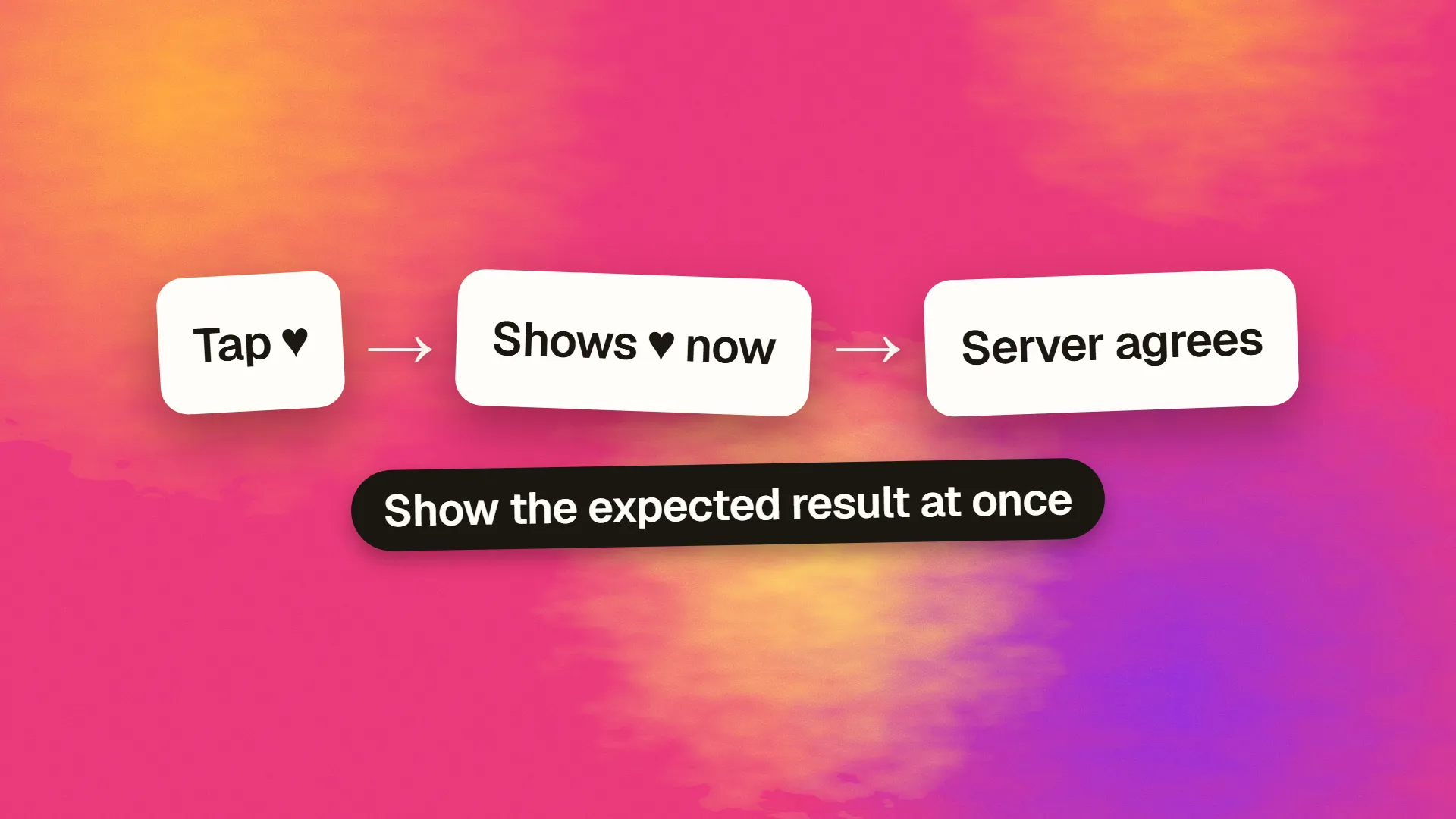
Optimistic UI is a pattern in which the interface updates immediately to show the expected result of a user's action, such as a like, a sent message or a reordered item, without waiting for the server to confirm, then quietly reconciles when the response arrives and reverts with an explanation if the action failed. It suits frequent, low-stakes, usually-successful actions where waiting would feel sluggish. It does not suit actions with serious consequences, uncertain outcomes or results the user cannot predict, such as payments, bookings against limited availability, or anything irreversible.
The pattern
A user taps a heart. Conventionally, the app sends the request, shows a spinner, and fills the heart when the server replies, a round trip of a few hundred milliseconds that makes every tap feel heavy. Optimistically, the app fills the heart immediately, sends the request in the background, and does nothing further if the server agrees, which it almost always does. If the server refuses, the heart empties and the user is told.
The interface has assumed success and taken responsibility for correcting itself if the assumption fails. Chat apps do this with sent messages, task apps with checkboxes, mail clients with archiving, editors with every keystroke. It is why the best-feeling products seem to respond faster than the network allows: they do.
Why it works
Perceived responsiveness is set by the time between action and visible reaction. Below about 100 milliseconds a reaction feels instant; above a few hundred it feels like waiting. Network requests almost always exceed the first threshold and often the second, so any interface that waits for the server before reacting feels slow by construction. Optimistic updates move the reaction to zero and push the network delay out of the user's attention entirely.
The pattern also reduces the number of loading states an interface needs, which simplifies the design and removes the flicker of spinners on every small action.
Actions that suit it
- Likes, favourites, reactions, follows.
- Toggling settings and checkboxes.
- Sending a message or a comment.
- Adding, removing or reordering items in a list the user owns.
- Renaming, tagging, labelling.
- Archiving and other reversible organisational actions.
- Saving a draft.
The common properties: the outcome is predictable, the action is frequent, failure is rare, and if it fails, reverting is cheap and the user can simply try again.
Actions that do not
- Payments and anything involving money.
- Booking against limited availability, where the server may say no because someone else got there first.
- Actions with irreversible consequences: deleting permanently, sending to many recipients, publishing.
- Anything whose result the interface cannot predict: a search, a calculation, a generated response.
- Actions with a meaningful failure rate, such as uploads over poor connections.
- Multi-step operations where a later step depends on the server's answer to an earlier one.
For these, showing success before it is real is a lie the user may act on. A user who sees "Booked" and closes the app, only to receive a failure email, has been misled at exactly the moment trust matters. The honest pattern for high-stakes actions is a pending state with clear feedback and a confirmed result.
Handling failure
The pattern is only as good as its rollback. When the server rejects an optimistic action:
- Revert the visible change to the previous state, so the interface reflects reality.
- Tell the user what happened and what to do, near the thing that reverted, in plain language: "Couldn't save your change. Try again." A change that silently disappears is worse than a spinner.
- Offer retry where it makes sense, and preserve the user's input so retrying is one tap.
- Distinguish failure types: a network drop can retry automatically; a permission error cannot; a conflict needs a decision.
- Handle out-of-order responses. If a user toggles twice quickly, the responses may arrive in either order; the interface must apply the latest intended state, not the last response received.
- Do not stack indefinitely. If the connection is down and optimistic actions accumulate, show the user that changes are pending, and queue them for background sync or ask them to retry once online.
The error-state design for optimistic failures deserves as much care as the happy path, because it is where the user discovers whether the interface was honest.
Conflicts
When several people edit the same thing, an optimistic update may be correct locally and wrong globally: the user reordered a list that someone else reordered a second earlier. Simple products resolve this by last-write-wins with a notice; collaborative products use merging strategies and operational transforms, which are an engineering subject of their own. The design question is what the user should see when their optimistic view is overtaken, and the answer is usually: the merged result, with a brief indication that something changed.
Implementation guidance
Most modern data-fetching libraries support optimistic updates directly: apply the expected change to the local cache, fire the request, and let the library reconcile or roll back on response. Keep the optimistic logic close to the data layer rather than scattered through components. Log optimistic failures, because their rate tells you whether the bet is still sound. And test the failure path deliberately, with the network throttled and the server returning errors, because in development the server always says yes.
Optimistic UI is one of the techniques behind products that feel fast on ordinary connections, alongside caching and real-user measurement. If yours feels laggy on every tap and the network is the reason, book a call; the conversion to optimistic updates for the right actions is usually a contained change.
Common questions
What is an example of optimistic UI?
Tapping a like button and seeing it fill instantly, before the server confirms; sending a chat message that appears in the thread immediately; ticking a task complete and seeing it move at once. In each case the interface assumes success, sends the request in the background, and reverts with an explanation only if the server refuses.
When should you not use optimistic UI?
For payments, bookings against limited availability, irreversible actions such as permanent deletion or publishing, results the interface cannot predict such as searches or generated content, and actions with a meaningful failure rate. Showing success before it is real can mislead the user at exactly the moment trust matters; use a pending state and confirm.
What happens if an optimistic update fails?
The interface reverts the visible change to the real state, tells the user what happened near the affected element, offers a retry with their input preserved, and distinguishes between recoverable failures such as a network drop and unrecoverable ones such as a permission error. A change that silently disappears is the worst outcome and must be avoided.
Does optimistic UI improve performance?
It improves perceived performance, not actual speed. The network request takes the same time, but the interface reacts immediately instead of waiting for the reply, moving the delay out of the user's attention. Because reactions under about 100 milliseconds feel instant, actions that previously felt sluggish feel immediate.
How do you implement optimistic updates?
Apply the expected change to the local state or cache immediately, send the request, and on success leave the state as is, or replace it with the server's version; on failure roll back and show an error. Most data-fetching libraries support this pattern directly. Handle rapid repeated actions so the latest intended state wins, and test the failure path with the network throttled.