In short
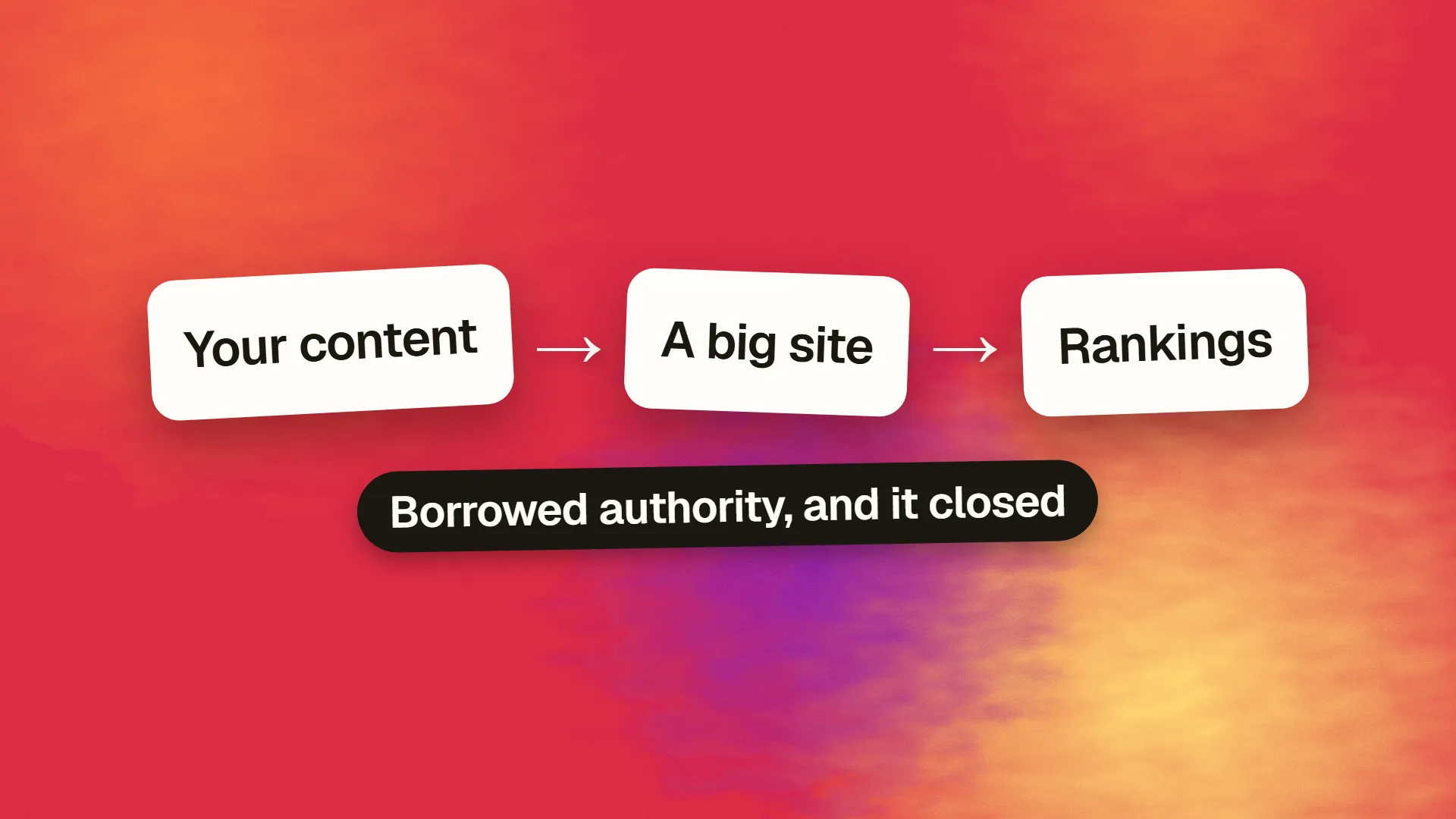
Parasite SEO is the practice of placing content on an established, high-authority website, through paid placements, guest posts, subdomains or user-generated sections, so that it ranks on the host's authority for commercial queries the author's own site could not win. It powered the coupon, review and casino content that appeared on news and university sites, and Google's site reputation abuse policy, enforced from May 2024 and tightened since, now demotes such content and penalises hosts that allow it. Genuine editorial contributions remain fine; content that exists to exploit the host's rankings does not.
The mechanism
Google's ranking systems weigh a site's overall authority heavily. A page on a major newspaper's domain starts with trust that a new site takes years to build. Parasite SEO exploits that: publish the page on the trusted domain, and it ranks for the target query almost immediately, carrying the author's affiliate links, product promotion or lead form.
The host is the parasite's host. Sometimes it is a willing one, selling the placement; sometimes it is a platform whose user-generated sections, forums, profiles or press-release pages, are used without editorial oversight; sometimes it is a subdomain leased to a third party wholesale.
How it became a scandal
By 2023 the pattern was everywhere. Major news publishers ran coupon sections, product review sections and "best of" listicles produced by third-party affiliate operators, ranking above specialist sites for lucrative queries on the strength of the newspaper's domain. University subdomains hosted casino content. Well-known platforms' free profile pages were filled with keyword-targeted spam. The searcher looking for a discount code found a page on a newspaper that had nothing to do with the newspaper, and the specialist who had built an honest site on the topic was buried under it.
The practice worked because Google's site-level trust was, for a time, easier to borrow than to earn, and it was profitable enough that publishers sold the space.
Google's response
In March 2024 Google announced the site reputation abuse policy, with enforcement from 5 May 2024: third-party content published on a site with little or no first-party oversight, intended to exploit the host's ranking signals, is spam. Enforcement began with manual actions against major publishers' coupon and review sections, which lost their rankings within days, and with algorithmic detection following. In late 2024 Google tightened the policy to remove the exemption for content produced with the host's involvement, so that a publisher's own affiliate section, built by a partner to exploit the domain, is covered too.
The practical outcome: the parasite pages disappeared from results, the hosts that ran them received penalties on the affected sections, and the market for placements on authoritative domains contracted sharply. It sits alongside scaled content abuse and expired domain abuse as the 2024 additions to the spam policies, all three targeting the borrowing of authority the borrower did not earn.
The line between contribution and abuse
Google's guidance is careful to say that not all third-party content is abuse. Genuine guest articles that the host commissions, edits and would publish regardless of rankings; syndicated content with proper attribution; wire stories; user reviews and forum posts on platforms built for them; and advertising clearly marked as such and not intended to rank are all fine. The test is purpose and oversight: was the content published because the host wanted it, with the host's editorial involvement, or was it published to exploit the host's rankings, with the host looking away?
For a business considering a placement, the questions are the same ones an honest guest post has always answered. Would this publication run this piece if it did not rank? Is an editor involved? Is the content for the publication's readers or for search engines? A yes to all three is a contribution. A placement sold by the page, with a keyword target and an affiliate link, is the other thing.
The searcher's side
The policy exists because of what parasite content did to results. A person searching for a discount code, a product recommendation or a comparison found, at the top, a page on a trusted publication that the publication had not written, did not check and was paid to host. The trust the searcher placed in the domain was the thing being sold. Restoring the connection between who publishes a page and who is accountable for it is the point of the enforcement, and it is why it landed on the hosts.
What to do instead
Build the authority on your own domain, which is slower and is yours. The pages that rank durably for commercial queries are on sites that have earned standing on the subject, and that standing survives policy changes because it was never borrowed. Contribute to other publications for their readers, with a link back where it is natural, which earns real referrals and real links rather than rented rankings. Use platforms as platforms: a profile on a marketplace or a directory is legitimate presence, and stuffing it with keyword pages is not.
And if a site has been the host, wittingly or not, of parasite content, remove or noindex it before the next enforcement round; the manual actions of 2024 landed on the hosts, and the sections took the publishers' broader rankings with them in several cases.
Parasite SEO was a loophole, and it has largely closed. The businesses that used it hold nothing now; the ones that built their own authority hold what they built. If you are being pitched a placement on an authoritative domain, book a call first; the price is usually a penalty deferred.
Common questions
Is parasite SEO against Google's guidelines?
Yes, since May 2024, under the site reputation abuse policy: third-party content published on a site to exploit its ranking signals, with little or no first-party oversight, is treated as spam, and the host site is penalised. Genuine editorial contributions, syndication with attribution, and platform-native user content remain acceptable.
What is site reputation abuse?
Google's name for the practice of hosting third-party content on an established site to exploit its authority for rankings: coupon sections, affiliate review pages, casino content on subdomains, and similar. Enforced from May 2024 through manual actions and algorithmic detection, and tightened later in 2024 to cover host-involved arrangements too.
Is guest posting the same as parasite SEO?
No, when it is genuine: an article the publication commissions or accepts for its readers, edits, and would run regardless of rankings, with a link back where natural. It becomes parasite SEO when the placement is bought by the page, targets a commercial keyword, carries affiliate or promotional links, and exists to rank on the host's authority rather than to inform its readers.
Why did Google crack down on parasite SEO?
Because by 2023 major publishers' coupon and review sections, produced by affiliate operators, were outranking specialist sites for lucrative queries purely on domain authority, and the results pages were filling with content the hosts did not oversee. The site reputation abuse policy restored the principle that authority must be earned by the site that holds it.
What should I do instead of parasite SEO?
Build authority on your own domain through pages that answer buyers' questions from real expertise, contribute genuine articles to other publications for their readers, and use platforms for legitimate presence rather than keyword pages. It is slower, it is yours, and it survives policy changes that have already removed the borrowed rankings.