In short
Choose OpenCode if you want an MIT-licensed agent that works with many providers, including local models, and you don't mind picking and paying for models yourself. Choose Claude Code if you want Anthropic's models and agent tuned together, with a simple subscription from $20 a month. Agent results depend heavily on the model behind them, so test OpenCode with the model you'd really use.
The basic difference
OpenCode is an open-source AI coding agent, MIT licensed, with a terminal interface, desktop app, IDE extension and web option. It supports 75 or more LLM providers through Models.dev, including local models, and you can sign in with some existing subscriptions, such as GitHub Copilot or ChatGPT Plus and Pro.
Claude Code is Anthropic's coding agent, which runs in a terminal, IDE, desktop app or browser. It's built around Anthropic's models, although its CLI and some IDE extensions also support third-party providers.
Side by side
Checked on 4 November 2026.
| OpenCode | Claude Code | |
|---|---|---|
| Licence | MIT | Proprietary |
| Software price | Free; some free models included | Included with paid Claude plans |
| Model cost | Depends on your provider or subscription | Plan limits, or API billing |
| Entry paid plan | None needed; optional subscription | Pro, $20/month ($17 annually) |
| Local models | Yes | Not its main design |
| Instructions file | See its docs | CLAUDE.md, or reads AGENTS.md |
What you gain with OpenCode
No vendor lock-in. If one provider raises prices or falls behind on quality, you can switch models and keep your workflow. In a market that's moving this quickly, that's real insurance.
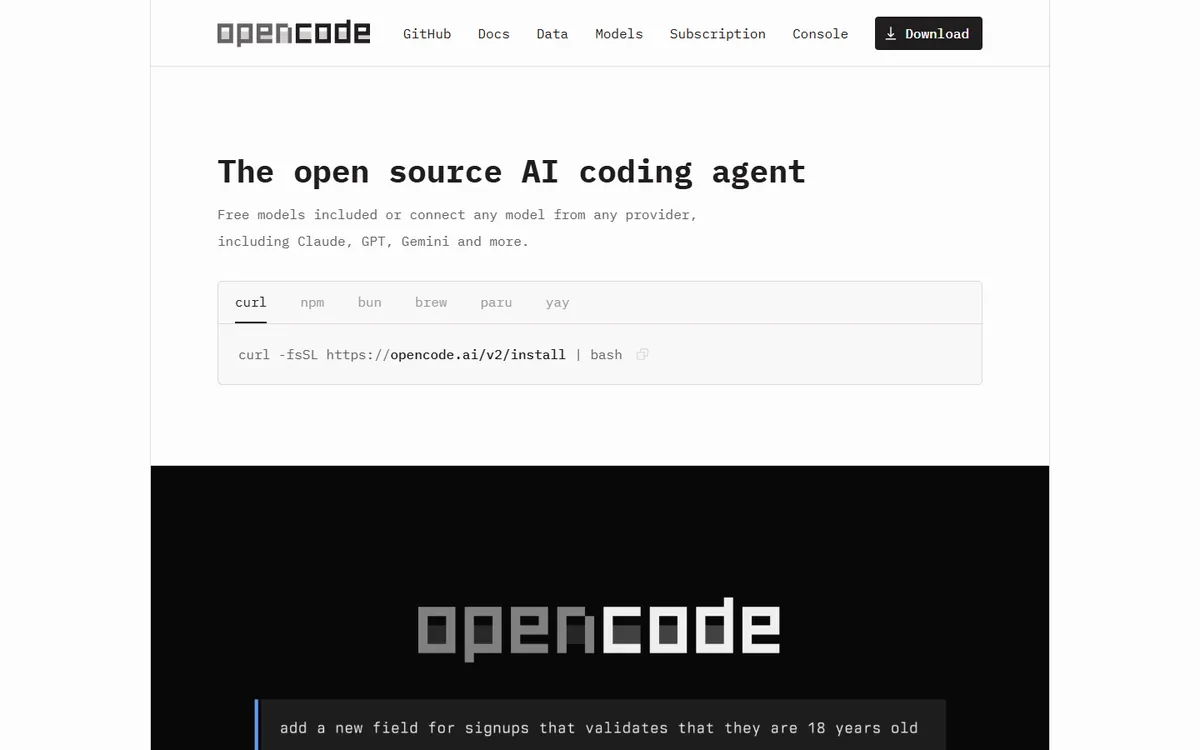
Lower potential costs. You can use budget APIs for routine work and stronger models for hard problems. For example, DeepSeek's Flash model lists at $0.15 per million input tokens off-peak, a small fraction of the price of top-tier models. Our LLM API pricing comparison shows how wide the range is.
Local and private options. Pairing it with Ollama or similar tools allows you to keep code on your own hardware, subject to model quality and your machine's limits. See how much hardware you need.
Transparency. You can read the source, audit its behaviour, fork it and contribute changes. Some companies require this kind of visibility for tools that have access to their code.
What you gain with Claude Code
Tight integration. The same company develops the agent and models, so prompts, tools and caching can be tuned to work together. Agent performance depends on more than the model alone, so this integration can matter.
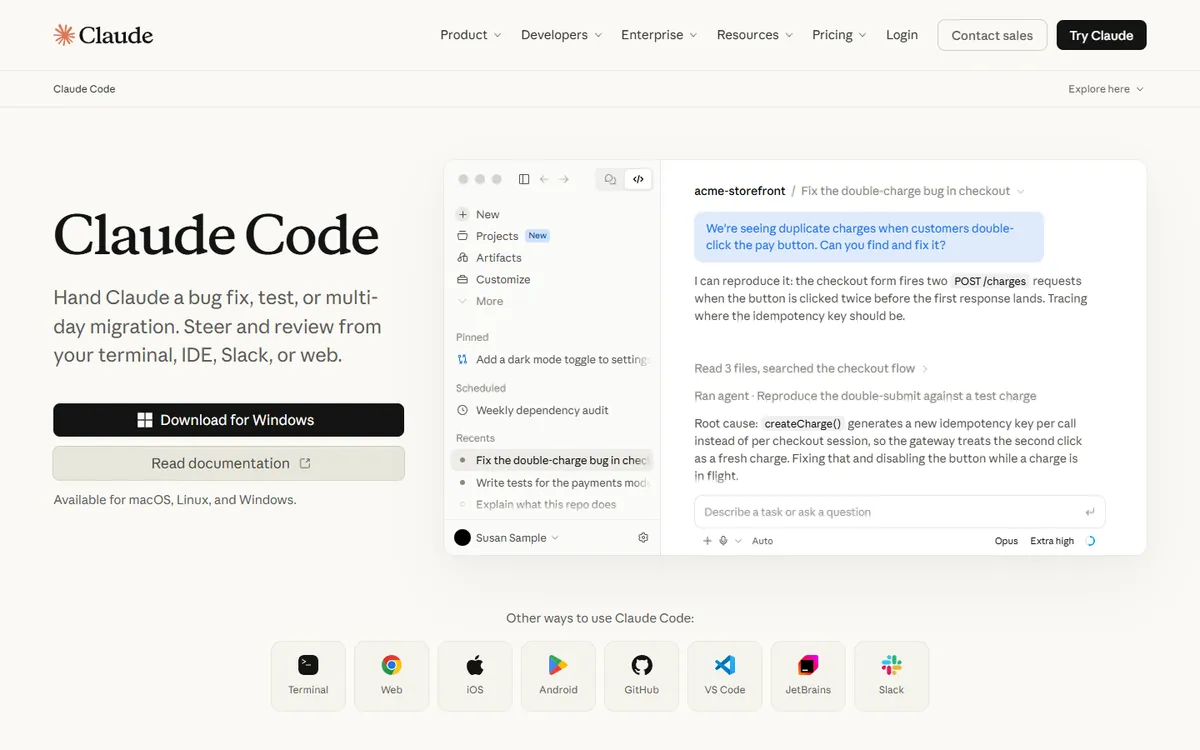
Simple billing. A flat subscription with usage limits means you don't have to manage API budgets, and you can predict your monthly cost. Heavy agent use on metered APIs can get expensive quickly, so a subscription may be better value for frequent users.
A broader official feature set. Skills, hooks, subagents, scheduled tasks, GitHub Actions, Slack routing and a desktop app are all documented and supported by one vendor. If something breaks, there's a clear place to go.
Team and enterprise plans, with admin controls and support contracts. That can make approval easier in larger organisations.
The hidden cost of model freedom
Choice has a price. You'll need to spend time testing which models work best with tool calling and long agent sessions. A cheap model that loops or breaks your code will waste more time than it saves. You also need to watch usage across providers, and configure caching properly, or your costs may run higher than expected. The same open agent can feel excellent with one model and frustrating with another, so don't judge it, or Claude Code, from a single test.
There's also a question about subscription logins. Vendors can change whether third-party tools may use a consumer subscription, and that's happened in this market before. If your plan relies on using a subscription in a third-party client, check the current terms for both, and have a fallback using an API key.
Privacy
Don't assume that either one is automatically private. With OpenCode, your code goes to whichever provider you've configured, so that provider's terms are the ones that matter. Its website says it doesn't store code or context, although its FAQ notes that data is stored when you use its free models, so read its privacy policy and avoid free models for sensitive work.
With Claude Code, your code goes to Anthropic or your cloud provider under your plan's terms. Read those, particularly for individual plans. In both cases, keep secrets out of reach, since these tools can read your files. How to handle secrets and API keys covers this.
How to test them fairly
- Use real tasks: a bug, a small feature and a multi-file refactor, as in Claude Code vs Codex.
- Test OpenCode with your intended model, and perhaps one premium model for comparison, so you can tell the agent's effect from the model's.
- Record the actual cost of each run, including any retries.
- Compare what you'd keep, not just whether the tests passed.
A shared AGENTS.md file keeps your project conventions portable, whichever you use. See how to use other models in Claude Code and Codex if you'd like some of that flexibility in the other direction.
How to choose
- You need open source or an auditable client: OpenCode.
- You want to use local models: OpenCode.
- You want to avoid tying your workflow to one vendor: OpenCode.
- You want predictable billing and minimal setup: Claude Code.
- You use agents heavily all day: compare subscription value against your actual API bills.
- You need vendor support for a large team: Claude Code or another commercial option.
They can coexist. Plenty of developers keep one main tool and try another whenever a major model ships.
If you want help designing a development workflow around these tools, book a call.
Common questions
Is OpenCode free?
The software is free and MIT-licensed, and it includes some free models that need no account. You'll pay your chosen provider for other models, or use an existing subscription where supported. Heavy agent use on metered APIs can become expensive.
Can OpenCode use Claude models?
Its site says it works with many providers, including Anthropic, through API access. Check current terms before using any consumer subscription with a third-party client, because providers can change what's permitted, and keep an API key as a fallback.
Is OpenCode as good as Claude Code?
It depends on the model behind it and your tasks. Results vary widely, because agent quality relies on both the model and how the tool uses it. Test with the exact model you plan to use, on your real code.
Is OpenCode safe to use with private code?
It can be, but your code goes to whichever provider you configure, so that provider's terms apply. OpenCode's FAQ says that data is stored when you use its free models, so avoid those for sensitive work and read its privacy policy.