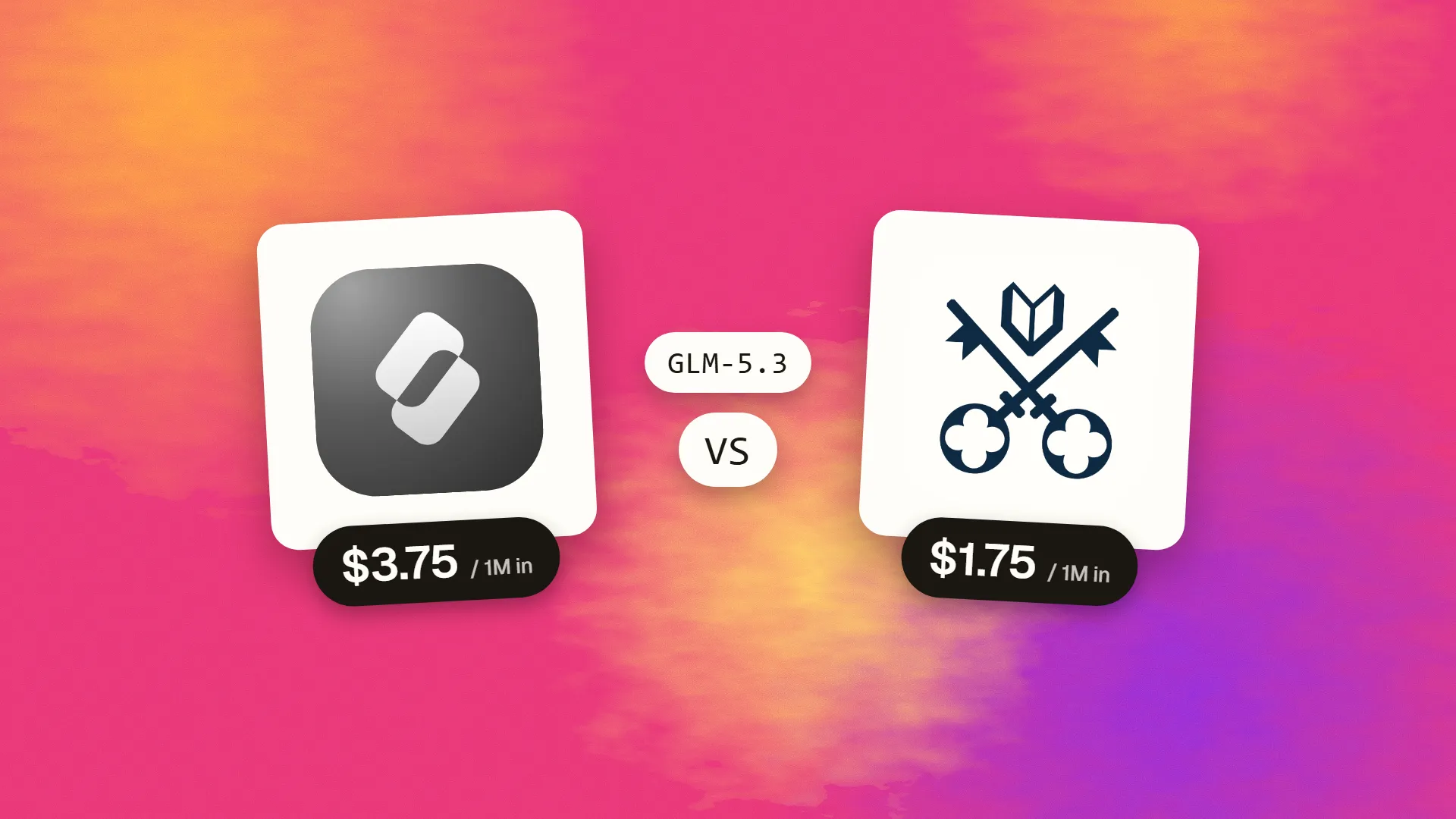
In short
SolCard Inference and Venice both offer GLM-5.3 and DeepSeek V4.1 Flash privately (SolCard's models are built on them) and accept crypto. Venice is cheaper on both: a 40-turn coding session costs about $1.40 on Venice's GLM-5.3 versus $1.95 on SolCard Large, and $0.15 versus $0.68 on DeepSeek V4.1 Flash, where SolCard's cached-input rate is about 17 times Venice's. Venice documents per-model privacy labels and offers TEE and end-to-end encrypted models; as of 31 October 2026 SolCard offers only a no-log statement. SolCard's advantages are a no-KYC wallet or email sign-up, payment from a SolCard card balance, Anthropic and Responses API formats, and a one-sentence install that adds its models to Claude Code or Codex while keeping your existing ones.
The short answer
SolCard Inference and Venice sell the same idea: strong open-weight models, served privately, with fewer refusals than mainstream assistants, and paid for in crypto if you want. They even run some of the same models. GLM-5.3 and DeepSeek V4.1 Flash are on both.
The differences come down to three things.
- Price: Venice is cheaper on both of the models they share. On DeepSeek V4.1 Flash it is cheaper by a wide margin.
- Privacy you can check: Venice publishes how each model handles your data and offers hardware-attested and end-to-end encrypted options. As of 31 October 2026, SolCard offers a promise and no documentation.
- Friction: SolCard needs no identity check, can be paid from a SolCard card balance, and installs into Claude Code or Codex with one sentence while keeping your existing models.
If you want the most evidence for the privacy claim and the lowest bill, choose Venice. Choose SolCard if no-KYC access, the SolCard balance or the one-step coding-agent setup matter more to you than a lower bill. The rest of this article shows the numbers behind that.
Who they are
Venice was launched publicly in May 2024 by ShapeShift founder Erik Voorhees as a private, uncensored alternative to ChatGPT. It has grown into a broad platform: chat, image, video and music generation, text-to-speech, a large model catalogue, and an OpenAI-compatible API at https://api.venice.ai/api/v1. It has its own crypto token economy, VVV and DIEM, which can pay for API usage.
SolCard Inference is new: it was live by late October 2026. It comes from SC PAYMENTS LIMITED, the Hong Kong company behind the SolCard crypto card. It is deliberately narrow: four text models, a chat app, and an API that speaks OpenAI Chat Completions, OpenAI Responses and Anthropic Messages. Our full explainer covers the product in depth.
Side by side
| SolCard Inference | Venice | |
|---|---|---|
| Text models | 4: GLM-5.3, DeepSeek V4.1 Flash, GLM-5.2, one undisclosed | Dozens, including GLM 4.6 to 5.3, DeepSeek V3.2 to V4.1, and Venice's own Uncensored models |
| Other media | None: text in, text out | Image, video, music, text-to-speech; multimodal input on supported models |
| API formats | OpenAI Chat Completions, OpenAI Responses, Anthropic Messages | OpenAI-compatible (as documented) |
| Privacy evidence | Company statement ("Nothing you send is logged"); no data-handling page yet | Per-model labels defined in docs (Private, Anonymized); TEE and end-to-end encrypted variants |
| Refusal stance | "No refusals" for legitimate work; unpublished usage policy behind a 403 error | Dedicated uncensored models; its own system prompt is added by default and can be switched off |
| Account | Wallet or email, no KYC | Account with API key; x402 pay-per-request with no account |
| Payment | Crypto deposit, SolCard balance, monthly plans | Card, crypto at USD rates, DIEM/VVV staking, x402 USDC |
| Output cap | 32,768 tokens per request | No fixed cap published |
| Coding-agent setup | One-sentence install for Claude Code and Codex, keeps existing models | Documented Claude Code setup through the open-source claude-code-router proxy |
Price on the models they share
This is the cleanest comparison available, because both services offer the same underlying models (SolCard describes its two as "built on" them). All rates are USD per million tokens, from each provider's pricing page on 31 October 2026.
| Model | Provider | Input | Cached input | Output | Context |
|---|---|---|---|---|---|
| GLM-5.3 | SolCard (solcard-inference-large) | $3.75 | $0.375 | $6.25 | 1,000,000 |
| Venice (GLM 5.3, "Private") | $1.75 | $0.325 | $5.50 | 1,000,000 | |
| DeepSeek V4.1 Flash | SolCard (solcard-inference-fast) | $1.25 | $0.125 | $2.50 | 1,048,576 |
| Venice (DeepSeek V4.1 Flash, "Private") | $0.30 | $0.0075 | $1.20 | 1,000,000 |
Per-token rates only become meaningful against a real workload, so here are three:
| Workload | SolCard | Venice | Difference |
|---|---|---|---|
| Coding-agent session on GLM-5.3: 40 turns of 55K cached + 5K new input + 1.5K output | $1.95 | $1.40 | SolCard +39% |
| Same session on DeepSeek V4.1 Flash | $0.68 | $0.15 | SolCard ×4.5 |
| A month of chat on GLM-5.3: 2M input + 0.5M output, no cache | $10.63 | $6.25 | SolCard +70% |
| A month of chat on DeepSeek V4.1 Flash, same volume | $3.75 | $1.20 | SolCard ×3.1 |
The pattern is consistent. On GLM-5.3, SolCard charges a premium of roughly 40 to 70%. On DeepSeek V4.1 Flash the premium is three to four and a half times, and it is largest for coding agents, because SolCard's cached-input rate is about 17 times Venice's. One caveat on Venice's side: it adds its own system prompt to requests by default (see below), which adds input tokens unless you switch it off.
Web search is close: SolCard charges $0.008 per search and Venice $10 per thousand requests ($0.01 each), both on top of the tokens the results add.
Subscriptions
Both also sell monthly plans, and they work differently.
- Venice: plans cover the consumer app first. Its own pricing page (as of October 2026) lists Pro at $18 a month, Pro Plus at $68 and Max at $200. Pro Plus includes $75 of monthly API spend with two-month credit banking, and Max $225 with three-month banking.
- SolCard: plans are Starter at $20, Pro at $100 and Max at $200. Each holds 20 to 25% more usage than the same money spent pay-as-you-go. That usage is released in 5-hour and weekly slices that don't roll over: on Starter, each 5-hour window holds roughly $1.20 of usage.
If you work in bursts, SolCard's pay-as-you-go balance, which never expires, is the better fit than its plans.
Privacy: promise versus documentation
Both services say they don't keep your prompts. The difference is how much each lets you check.
Venice labels every model. Its docs define the labels plainly:
- Private: the prompt and response are "not retained after the request completes", under contract with the infrastructure provider.
- Anonymized: Venice strips your identity, but "prompt content is still visible to that provider".
- TEE and E2EE: some models run in trusted execution environments with remote attestation, and an end-to-end encrypted mode lets your client encrypt the prompt so that "only the verified TEE decrypts it".
Venice also says what it does keep: operational metadata such as the model, token counts, timestamps and account identifiers. That honesty is useful. Choose a Private or E2EE model and you know exactly which promise applies.
SolCard makes one promise for everything. "Nothing you send is logged, so there's nothing to leak or sell", plus "Your prompts never reach the labs behind them". As of 31 October 2026, the footer's "Data handling" link just jumps back to the top of the page, the hosting provider and region are not disclosed, and there is no attestation option. There is one partial exception. SolCard's coding-agent installer runs an open-source proxy on your own machine, and the runbook says it doesn't log requests. That part you can verify yourself. The servers behind it you can't.
If your threat model is "I don't want my prompts used for training or read by staff", both promise that. If it is "I need to show someone why I trust this provider", only Venice gives you documents to point to, and only Venice offers cryptographic attestation.
Refusals: two different approaches
Venice offers explicitly uncensored models, such as Venice Uncensored 1.2 and Role Play Uncensored, alongside mainstream open models. Venice also adds its own system prompt to requests by default. The API exposes include_venice_system_prompt in venice_parameters, which "defaults to true". Developers who want the raw model behaviour should set it to false.
SolCard has no "uncensored" models. It runs GLM-5.3 and DeepSeek V4.1 Flash and markets the whole service as refusing nothing legitimate. Its examples are professional: reproducing a disclosed CVE in a lab, writing YARA and Sigma rules from a malware sample, and generating adversarial test sets for a moderation model. Its API still documents a 403 content_policy_violation for requests "outside the usage policy", and that policy has not been published.
Open-weight models served without a consumer app's extra instructions and filters can refuse less than consumer chat assistants, but behaviour varies by model and by request. For truly unrestricted creative or role-play output, Venice's purpose-built uncensored models are the more direct route. For professional dual-use work in security or trust and safety, SolCard is the one that markets itself around that framing. Either way, test your own real prompts on both before you commit.
Payment and identity
This is SolCard's strongest ground.
- SolCard: - Sign up with a wallet or an email address. No KYC. - Fund it with a crypto deposit (the docs describe USDC on Solana) or spend straight from a SolCard card balance, so there's no card on file. - New accounts get $1 of free credit, according to SolCard's install runbooks.
- Venice: - Accepts cards, and crypto at the same rates as USD. - Staking VVV or DIEM gives a fixed daily inference allowance; each DIEM is worth $1 a day of credit that refreshes daily. - x402 lets an agent pay per request in USDC from a Base wallet, with "no account or API key required". For automated use, that is even lighter than SolCard's sign-up.
Remember that crypto is not anonymity on either platform. On-chain payments are traceable to the sending wallet. A Platinum SolCard is identity-verified, so paying from that balance links your inference account to a real identity.
For developers
- API formats: Venice documents an OpenAI-compatible API. SolCard also serves the Anthropic Messages format and the OpenAI Responses format, so the Anthropic SDK, Claude Code and Codex can talk to it directly.
- Coding agents: SolCard's install takes one sentence. It runs a checksum-verified local proxy that keeps your Claude or ChatGPT models working on your own login and adds SolCard's models below them. Venice documents a manual Claude Code setup that runs requests through claude-code-router, an open-source local proxy, to its chat completions API. Our tutorial on using other models in Claude Code and Codex covers both approaches.
- Limits: SolCard caps every reply at 32,768 tokens and accepts text only. Venice publishes no fixed output cap and accepts images, audio, video and files on models that support them.
- Rate limits: SolCard starts at 60 requests a minute and 5 concurrent on pay-as-you-go, rising to 600 and 16 on Max.
Which one to use
| If you… | Choose | Why |
|---|---|---|
| Want the lowest cost on GLM-5.3 or DeepSeek V4.1 Flash | Venice | Cheaper on both; several times cheaper on the Flash tier |
| Need privacy you can document or attest | Venice | Defined per-model privacy labels; TEE and E2EE options |
| Need images, audio, video or file input | Venice | SolCard is text-only |
| Want explicitly uncensored creative or role-play models | Venice | Purpose-built uncensored models |
| Won't do identity verification and want an account | SolCard | Wallet or email sign-up, no KYC |
| Already hold a SolCard balance | SolCard | Pay inference straight from it |
| Want GLM-5.3 inside Claude Code or Codex without losing your Claude or ChatGPT models | SolCard | One-sentence install with a local routing proxy |
| Run an autonomous agent that should pay per call with no account | Venice | x402 USDC payments |
Our read
Venice is the more mature product: broader, cheaper on every model the two share, and far more transparent about data handling. SolCard is a brand-new entrant whose real innovation is in distribution, not inference. It meets crypto holders where their money already is, skips identity checks, and gets a strong open model into the coding agents developers already use with very little effort.
That makes SolCard a reasonable choice if those conveniences are worth a premium of 40% or more to you, and a poor one if cost or verifiable privacy is the priority. Two things would change the picture: a published data-handling policy with hosting details, and a cached-input rate on the Fast tier closer to market. Both are within SolCard's control, and both are worth checking again in a few months.
Common questions
Is SolCard Inference cheaper than Venice?
No. On the two models both serve, Venice is cheaper as of 31 October 2026: GLM-5.3 costs $1.75 input and $5.50 output per million tokens on Venice versus $3.75 and $6.25 on SolCard, and DeepSeek V4.1 Flash costs $0.30 and $1.20 on Venice versus $1.25 and $2.50 on SolCard. The gap is widest for coding agents because SolCard charges $0.125 per million cached tokens against Venice's $0.0075.
Which is more private, SolCard Inference or Venice?
Venice provides more evidence. Its documentation defines Private models (prompts not retained after the request, under contract), Anonymized models (identity stripped, content visible to the provider) and TEE or end-to-end encrypted models with attestation. SolCard states that nothing is logged and that prompts never reach the model labs, but has not published a data-handling policy, hosting details or attestation.
Do SolCard Inference and Venice require KYC?
SolCard Inference has no identity verification: you sign up with a wallet or an email address. Venice's API uses an account and API key, and Venice also supports x402 payments in USDC from a Base wallet with no account or API key at all. On-chain payments remain traceable to the sending wallet on both.
Which models do SolCard Inference and Venice share?
GLM-5.3 (SolCard's solcard-inference-large) and DeepSeek V4.1 Flash (solcard-inference-fast). Venice also runs many other GLM and DeepSeek versions, its own Venice Uncensored models and image, video and audio models. SolCard offers four text models in total.
Is Venice uncensored?
Venice offers dedicated uncensored models such as Venice Uncensored 1.2 and Role Play Uncensored. It also adds its own system prompt by default, which developers can switch off with include_venice_system_prompt set to false in venice_parameters.
Which works better with Claude Code and Codex?
SolCard is easier to set up. It serves the Anthropic Messages and OpenAI Responses formats directly and has a one-sentence installer that runs a checksum-verified local proxy, keeping your Claude or ChatGPT models on your own login and adding SolCard's below them. Venice documents an OpenAI-compatible API and a manual Claude Code setup that runs through claude-code-router, an open-source local proxy.
