In short
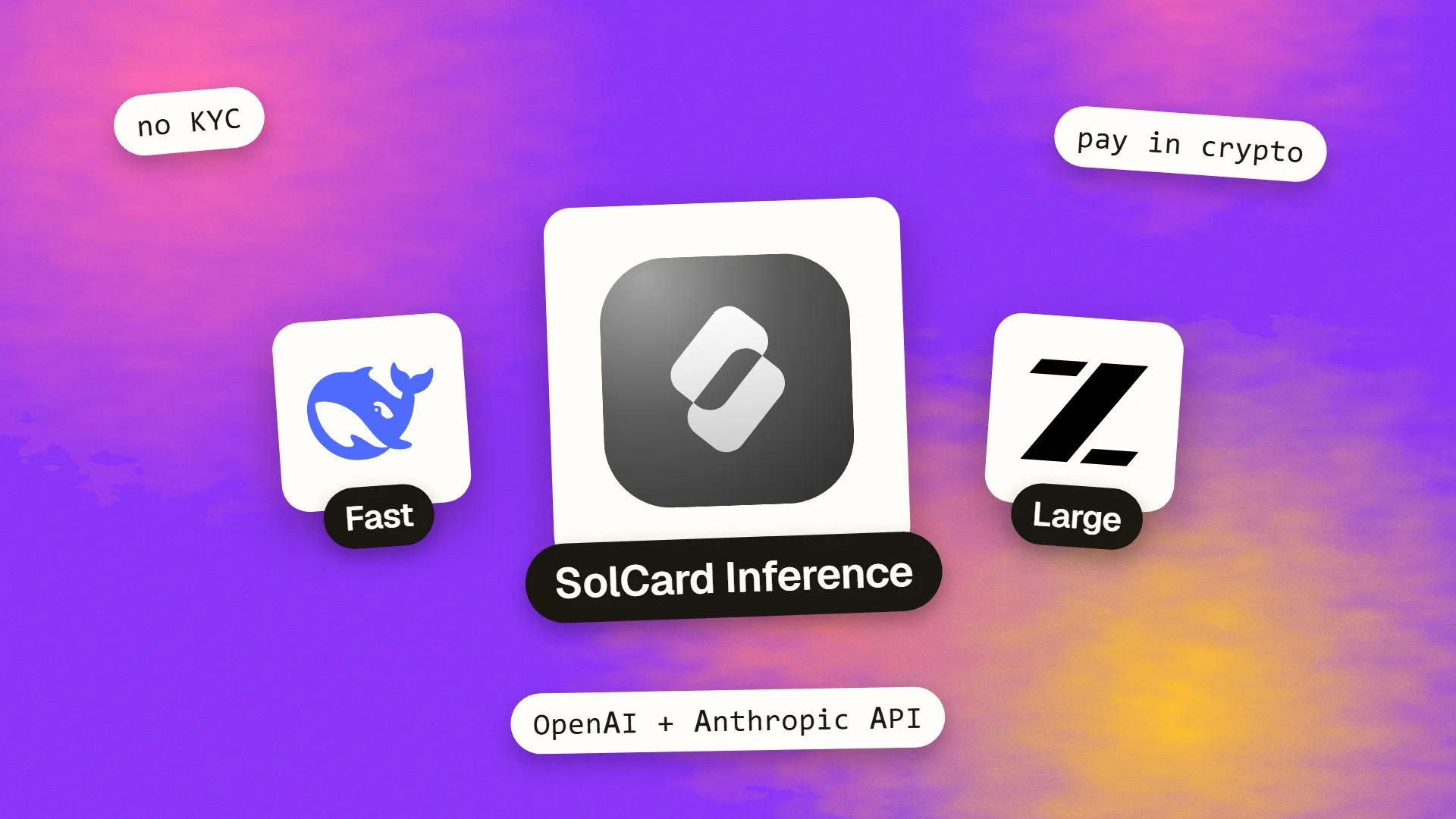
SolCard Inference, launched in late October 2026 by Hong Kong-based SC PAYMENTS LIMITED, is a private AI API and chat app built on open-weight models: solcard-inference-large runs Z.ai's GLM-5.3 and solcard-inference-fast runs DeepSeek V4.1 Flash, served without sending prompts to those labs. It speaks the OpenAI and Anthropic APIs, installs into Claude Code or Codex with one sentence, needs no KYC, and is paid in crypto or from a SolCard balance. Prices run from $1.25/$2.50 per million input/output tokens (Fast) to $3.75/$6.25 (Large), or plans from $20 a month. The trade-offs: output is capped at 32,768 tokens, input is text only, an unpublished usage policy still blocks some requests, the no-log promise has no published data-handling terms or attestation yet, and cached input on Fast costs roughly 17 to 40 times what DeepSeek and Venice charge.
What SolCard Inference is
SolCard Inference is a private AI service for chat and code, launched at the end of October 2026 by the company behind the SolCard crypto card. You can use it two ways: a chat app at app.solcardinference.ai, or an API that speaks both OpenAI's and Anthropic's request formats. That second part matters more than it sounds. It means Claude Code, Codex and almost every SDK or tool built for those two vendors can be pointed at it by changing a base URL.
The company sums it up in four words: "Answers everything. Keeps nothing." The pitch rests on three promises, and the rest of this article checks each one against the company's own documentation:
- It does not refuse legitimate work. Prompts that mainstream assistants turn down, like reproducing a disclosed CVE in a lab or writing detections for a malware sample, are meant to just run.
- It keeps no record of what you send. "Nothing you send is logged," the site says, along with "0 copies kept", "0 eyes on your prompts" and "0 prompts trained on."
- You pay in crypto and skip identity checks. You sign in with a wallet or an email address, top up with crypto or spend straight from a SolCard balance, and there is no KYC.
Behind the brand are open-weight models from two Chinese labs, Z.ai's GLM-5.3 and DeepSeek's V4.1 Flash. SolCard serves them itself rather than forwarding your prompts to those labs. The operator is SC PAYMENTS LIMITED, a Hong Kong company (business registration 78350827). It is the same entity that runs the SolCard card.
Why a crypto card company is selling AI
This looks like a strange move until you see who SolCard already sells to. Its blog is largely made up of guides to paying for AI tools with crypto: Claude, ChatGPT, Cursor, OpenRouter, Venice, DeepSeek, Kimi and more. It also launched a dedicated "Virtual for AI & Ad Spend" card because, by its own numbers, prepaid cards often fail at AI checkouts. In its own payment data, about four in five Anthropic charges on that card succeed.
So the customer base already spends crypto on AI subscriptions and API credits. Selling the inference directly removes the card from the middle: no checkout to fail, no card on file, and the balance you already hold pays the bill. The privacy and "no refusals" positioning is how it competes with the providers those customers were already paying.
The models, and what they are built on
SolCard Inference exposes four model IDs. The names are SolCard's own, but three of the four say plainly what they run.
| Model ID | Built on | Context window | What it is for |
|---|---|---|---|
| solcard-inference-fast | DeepSeek V4.1 Flash | 1,048,576 tokens | The default: fastest and cheapest. Reasoning off unless you ask for it. |
| solcard-inference-large | GLM-5.3 (Z.ai) | 1,000,000 tokens | The most capable. Always reasons. |
| solcard-inference-base | Not disclosed | 262,144 tokens | "General purpose." SolCard does not publish the underlying model. |
| solcard-inference-large-legacy | GLM-5.2 (Z.ai) | 1,000,000 tokens | The previous Large, kept for compatibility. |
Both named base models are serious. Artificial Analysis gives GLM-5.3 (Max) a score of 32 on its Intelligence Index v5.0, second of 22 models in its class. It is a 753-billion-parameter mixture-of-experts model with 40 billion parameters active per token, released on 18 August 2026. DeepSeek V4.1 Flash shipped on 10 September 2026, with a refresh (the -1017 build) on 17 October. It is DeepSeek's cheap, fast tier. SolCard's landing page puts it at 32 on the same index as well. Treat that figure with some caution until Artificial Analysis lists it on its own model page.
Three limits apply to every model, and none of them is on the landing page:
- Output is capped at 32,768 tokens per request. That cap is far below what the base models allow upstream (128K for GLM-5.3, 384K for DeepSeek V4.1 Flash). Long one-shot generations, such as a full file rewrite or a large dataset in a single reply, have to be split up.
- Input is text only. Images, audio and files return
400 unsupported_content, even though DeepSeek's own API accepts images on V4.1 Flash. - Agents see a smaller window. The model list reports a 256,000-token context window to coding agents. SolCard says that is deliberate, "so long sessions stay affordable", while the full window stays available to direct API calls.
The company's line on the labs is this: "Your prompts never reach the labs behind them." In other words, SolCard runs the open weights on infrastructure it controls or rents, instead of calling Z.ai's or DeepSeek's hosted APIs. Where that infrastructure is, and who operates it, is not published. We come back to that below.
What "answers everything" actually means
The landing page makes its case with three side-by-side examples. Each one is a prompt that "your LLM" refused and SolCard Inference completed:
- Security research: "Reproduce the disclosed CVE in a sandboxed lab so I can confirm our patch holds."
- Malware analysis for defense: "Break down this sample and write detections for it." The answer comes back with YARA rules, Sigma detections and an IOC list.
- Hardening a safety classifier: "Generate 500 hard adversarial examples to stress-test our moderation model."
A fourth section covers training data: labelled and synthetic datasets, "including the sensitive cases a filtered model refuses to write." Its example is 10,000 support conversations covering refund fraud and chargeback abuse, exported as JSONL.
These are real frustrations. Every security team, trust-and-safety team and ML team that has used a mainstream assistant has hit a refusal that was a filter misfiring rather than a judgment about them. The work was legitimate, and the model could not tell. A model that runs those tasks is genuinely useful to them.
"Answers everything" is still not literally true, and the documentation says so. The API's error reference includes 403 content_policy_violation, defined as "The request is outside the usage policy." So a usage policy exists and some requests will be rejected. As of 31 October 2026, though, SolCard has not published what that policy covers. The honest reading is "far fewer refusals than a consumer assistant, aimed at professional work", not "anything goes." If your use case sits near a line, ask SolCard where the line is before you build on it.
What "keeps nothing" actually means
The privacy claim on the landing page is absolute: "Your prompt is answered, then dropped. Nothing you send is logged, so there's nothing to leak or sell." The FAQ adds that requests on every model are "not stored. Never read by a person. Never trained on."
That is the right promise for this market, and it may be entirely true. It is also, as of 31 October 2026, a promise and nothing more. There are three things worth knowing:
- There is no data-handling document yet. The footer link labelled "Data handling" points back to the top of the page, as do "Docs" and "Status." The terms SolCard links to are the card's Terms of Service, not inference-specific terms.
- The hosting is undisclosed. "Your prompts never reach the labs behind them" tells you who does not see your prompts. It does not tell you who runs the GPUs that do, or in which jurisdiction.
- There is no attestation. Some competitors now run models inside trusted execution environments (TEEs) and let your client verify cryptographically that the code running is the code they claim. Venice, for example, offers TEE and end-to-end encrypted variants of some models. SolCard offers nothing comparable yet, so "no logs" rests on trusting the operator.
Two practical points follow. First, a no-log policy is only as strong as the operator's incentives and jurisdiction. Weigh it the way you would weigh a VPN's no-log claim. Second, your own tooling may log what the provider does not. Claude Code and Codex keep local session history, and their vendors' telemetry rules still apply to the tool itself. Pointing the model at SolCard changes who serves the tokens, not what the rest of your stack records. Our piece on whether it is safe to send customer data to an LLM covers the wider checklist.
Pricing, with the numbers worked out
SolCard Inference has two ways to pay: a prepaid balance billed per token, or a monthly plan. Both reach every model.
Pay as you go
| Model | Input / 1M tokens | Cached input / 1M | Output / 1M |
|---|---|---|---|
| Fast | $1.25 | $0.125 | $2.50 |
| Large | $3.75 | $0.375 | $6.25 |
| Base | $1.25 | $0.125 | $3.75 |
| Large (legacy) | $3.75 | $0.375 | $6.25 |
Reasoning tokens bill as output, and Large always reasons. Web search costs $0.008 per search on top of the tokens its results add. Top-ups can be any amount and never expire. According to SolCard's install instructions, new accounts start with $1 of free credit.
Before each request runs, SolCard places a hold on your balance big enough for the request's input plus its maximum possible output. When the request finishes it charges what was actually used and releases the rest. If your balance cannot cover your max_tokens, the service quietly lowers the output limit to what you can afford instead of failing. That is useful, but it can surprise you with a truncated answer.
Monthly plans
| Plan | Price | Usage | Requests / min | Concurrent | Usage per 5-hour window* |
|---|---|---|---|---|---|
| Pay as you go | — | What you top up | 60 | 5 | — |
| Starter | $20/mo | 20% more than $20 PAYG (≈$24) | 120 | 8 | ≈$1.20 |
| Pro | $100/mo | 5× Starter (≈$120) | 300 | 10 | ≈$6 |
| Max | $200/mo | 10× Starter, "25% more" (≈$240–250) | 600 | 16 | ≈$12 |
*Our calculation. The docs say each 5-hour window holds a twentieth of the month's usage, and the weekly limit holds "a little under a quarter."
The last column is the one to read twice. A plan does not give you its whole month whenever you want it. On Starter, each five-hour window holds roughly $1.20 of pay-as-you-go-priced usage. Once that is spent, chat falls back to "extra usage" paid from your balance (you can cap it or turn it off), and API calls fall back to your credits. Unused usage does not roll over, renewals are charged from your balance, and nothing is refunded. Plans make sense if you chat daily and steadily. They make less sense if you work in occasional heavy bursts.
What a coding session costs
Coding agents resend the whole conversation on every turn, so most of their input is cached. To make the prices concrete, take a mid-sized agent session. Assume 40 turns, each carrying about 55,000 cached tokens, 5,000 new input tokens and 1,500 output tokens. All rates are as published on 31 October 2026.
| Where the model runs | Cost per turn | 40-turn session |
|---|---|---|
| SolCard Inference Large (GLM-5.3) | $0.049 | $1.95 + reasoning tokens |
| SolCard Inference Fast (DeepSeek V4.1 Flash) | $0.017 | $0.68 |
| Venice, GLM-5.3 ("Private" label) | $0.035 | $1.40 |
| Venice, DeepSeek V4.1 Flash ("Private") | $0.0037 | $0.15 |
| DeepSeek's own API, V4.1 Flash (peak rate) | $0.0036 | $0.15 |
| Z.ai's own API, GLM-5.3 | $0.028 | $1.12 |
Two conclusions follow. On GLM-5.3, SolCard's Large carries a moderate premium: about 40% more than Venice's private hosting of the same model, and about 75% more than Z.ai's own API. On DeepSeek V4.1 Flash, SolCard's Fast costs about four to five times what Venice or DeepSeek charge, almost entirely because of the cached-input rate. SolCard charges $0.125 per million cached tokens, against $0.0075 at Venice and $0.003–0.006 at DeepSeek, and cached tokens are most of what a coding agent sends. If you route heavy agent work through Fast, that premium is the one that adds up. Our guide to controlling AI API costs explains how to measure it on your own traffic.
Paying without KYC
According to the FAQ, signing up needs a wallet or an email address and no identity check. The landing page says you can pay with "SOL, USDC, ETH, BTC and more, on 9+ networks", or spend directly from a SolCard card balance. The developer docs are narrower: they describe topping up by sending USDC on Solana to your deposit address on the dashboard's Top up page. Until the two agree, assume USDC on Solana is the dependable route and that other assets may be converted first.
Do not confuse "no KYC" with anonymity. SolCard's own About page says, about the card business: "We do not offer an anonymous or untraceable product." On-chain payments are public and traceable to the wallet that sent them. What the inference product skips is identity verification. It is not a promise that your usage cannot be linked to you. If you hold a Platinum SolCard, which does require KYC, and pay from that balance, your inference account is tied to a verified identity anyway.
Using it from Claude Code, Codex and SDKs
The integration is the most polished part of the launch. For Claude Code or Codex, you paste one sentence into the tool:
Add SolCard Inference to my models: solcardinference.ai/installThat page is not a script. It points the agent to a step-by-step runbook (api.solcardinference.ai/install/claude-code, or /codex) that the agent reads and carries out, asking you once before it starts. We read both runbooks in full. The design is more careful than a one-line install suggests, and it does something you should understand before agreeing to it.
Your existing models stay. The installer does not replace Claude or ChatGPT. It downloads CLIProxyAPI, an open-source routing proxy, and refuses the download unless its SHA-256 checksum matches a pinned value. Claude Code gets the upstream 8.0.46 release. Codex gets SolCard's fork, 8.0.46-solcard.2, published at github.com/SolCardDev. The proxy runs as a background service that listens only on 127.0.0.1 behind a key generated on your machine, and it starts at login (systemd on Linux, launchd on macOS, a Startup-apps entry on Windows). Requests for solcard-inference-* models go to SolCard with your SolCard key. Everything else goes to Anthropic or ChatGPT unchanged.
Your Claude or ChatGPT login passes through the proxy. For those models, the proxy forwards the Authorization header your tool already sends, so they keep running on your own subscription. SolCard's runbooks say the proxy never stores, copies or refreshes that login and that request logging is off. The proxy is open source and runs on your own machine, so this is checkable, which the server-side "no logs" claim is not.
What changes on disk. - Claude Code: your shell profile gains ANTHROPIC_BASE_URL pointing at the local proxy. ~/.claude/settings.json gains four model-picker rows and a SessionStart hook that starts the proxy if it isn't running. Your default model is left alone. - Codex: the proxy becomes Codex's model provider, after the installer backs up config.toml.
What stops working. - Claude Code: Remote Control is unavailable while the proxy is set up. The desktop app's Code tab and Cowork don't pick it up at all, because the setup only reaches Claude Code started from a terminal. - Codex: it needs a ChatGPT login (not an API key), and the ChatGPT app turns Apps (connectors) off while SolCard is set up.
Approval happens in the browser: you sign in at app.solcardinference.ai, confirm a code and click Approve, and the agent collects the key without printing it. To undo everything, ask the agent to "remove SolCard Inference from my models".
One caution sits outside SolCard's control. Anthropic's own documentation says it "doesn't support routing Claude Code to non-Claude models through any gateway". It works, but if a Claude Code update breaks the proxy route, Anthropic support won't help. Our Claude Code and Codex guides show where those settings files live if you'd rather check them yourself.
For your own code, it is a base-URL swap:
from openai import OpenAI
client = OpenAI(base_url="https://api.solcardinference.ai/v1", api_key="sk-si-...")
reply = client.chat.completions.create(
    model="solcard-inference-fast",
    messages=[{"role": "user", "content": "Summarise this changelog."}],
)
With the Anthropic SDK, drop the /v1. That SDK appends /v1/messages itself, so its base URL is https://api.solcardinference.ai. Endpoints for Chat Completions, Responses, Messages and a free count_tokens call are all supported. So are streaming, function calling, JSON-schema structured output, reasoning effort and web search (Chat Completions only). Hosted tools such as a code interpreter are not, and neither are previous_response_id, n > 1 or non-text input. The full setup, error codes and rate limits are in our SolCard Inference guide.
How it compares
| SolCard Inference | Venice API | OpenRouter | DeepSeek / Z.ai direct | |
|---|---|---|---|---|
| Models | 4 (GLM-5.3, DeepSeek V4.1 Flash, GLM-5.2, undisclosed) | Dozens, incl. the same GLM and DeepSeek builds plus its own uncensored models | Hundreds, many providers | The lab's own models |
| Refusal stance | "No refusals" for legitimate work; unpublished usage policy | Dedicated "Uncensored" models | Varies by model and provider | The lab's own moderation |
| Privacy evidence | Marketing claim; no data-handling page yet | Per-model labels (Private / Anonymized) defined in docs; TEE and E2EE options | Depends on the provider you route to | The lab's own policies; data processed in its jurisdiction |
| KYC | None (wallet or email) | Account required | Account required | Account required |
| Crypto payment | Yes, plus SolCard balance | Yes, at USD rates; DIEM staking | Yes | No |
| Claude Code / Codex install | One sentence | Manual config | Manual config | Manual config |
Its closest rival is Venice, which sells a near-identical idea: private inference, uncensored models, crypto payment. Venice is cheaper on both shared models (modestly on GLM-5.3, several times over on DeepSeek V4.1 Flash) and publishes far more about how it handles data. SolCard's advantages are the no-KYC sign-up, paying straight from a SolCard balance, and an install that takes a coding agent across in one step.
Who should use it, and who should not
It is a good fit if you hold crypto or already use SolCard, you want a capable model with far fewer refusals for security, safety or data-generation work, and you want it inside Claude Code or Codex without hand-editing config. On Large, the premium over other GLM-5.3 hosts is modest enough that convenience and the payment route can reasonably decide it.
Look elsewhere if you need documented, verifiable privacy guarantees for regulated data. Until SolCard publishes data-handling terms and hosting details, a provider with written policies or TEE attestation is the safer choice. The same applies if your workload is cost-sensitive and runs mostly on the fast tier, where DeepSeek direct or Venice is several times cheaper. You also need something else for image or file input, or single responses longer than 32,768 tokens.
Before you commit, put three questions to support@solcardinference.ai: what the usage policy behind content_policy_violation covers, where the models are hosted, and which crypto assets the top-up page actually accepts. A launch-week product will change quickly, and those answers will tell you more than the landing page does.
Common questions
What is SolCard Inference?
A private AI service for chat and code from the company behind the SolCard crypto card, launched in late October 2026. It offers a chat app and an API compatible with both OpenAI and Anthropic SDKs, runs open-weight models (GLM-5.3 and DeepSeek V4.1 Flash among them), says it logs nothing you send, aims to answer prompts mainstream models refuse, and takes payment in crypto with no identity verification.
Which models does SolCard Inference use?
Four, as of 31 October 2026: solcard-inference-fast (built on DeepSeek V4.1 Flash, 1,048,576-token context), solcard-inference-large (built on GLM-5.3, 1,000,000 tokens, always reasons), solcard-inference-base (262,144 tokens, underlying model not disclosed) and solcard-inference-large-legacy (GLM-5.2). Every model caps output at 32,768 tokens per request and accepts text only.
Does SolCard Inference really have no refusals?
Not literally. It is positioned to complete legitimate work that filtered assistants block, such as reproducing a disclosed CVE in a lab, analysing malware to write detections, or generating adversarial test data. But its API documents a 403 content_policy_violation error for requests 'outside the usage policy', and that policy has not been published. Expect far fewer refusals, not none.
Is SolCard Inference private?
SolCard says prompts are never logged, never read by a person and never trained on, and that they never reach Z.ai or DeepSeek. As of 31 October 2026 there is no published data-handling document, no disclosure of where the models are hosted, and no attestation such as a trusted execution environment, so the claim rests on trusting the operator, SC PAYMENTS LIMITED in Hong Kong.
How much does SolCard Inference cost?
Pay as you go: $1.25 input, $0.125 cached input and $2.50 output per million tokens on Fast; $3.75, $0.375 and $6.25 on Large. Web search adds $0.008 per search. Plans are $20 (Starter), $100 (Pro) and $200 (Max) a month, each giving 20 to 25% more usage than the same money on pay as you go, but split into 5-hour and weekly limits, with no rollover and no refunds.
Do I need KYC to use SolCard Inference?
No. You sign up with a crypto wallet or an email address. That is not the same as anonymity: on-chain payments are traceable to the sending wallet, and if you pay from a Platinum SolCard balance, that account has already been identity-verified.
How do I use SolCard Inference in Claude Code or Codex?
Paste 'Add SolCard Inference to my models: solcardinference.ai/install' into a terminal session of Claude Code or the Codex CLI. The agent follows SolCard's runbook: it asks once, installs a checksum-verified open-source proxy (CLIProxyAPI) that runs only on your machine, has you approve SolCard in the browser, and adds the four SolCard models below your existing Claude or ChatGPT models, which keep running on your own login. Ask it to 'remove SolCard Inference from my models' to undo it.
Is SolCard Inference cheaper than Venice or DeepSeek?
No. On GLM-5.3, a typical 40-turn coding session costs about $1.95 on SolCard Large versus about $1.40 on Venice and $1.12 on Z.ai's own API. On DeepSeek V4.1 Flash the gap is wider: about $0.68 on SolCard Fast versus about $0.15 on Venice or DeepSeek, mostly because SolCard charges $0.125 per million cached tokens. You pay the premium for no KYC, SolCard-balance payment and the one-step agent install.
