In short
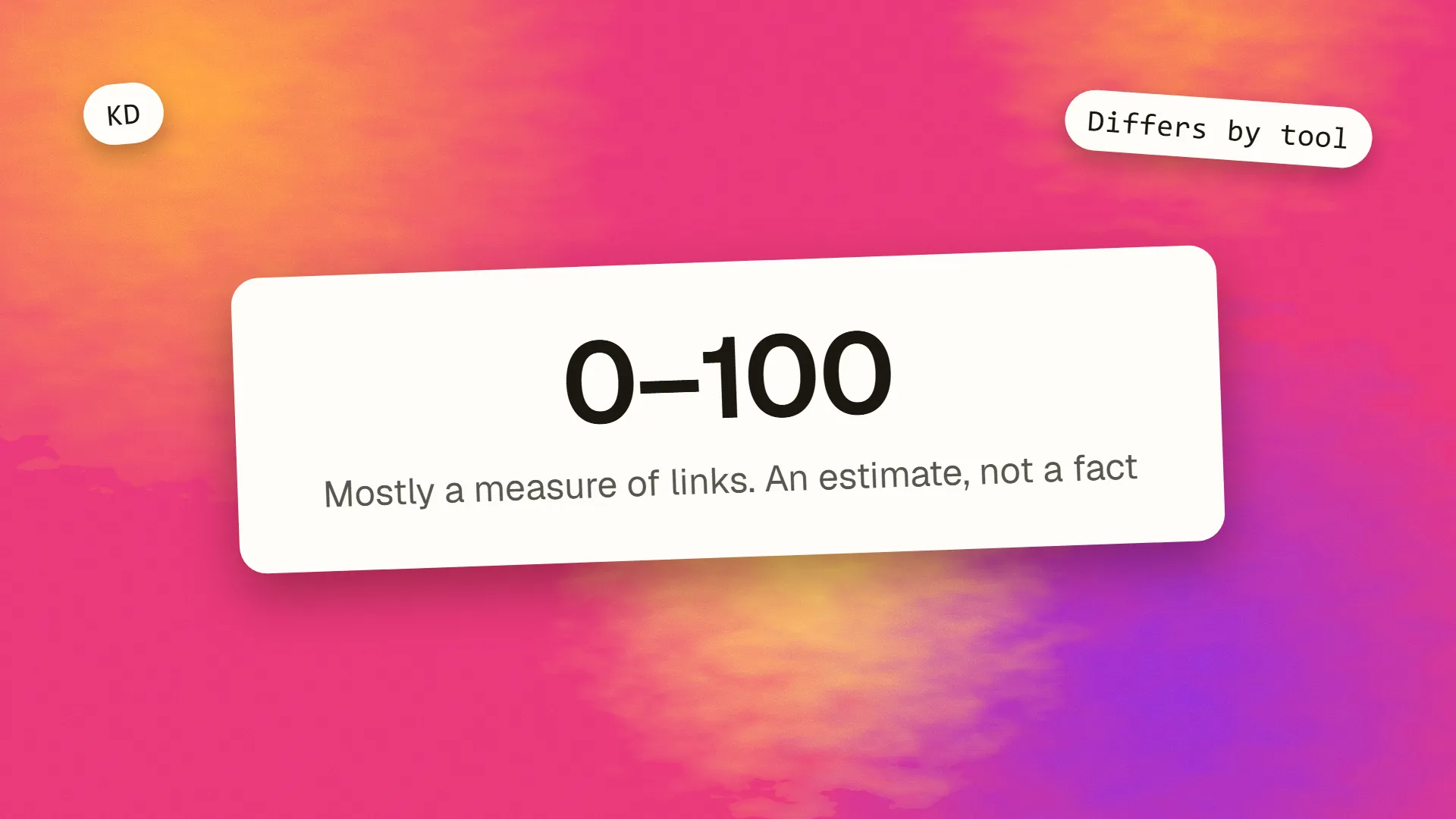
Keyword difficulty is a score, usually 0 to 100, that SEO tools assign to a search term to estimate how hard it would be to rank on the first page, calculated mainly from the number and strength of links pointing to the pages currently ranking, sometimes with adjustments for search features and content signals. It is a rough relative indicator: a term scored 80 is harder than one scored 20. It ignores whether the ranking pages actually match the intent, how good they are, and what your own site brings, so it is best used to sort candidates and then checked by reading the results page.
What the score is made of
Each tool has its own formula, but the core is the same: look at the pages ranking on the first page for the term, measure the links pointing to them and to their domains, and express the result as a difficulty. Ahrefs' Keyword Difficulty is explicitly based on the number of referring domains to the top results. Semrush's blends link authority with SERP features, search volume and other factors. Moz's uses its page and domain authority metrics. All of them are, at heart, a summary of how well-linked the incumbents are.
That makes the score a measure of one ranking factor, links, as seen through one tool's index of the web. It is a useful approximation of competition and a poor description of it.
Strength of those links
Content quality
Your own site's strength
Topical relevance of the links
What it misses
Intent. A term may be scored as difficult because strong sites rank for it, while those sites answer a slightly different question. If the results are all definitions and the searcher wants a comparison, the intent is unserved and the difficulty score is irrelevant; a page that matches intent can rank above stronger pages that do not.
Content quality. Ten weak, dated, generic pages from strong domains score as difficult and are beatable by a genuinely good page. Ten excellent pages from modest domains score as easy and are not.
Your own site. Difficulty is absolute; ranking is relative. A term scored 50 is achievable for a site with topical authority in the subject and out of reach for a site with none. The score does not know who is asking.
Topical relevance of the links. Tools count links; Google weighs their relevance. A page with many links from unrelated sites looks strong in a tool and less so to Google.
SERP features and AI answers. A term may be easy to rank for and worthless to rank for, because the answer appears in an AI Overview and nobody clicks. Some tools now flag this; most difficulty scores do not.
Freshness and locality. Queries where Google favours recent content or local results behave differently from what a static link-based score suggests.
Why tools disagree
Each has its own crawl of the web, its own link index, its own way of weighting links, and its own adjustments. The same term can be 35 in one tool and 60 in another, and both are internally consistent. The scores are comparable within a tool, not across tools, and the sensible use is ordinal: this term is harder than that one, according to this index.
All of them are also estimates of the past. The score reflects the results page as last crawled; a core update or a new competitor changes the reality before the score.
Judging difficulty yourself
The results page is the primary source, and reading it takes two minutes:
- Who ranks? Major brands and established specialists, or a mix including small sites, forums and thin pages? A page one with any weak entries is a page one with room.
- What ranks? The format and depth of the results. If every result is a 3,000-word guide, that is the bar; if they are 400-word pages, a better answer wins.
- How well do they match the intent? Read the top three as the searcher would. If they are off, the opportunity is large regardless of their links.
- How old are they? Dated content on a moving topic is vulnerable.
- What features appear? An AI Overview, a featured snippet, a map pack, shopping results. These decide how much traffic position one actually receives.
- How does your site compare on subject coverage and links? Honestly.
A term where the results are weak, mismatched or dated is a good target whatever the score; a term where they are strong, excellent and current is a long project whatever the score.
Using the score properly
Sort a long list of candidate terms by difficulty to separate the plausible from the implausible for your site's current strength. Then read the results page for each plausible one and decide. Prioritise terms with real intent for your business over terms with attractive scores. Track rankings for the terms you chose and let the outcomes calibrate your sense of what the tool's scores mean for your site, since a site that ranks for its 40s can try its 50s.
Difficulty scores belong alongside volume estimates as tool outputs to be respected and not believed. The results page is the truth, and it is free. If you would like a candidate list sorted and read against the actual results, book a call.
Common questions
How is keyword difficulty calculated?
Mainly from the links pointing to the pages currently ranking on the first page for the term, summarised into a 0 to 100 score, with some tools adding adjustments for search features, volume and content signals. Each tool uses its own link index and formula, so the same term scores differently across tools.
What is a good keyword difficulty score to target?
It depends on your site's strength. New and small sites usually succeed with terms in the lower range of their tool's scale, roughly under 30; sites with established authority in a subject can target higher. More useful than the number is reading the results page: weak, mismatched or dated results are beatable whatever the score.
Why do keyword difficulty scores differ between Ahrefs, Semrush and Moz?
Because each tool has its own crawl of the web, its own link index and its own formula and weightings. The scores are consistent within a tool and not comparable across tools. Use them to rank terms relative to each other in one tool, not as absolute measures.
Is keyword difficulty accurate?
As a rough relative indicator of how well-linked the current top results are, reasonably. As a prediction of whether you can rank, poorly, because it ignores intent match, content quality, your own site's authority in the subject, link relevance, and whether the query now resolves in an AI answer. Check every promising term against the actual results page.
Can you rank for high-difficulty keywords?
Yes, when the ranking pages fail to match the intent, are thin or dated, or when your site has strong topical authority in the subject. Difficulty measures the incumbents' links, not their quality or relevance. It is a longer project than a low-difficulty term, and it usually starts by winning the related long-tail queries first.