In short
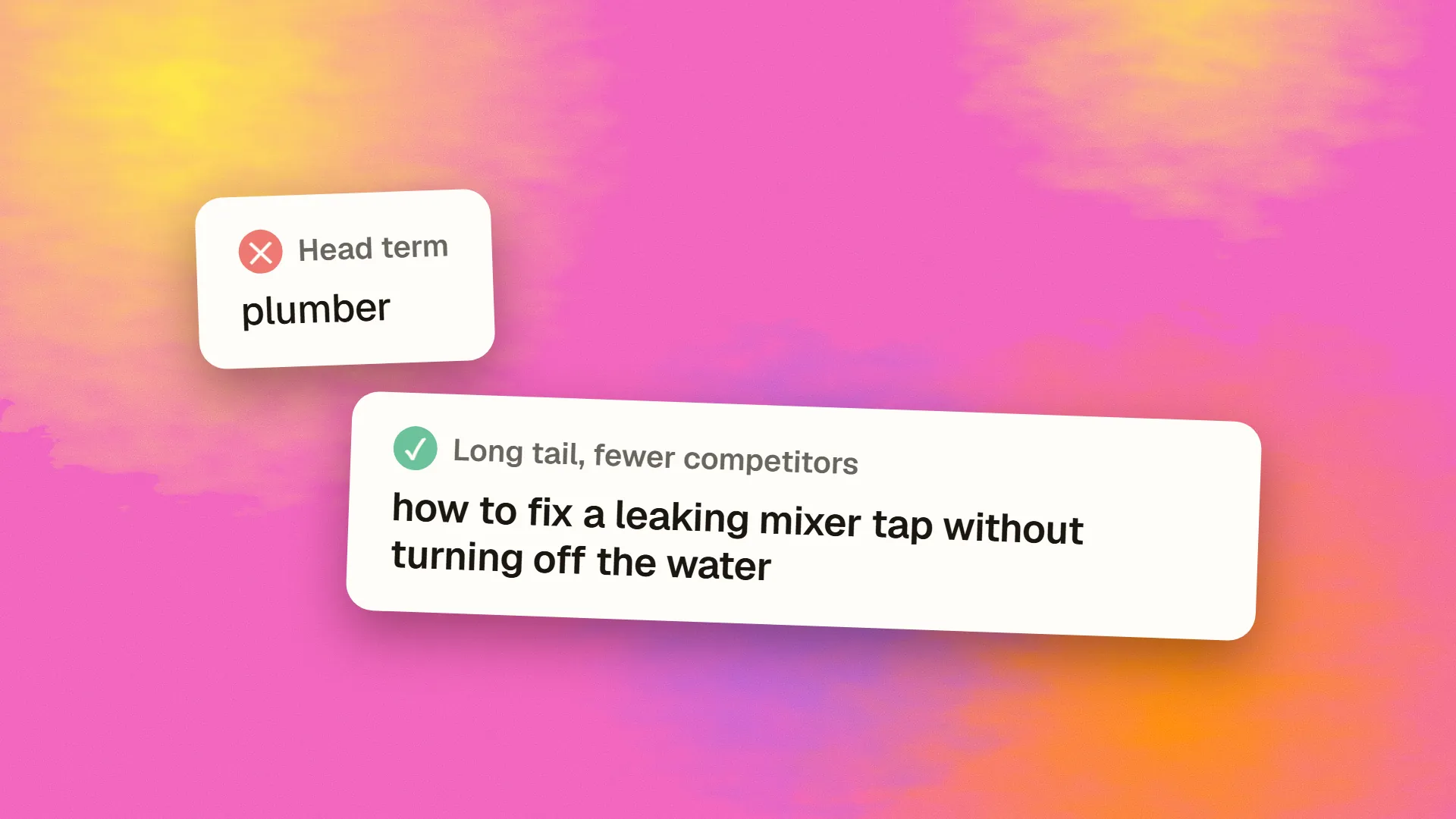
A long-tail keyword is a longer, more specific search query with low individual search volume, such as 'how to fix a leaking mixer tap without turning off the water' rather than 'plumber'. They are easier to rank for because fewer pages target them and the intent is explicit, so a page that answers the exact question can win quickly; they convert better because the searcher has already narrowed what they want. Collectively they account for the majority of all searches, and AI assistants and voice search have made queries longer still. Find them in People Also Ask, autocomplete, Search Console and customer questions, and answer each on a page or section built for it.
Where the term comes from
Plot every search query by how often it is made, most frequent on the left, and the curve is a steep head followed by a long, flat tail. The head is a few thousand short, generic queries with enormous volume: "hotels", "insurance", "web design". The tail is hundreds of millions of specific queries, each searched a handful of times a month: "boutique hotel near Prishtina old town with parking". The term "long tail" was borrowed from the business writer Chris Anderson's 2004 description of niche demand, and it stuck because the shape is exact.
The arithmetic that matters: the tail, added up, is larger than the head. Google has said that around 15% of the queries it sees each day have never been seen before. Most searching is specific.
Why long-tail queries are easier
Less competition. A head term is targeted by every site in the category, and the top results are established pages with years of links. A specific query is targeted by few pages, sometimes none, and a good page can rank for it within weeks rather than months.
Explicit intent. "Web design" could mean a job, a course, an agency or a definition; matching it is guesswork. "How much does a five-page website cost for a small business" states exactly what the searcher wants, and a page that answers it matches perfectly. Search intent is the whole game, and long-tail queries announce theirs.
Lower authority needed. Because the competing pages are weaker and the match is closer, a newer or smaller site can win a long-tail query on relevance alone, which is how such sites earn their first traffic and their first topical authority.
Why they convert better
A searcher who types a head term is early: exploring, comparing, or just curious. A searcher who types a long-tail query has done the exploring and knows what they want: a specific product, a specific answer, a specific service in a specific place. They arrive closer to a decision, and pages that answer their query convert at multiples of the rate head-term traffic does. Ten long-tail pages bringing fifty visitors a month each often produce more enquiries than one head-term ranking bringing five hundred.
What AI search changed
People ask assistants and AI search modes in full sentences with context: not "CRM", but "which CRM suits a three-person consultancy that bills hourly and uses Google Workspace". Queries have lengthened, and answer engines retrieve and cite pages that address specific questions specifically. The long tail was always where the opportunity lay for smaller sites; AI made it where the retrieval happens for everyone. A page written to answer one precise question is now the unit that gets cited, not the broad page that ranks for the head term.
Finding long-tail keywords
People Also Ask and autocomplete, which show the specific questions and phrasings Google sees often enough to suggest.
Search Console, whose query report for any page lists the long-tail phrasings it already appears for, most of which nobody targeted; these are the cheapest wins on any site.
Customer questions: support tickets, sales calls, emails, the phone. Every recurring question is a long-tail query someone else is typing.
Forums and communities in the field, where people ask in their own words.
Keyword tools, with the caveat that their volume estimates are least reliable exactly in the tail; a reported zero often means real but unmeasured.
Your own site search, which records what visitors could not find.
Using them
Do not build one page per phrasing. Long-tail queries cluster around questions, and one page that answers a question well ranks for all its phrasings. Group the queries by intent, write one thorough answer per group with the primary phrasing as the heading, and cover the related sub-questions as sections. A page about "how much does a small business website cost" naturally ranks for dozens of long-tail variants about pages, features, timelines and platforms, because it answers them.
The pages should be specific, direct, and written by someone who knows the answer, which is the format that ranks, converts and gets cited. Scale comes from the number of real questions answered, not from the number of phrasings stuffed into each page, and it is the honest version of what programmatic approaches fake.
The practical programme
List the fifty questions customers actually ask. Check each in autocomplete and People Also Ask for phrasings. Group into pages. Write them, one thorough answer each. Watch Search Console for the phrasings that arrive, and extend the pages toward the ones nearly ranking. Repeat quarterly. This is the long-tail strategy in full, and for most small and medium sites it is the strategy that works. If you would like the question list built and grouped, book a call.
Common questions
What is an example of a long-tail keyword?
'How much does a five-page website cost for a small business' is long-tail; 'website cost' is a head term. Long-tail queries are longer, more specific and lower in individual volume, and they state the searcher's intent explicitly. Others: 'accountant for freelance designers in Manchester', 'fix leaking mixer tap without turning off water'.
Why are long-tail keywords easier to rank for?
Fewer pages target them, so the competition is weaker; their intent is explicit, so a page that answers the exact question matches closely; and relevance can outweigh authority, so newer and smaller sites can win them. A well-written answer to a specific question often ranks within weeks rather than months.
Do long-tail keywords have enough search volume to be worth it?
Individually little, collectively the majority of all searches. A single long-tail page may bring a few dozen visitors a month, but they arrive close to a decision and convert at far higher rates than head-term traffic, and a site answering many specific questions builds the topical authority that eventually wins broader terms too.
How do I find long-tail keywords for free?
Google's People Also Ask boxes and autocomplete suggestions, the query report in Search Console for pages you already have, questions from customers in support and sales conversations, forums in your field, and your own site's search logs. Keyword tools are least accurate in the tail, so treat a reported zero as unmeasured rather than absent.
Should I create a separate page for each long-tail keyword?
No. Group long-tail phrasings by the question they express and write one thorough page per question; it will rank for all the variants because it answers them. Separate pages for near-identical phrasings compete with each other and produce the thin, templated content Google penalises.