In short
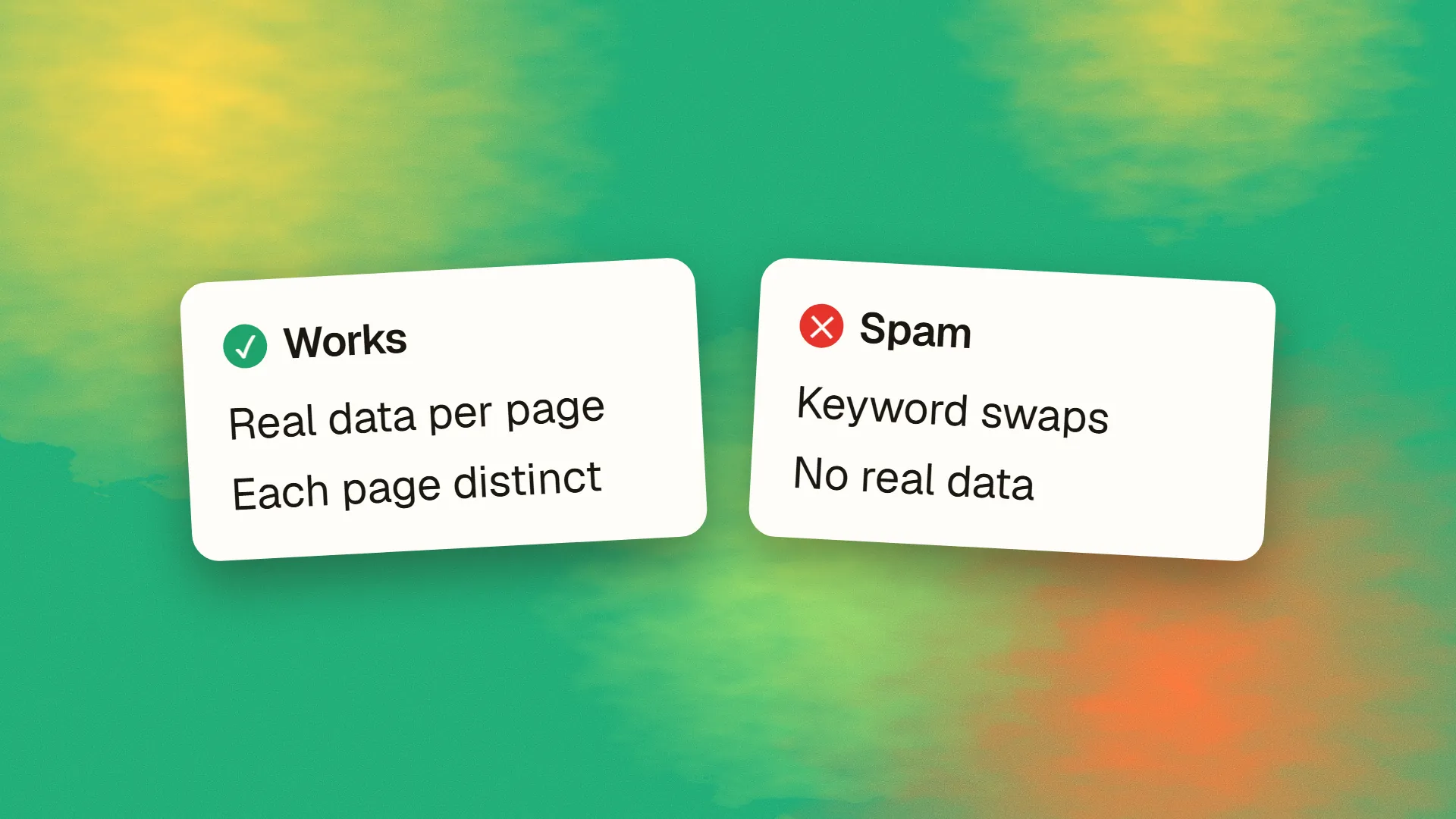
Programmatic SEO is the practice of generating large numbers of pages automatically from a template and a structured dataset, each targeting a specific query variant, such as a page per city, per product comparison or per data point. It works when each page presents real, distinct, useful data that a searcher wants, as on travel, property, weather and directory sites. It is spam, and now explicitly covered by Google's scaled content abuse policy, when the pages are template text with a keyword swapped in, offering nothing a searcher could not get from one page. The test is whether each page would be worth publishing on its own.
What it is
Most content is written one page at a time. Programmatic SEO produces pages by code: define a template, connect a dataset, and generate one page per row. A property site has a page for every neighbourhood with its listings and prices; a travel site a page for every route with its times and fares; a software directory a page for every integration pair; a weather service a page for every town. Tens of thousands of pages, each targeting a specific query nobody would write a page for by hand, each populated from data.
The canonical examples, Zillow, Tripadvisor, Yelp, Wise's currency pages, Zapier's integration pages, are among the largest search properties on the web, and they are programmatic. The approach is legitimate at its core. The trouble is that the same mechanics produce the largest category of spam on the web, and the difference is not always visible from the template.
What makes it work
The successful programmatic sites share properties:
Real data per page. Each page shows something specific and true about its subject: prices, availability, ratings, measurements, listings. The data is the content; the template is the frame.
Distinct value per page. A searcher for one town's weather wants that town's weather. The page for the next town is genuinely different because the data is.
A dataset that is hard to get. Aggregated, licensed, collected or computed data that a searcher could not assemble themselves.
Demand for each variant. The long-tail queries exist, in the aggregate volume that justifies the pages.
Quality control at scale. Pages with missing or thin data are suppressed rather than published; templates handle edge cases; the site is crawled and monitored like any other.
Where it becomes spam
Google's March 2024 spam policy update added scaled content abuse: generating many pages for the purpose of manipulating rankings without adding value for users, regardless of whether humans, automation or AI produced them. Programmatic sites are the archetype, and the pattern is recognisable:
Keyword-swap templates. "Best [service] in [city]" pages with identical text and the city name substituted, no local data, no local content. A thousand pages that are one page.
Thin or absent data. Pages generated for every combination in a dataset whether or not there is anything to show, producing empty listings and "no results found" at scale, which are soft 404s by the thousand.
Content nobody searches for. Combinations generated because they were possible, not because anyone wants them.
AI-padded templates. A paragraph of generated prose per page to make the template look less like a template, which adds words and no information.
Doorway behaviour. Pages that exist to capture a query and funnel visitors to the same destination.
We found the pattern on our own site: 1,072 guide pages built from seven templates across 134 platforms, with 18 of 25 sentences identical between siblings, which we consolidated to 403 because it was exactly what the policy describes. The templates were not the problem; the absence of anything distinct per page was.
Times: 62 departures
Fares: from €19
Same text on every page
Only the city name changes
The tests
For any programmatic set, ask of a random page:
- Would this page be worth publishing if it were the only one? If the answer is no, it is a variant, not a page.
- What does this page show that the page next to it does not? If the answer is a swapped word, it is a duplicate.
- Does a searcher for this exact query get what they wanted here, without going elsewhere?
- Is the data real, current and specific, or is it filler around a keyword?
- Would you be comfortable showing this page to Google's quality raters as an example of the site's work?
A set that passes is a data product with search visibility. A set that fails is a penalty waiting for the next spam update.
Doing it responsibly
Start from a dataset worth having, not from a keyword list. Design the template to present the data clearly, with the specific answer first and structured for extraction. Generate pages only where the data is sufficient, and suppress the rest with noindex or by not creating them. Add per-page value where it can be automated honestly: computed comparisons, aggregated statistics, related items. Write the shared parts, the explanations and guidance, once and well, and vary them by category where the categories genuinely differ. Interlink the pages so the structure is navigable. Monitor Search Console for pages excluded as thin or duplicate and treat that as a signal to cut. And keep the set the size the data supports rather than the size the keyword tool suggests.
The decision
If you have data that people search for, page by page, programmatic SEO is the correct way to publish it and one of the most powerful strategies on the web. If you have a template and a keyword list, you have the raw material for scaled content abuse, and the approach will produce traffic until it produces a penalty. The test is the page, not the method. If you are considering a programmatic set and want it built to pass the tests, book a call; the difference is in the data model.
Common questions
Is programmatic SEO against Google's guidelines?
Not in itself. Generating pages from templates and data is how many of the largest legitimate sites work. It violates Google's scaled content abuse policy when the pages are produced to manipulate rankings without adding value: keyword-swapped templates, thin or empty data, combinations nobody searches for. The method is neutral; the value per page decides.
What is an example of programmatic SEO done well?
A property site with a page per neighbourhood showing current listings and price data; a travel site with a page per route showing times and fares; a currency service with a page per pair showing live rates and history; an integration directory with a page per app pair showing what the connection does. Each page presents real, distinct data a searcher wants.
How many pages is too many for programmatic SEO?
There is no number; the limit is the data. A set is too large when it includes pages with thin, missing or duplicated data, combinations nobody searches for, or template text with a keyword swapped in. Generate only where the data is sufficient and distinct, suppress the rest, and let Search Console's thin and duplicate exclusions tell you where to cut.
Does programmatic SEO work in 2026?
Yes, for sites with real per-page data, and it remains one of the most scalable strategies available. It has stopped working, and become a penalty risk, for keyword-swap templates and AI-padded variants, which Google's scaled content abuse policy and spam updates target. The bar is whether each page would be worth publishing on its own.
Can I use AI to write programmatic SEO pages?
AI-generated prose added to a template to make thin pages look fuller is exactly the pattern Google penalises. AI is useful for structuring and presenting genuine data, generating honest per-page summaries from real figures, and quality-checking pages at scale. The value has to come from the data; generated text around a keyword adds words, not value.