In short
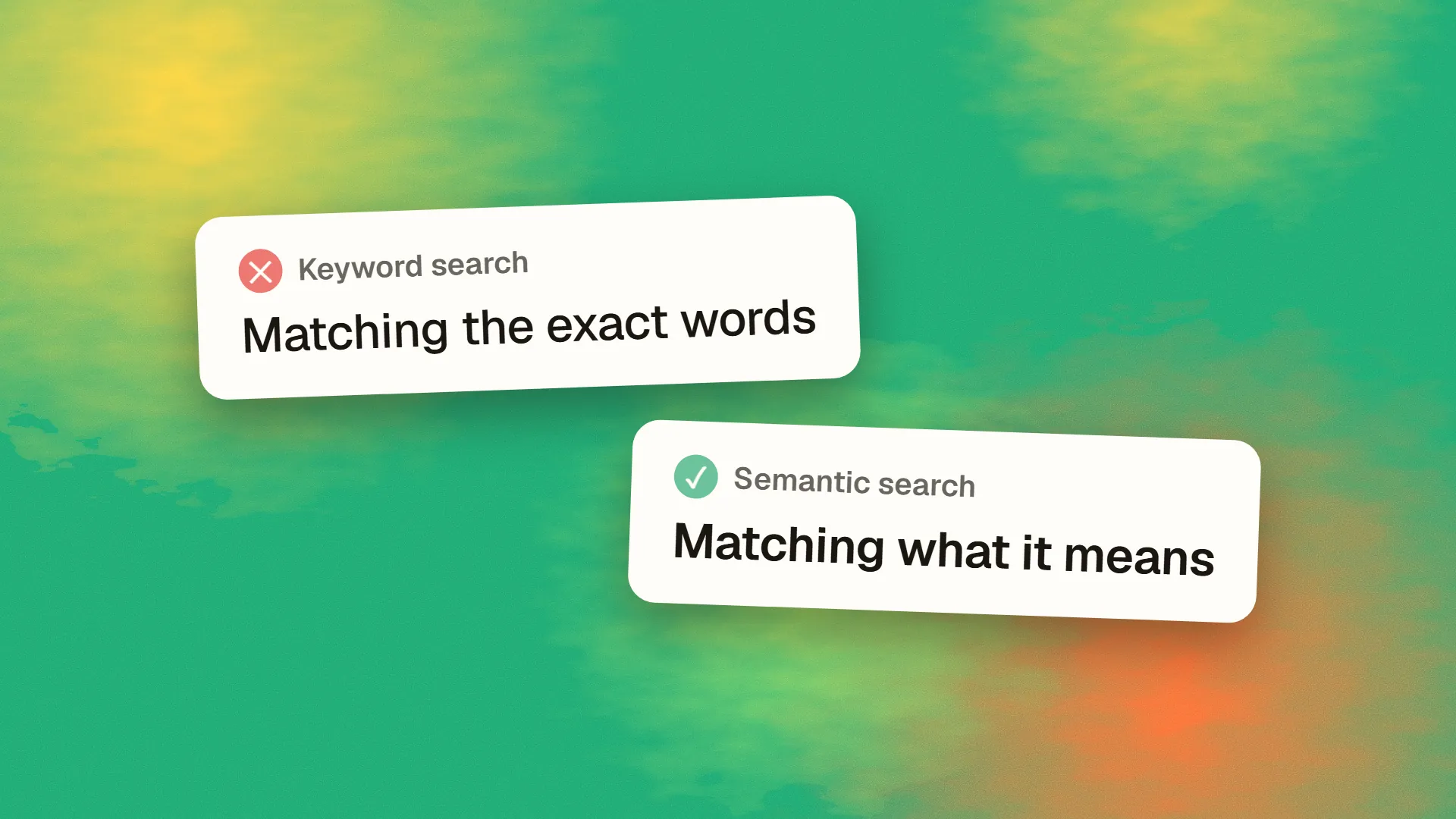
Semantic search is retrieval based on the meaning of a query and of documents rather than on matching the exact words: the engine represents both as concepts and relationships, using language models and a knowledge graph of entities, so that a page can rank for a question phrased in words it never uses, and a query can be understood despite ambiguity. Google's Hummingbird update in 2013, RankBrain in 2015, BERT in 2019 and MUM in 2021 progressively made its search semantic. For content, it means writing to answer questions thoroughly in natural language, covering a topic rather than repeating a phrase.
Lexical and semantic
Early search engines were lexical: they indexed the words on pages and returned pages containing the words in the query, ranked by how often and prominently the words appeared, adjusted by links. "Cheap flights London" returned pages with those three words. Ranking meant having the words, and the SEO of the era followed: put the keyword in the title, the headings, the URL, and the text, repeatedly.
Semantic search represents queries and pages as meaning. "Cheap flights London" is understood as a person wanting inexpensive air travel to or from a specific city; a page about budget airfares to the British capital matches even if it never says "cheap". A query with a typo, a synonym, a different word order or a question form is understood as the same intent. Ambiguity is resolved by context: "jaguar speed" is about the animal or the car depending on signals.
| Query: cheap flights | Lexical search | Semantic search |
|---|---|---|
| A page saying "cheap flights" | Match | Match |
| A page saying "low-cost airfare" | No match | Match |
| A page about cheap flight simulators | Match | Likely not |
How Google got there
Hummingbird, 2013, rewrote the core algorithm to interpret whole queries as meaning rather than as word lists, particularly conversational and question queries.
The Knowledge Graph, 2012 onward, gave Google a database of entities, people, places, organisations, concepts, and their relationships, so that a query about a thing could be matched to pages about the thing rather than pages containing its name.
RankBrain, 2015, applied machine learning to interpret queries Google had never seen, mapping them to concepts.
BERT, 2019, brought transformer language models to query understanding, reading words in the context of their neighbours so that prepositions and word order changed meaning correctly.
MUM, 2021, extended understanding across languages and media, and the same model families now generate AI Overviews.
Embeddings, throughout: representing text as vectors in a space where similar meanings are close, so that retrieval can be done by nearness rather than word overlap. This is also the mechanism inside AI assistants' retrieval.
Each step moved ranking further from the words on the page and closer to what the page is about.
What it means for keywords
Keywords did not stop mattering; they stopped being the unit. A page targets a topic and a question, and it ranks for the many phrasings of that question, which is why one page can rank for hundreds of queries and why writing separate pages for synonyms is counterproductive. Keyword density is irrelevant. Exact-match phrasing helps at the margins, in titles and headings where it signals topic clearly, and hurts when it produces unnatural text.
Entities matter more. A page that clearly concerns a recognised entity, and connects it to related entities, is understood more precisely than one that repeats a phrase. Structured data, consistent naming and being an entity yourself, with a knowledge panel, are semantic signals.
What it rewards in content
Thoroughness on a topic: covering the sub-questions, the related concepts and the context, in the natural vocabulary of the subject, which is what a genuinely expert page does anyway. Clear structure that states what each section is about. Direct answers to specific questions, which semantic systems extract as passages. Consistency with what the engine already understands about the topic, so that a page is recognised as being about it. And depth across a site, since semantic understanding operates at the site level too, which is the basis of topical authority.
What it does not reward: a page engineered around a phrase, thin pages per variant, or text written for the matcher rather than the reader. The systems were built to see through those, and they mostly do.
The connection to AI search
AI assistants and Google's AI answers are semantic search with a generator attached: the query is understood as meaning, relevant passages are retrieved by meaning, and an answer is composed from them. The content that semantic search ranks is the content AI answers cite, for the same reasons. A site written for meaning is ready for both.
A concrete illustration
Take the query "why does my site drop after an update". A lexical engine would look for pages containing "site", "drop" and "update". A semantic engine understands a website owner asking about a ranking decline following a Google algorithm change, and retrieves pages about traffic drops after core updates, whether or not they use the word "drop", ranking above them any page that answers that specific situation directly. The page that wins is the one that understood the question, which is the same page a knowledgeable person would recommend.
The practical version
Write for a person who asked the question, in the words a knowledgeable person would use, covering what they would need to know. Put the direct answer first. Structure the page so its parts are clear. Name things consistently. Cover the topic across the site, not just on one page. That is semantic SEO, and it is indistinguishable from writing well about something you know. If a site of yours is still being written around keyword lists, book a call; the shift to topics is usually a restructuring rather than a rewrite.
Common questions
What is the difference between semantic search and keyword search?
Keyword search matches the words in a query against the words on pages and ranks by their frequency and prominence. Semantic search represents both query and pages as meaning, using language models and an entity graph, so a page ranks for a question phrased in words it never uses and a query is understood despite synonyms, typos, word order or ambiguity.
When did Google start using semantic search?
Progressively from 2012: the Knowledge Graph introduced entities that year, Hummingbird rewrote query interpretation in 2013, RankBrain added machine-learned query understanding in 2015, BERT brought transformer models in 2019 and MUM extended them in 2021. Modern ranking and AI answers are built on these semantic foundations.
How does semantic search change SEO?
Pages target topics and questions rather than phrases, and one thorough page ranks for many phrasings; separate pages for synonyms compete with each other; keyword density is irrelevant; entities, consistent naming and structured data help the engine understand what a page is about; and depth across a site builds topical authority. Writing well for readers is the strategy.
What are entities in semantic search?
Distinct things the engine recognises, such as people, places, organisations, products and concepts, held in a knowledge graph with their relationships. Semantic search matches queries about an entity to pages about it rather than pages containing its name, and a business that is a recognised entity is understood and described more accurately by search and AI systems.
Is semantic search the same as AI search?
AI search is semantic search with an answer generator: the query is understood as meaning, passages are retrieved by meaning, and a response is composed from them with citations. The content semantic search ranks is the content AI answers cite, so writing for meaning serves both.