In short
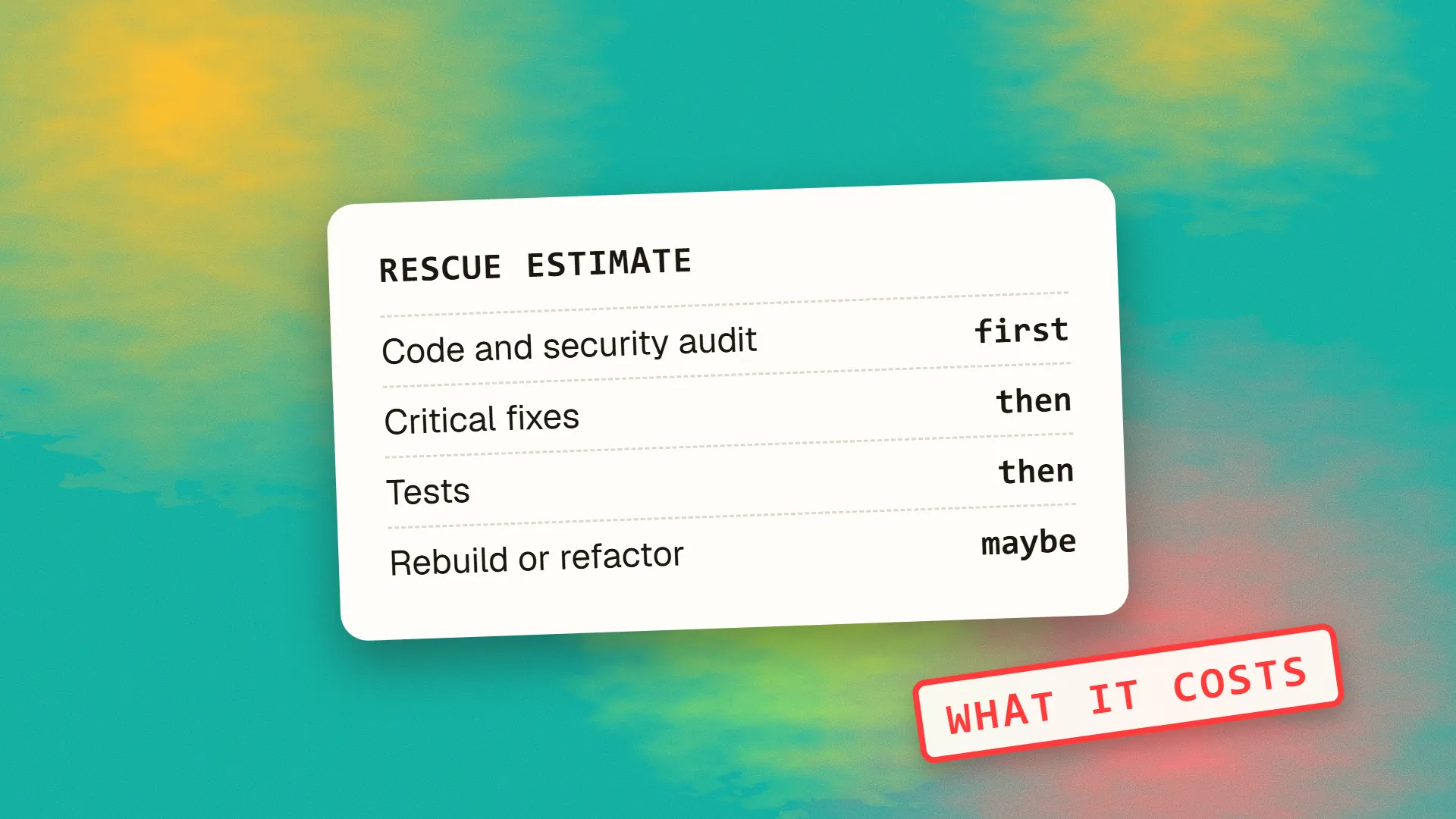
A vibe code rescue can cost from a few hundred dollars for a light audit to $3,000–$8,000 for a focused cleanup, and $15,000–$150,000 for serious rescues of larger systems, based on published vendor offers. Costs depend on code size, sensitive data, payments and how much must change. Start with a paid audit, as it makes every later number more reliable.
What the market is asking
There's no standard price. The figures below come from vendors' own pages in late 2026, so treat them as asking prices, not market averages.
| Service | Published example | Source |
|---|---|---|
| Light audit | From $199, with an optional cleanup quote | Valletta Software |
| Scoping, audit and production work | $195 call, $950 audit, $4,500 production-ready | A Fiverr agency listing |
| Specialist cleanup | $1,500–$5,000 | Aibrify's 2026 comparison |
| Full-stack rescue agency | $3,000–$8,000 | Aibrify's 2026 comparison |
| Fractional CTO rescue | Typically $25,000–$50,000; smaller from $15,000 | Justin McKelvey |
| Larger rescue engagements | $50,000–$150,000 | MetaCTO |
These don't cover the same work, which is why the range is so wide. A $4,500 job isn't a cheap version of a $100,000 job. They address different scopes and levels of risk. We also can't verify what each listing delivers, so ask for specifics.
How long it takes
Wavect publishes useful planning ranges in time rather than money, and says these aren't market benchmarks or quotes:
- Audit: a few focused days to roughly a week, for an accessible, bounded system.
- Bounded, low-impact internal tool: a few days of hardening.
- Single-tenant app with moderate exposure: about one to two weeks.
- Multi-tenant SaaS with payments: two to four weeks or more.
- Core rebuild needed: re-scoped as a new build.
You can turn those into a rough cost by multiplying days by a day rate. Rates vary greatly by country and seniority, so get several real quotes.
What drives the cost
What's at stake. An internal tool with no personal data is a very different job from a SaaS app with payments and health data. Higher stakes need more review and testing, and possibly specialist penetration testing.
The data model. This is often the largest factor. If the data structure is sound, then you can improve the code around it. If it's wrong, and you have live users, migration can dominate the budget. See how to fix a vibe-coded app.
How much is tangled up. Duplicated logic and abandoned attempts make every change slower, and absent tests mean that everything must be checked by hand.
Platform dependency. Leaving a platform whose backend you can't take with you means rewriting that layer. See how to migrate off Base44.
Live users. Working on a running system takes more care than working on one that's not yet launched.
Your clarity. Vague requirements cost money. The more precisely you can say what must work, the less time anyone has to spend finding out.
Compliance. GDPR, HIPAA, payment rules or an enterprise customer's security questionnaire all add work.
Rescue or rebuild?
One vendor, Azumo, claims that rebuilds run 3 to 5 times the cost of a targeted rescue. It sells this work, so weigh that accordingly. But the direction is plausible for apps with sound foundations. It flips when the foundations are wrong, because then you may pay for a rescue and a rebuild. An audit exists to answer this question.
What you should get for your money
From an audit:
- Scope and limitations of what was reviewed
- Evidence for findings, which can be reproduced
- Findings ranked by severity, with reasons
- Remediation options, with estimates
- Clear notes on what's fine and can stay
From a rescue:
- Fixes for agreed issues, in your own repository
- Tests for your critical journeys
- Documentation, including how to deploy and how to roll back
- A handover that means you don't depend on them forever
- A record of remaining risks that you've chosen to accept
How to compare quotes
Ask each supplier the same questions:
- What exactly is in scope, and what's excluded?
- Have you read the code, or is this an estimate from a description?
- What happens if you find something unexpected?
- Is it a fixed price or time and materials? See fixed price or time and materials.
- What tests and documentation are included?
- Who owns the work and the accounts at the end?
Warning signs: a full rewrite proposed before anyone has looked at the code, a very low price with no named deliverables, or no mention of data, backups or security. Conversely, a high price with nothing but a big-picture slide deck should make you just as cautious.
How to spend less
- Run the free checks yourself first. Work through the security checklist and check your database rules.
- Prepare your materials. See when to hire a developer after vibe coding.
- Reduce scope. Remove the features that nobody uses before anyone hardens them.
- Fund in tiers. Pay to fix blockers first, then high-severity issues, and leave cleanup until the business justifies it.
- Keep the fixes. Add tests and a review step, or you could be paying for the same rescue next year.
Compare the cost with what's at stake. If your app earns very little, then a large rescue may not be justified, and a simpler product might be a better answer. If a breach could end your business, then a few thousand dollars is cheap. Our MVP cost guide offers another point of comparison.
Want a clear, ranked picture of your own app? Book a call.
Common questions
How much does it cost to fix a vibe-coded app?
Published offers range from a few hundred dollars for a light audit to $3,000–$8,000 for focused cleanups, and from $15,000 to $150,000 for larger rescues. Your cost depends on the risks, the code and how much must change. Start with an audit.
How long does a vibe code rescue take?
One vendor's planning ranges suggest a few days for a low-risk internal tool, one to two weeks for a single-tenant app, and two to four weeks or more for multi-tenant SaaS with payments. A core rebuild is a larger project.
Is it cheaper to rescue or rebuild?
Usually rescue, when the data model is sound and the app has users, because a rebuild has to repeat a lot of work. If the foundations are wrong and you have no users, then rebuilding the core can be cheaper. An audit should tell you which.
Can I fix a vibe-coded app without paying anyone?
You can make real progress: check database rules, secrets and login, add tests, and tidy up with careful prompts. If you handle people's data or money, then it's still wise to have an independent review before relying on your own checks.