In short
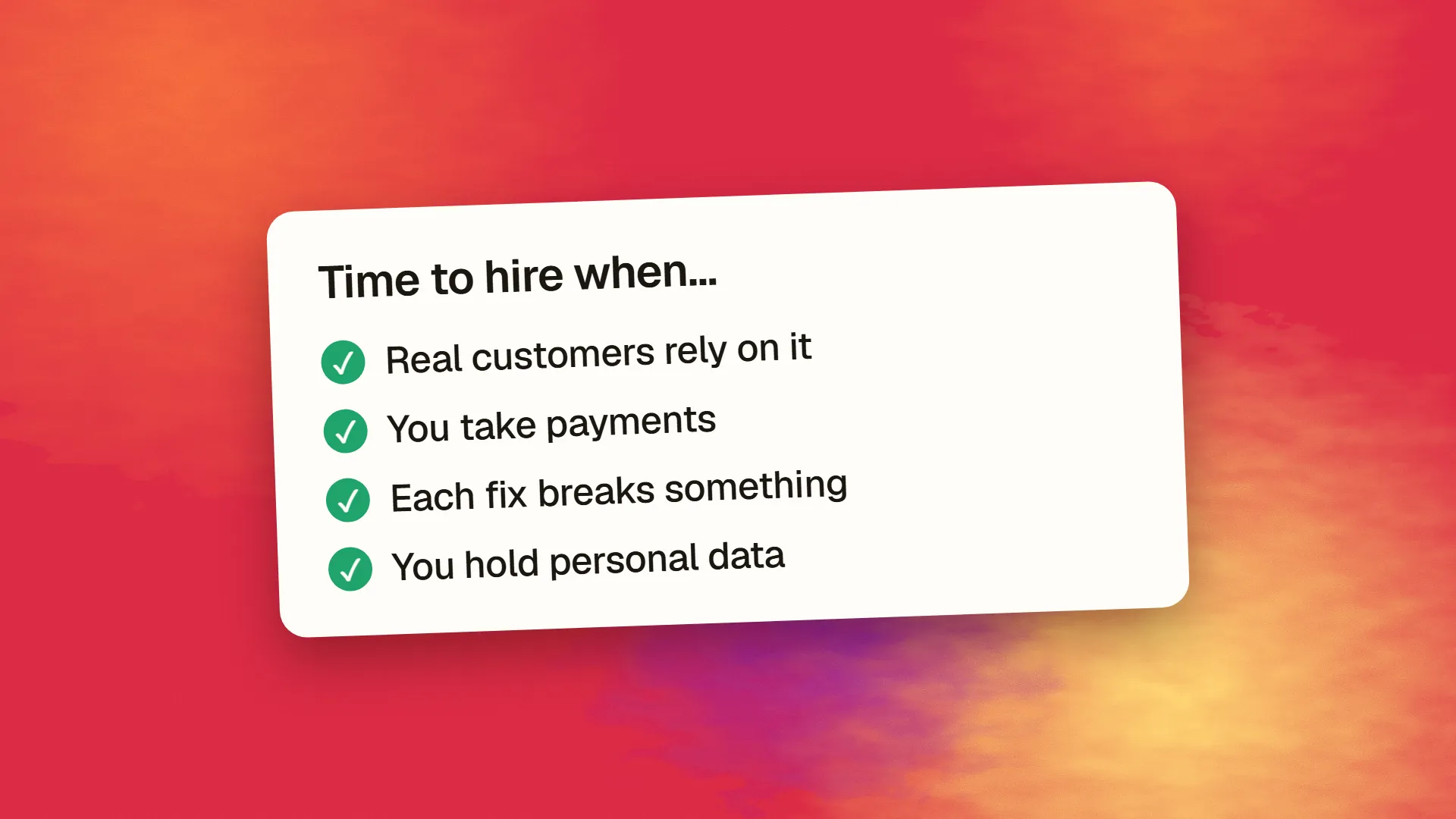
Hire a developer before you take real customer data or payments, when bugs keep coming back, when changes break unrelated features, when you can't explain how something works, or when your costs or stakes outgrow the tool. Start with a paid audit rather than a rewrite. Bring your code in a repository, a list of what must work, and your real usage numbers.
You don't have to hire straight away
Building a prototype yourself is a sensible way to test an idea cheaply, and you'll be a far better client for having done it. The question isn't whether to bring in a developer eventually. It's what should trigger it. Our guide to whether vibe coding is bad sets out where it works and where it starts to break.
Seven signs it's time
1. You're about to handle real people's data or money. This is the clearest line. The moment that strangers trust you with personal details or payments, your obligations change, and the failure modes get expensive. Get a review before this point, not after. Our security checklist shows you what's involved, and why vibe-coded apps get hacked explains why it matters.
2. Bugs keep coming back. You fix one, and it returns a week later or moves somewhere else. The tool no longer has an accurate picture of your system, and more prompting usually makes this worse.
3. Small changes break unrelated features. There are no tests and no clear structure, so each change is a gamble. See how to fix a vibe-coded app.
4. You can't explain how a critical part works. If login or billing fails on a Saturday, could you fix it? If the honest answer is “I'd ask the AI and hope”, then you have a business risk.
5. Costs are climbing faster than value. Credits burned on retries, or infrastructure bills you can't explain, are signs. Compare your monthly spend with typical costs.
6. The platform is holding you back. You need something the builder can't do, or you can't get your data out. See which builders you can actually leave.
7. Someone outside is asking. A big customer's security questionnaire, an investor's technical due diligence or a compliance requirement often forces the issue. Better to be prepared than to discover the gaps during the deal.
What you can keep doing yourself
Hiring doesn't mean that you have to stop building. Many founders continue to:
- Prototype new features to show what they want
- Write copy and adjust designs
- Build internal tools with no sensitive data
- Use AI to understand the code, and ask better questions
A good arrangement is for you to explore, and for the developer to review and own whatever reaches production. Agree on the rules together, particularly who can deploy.
Write copy
Internal tools with no sensitive data
Payments and data
Production-ready versions
Prepare before you talk to anyone
A little preparation can save you days of paid time.
- Get the code into a repository you own. See how to export code from Lovable or how to move an app off Replit.
- List your accounts: hosting, database, payments, email, domain and analytics.
- Write down what must keep working, in plain language, with screenshots if it helps.
- List the known problems, and what you've already tried.
- Gather your numbers: users, revenue, monthly costs and the growth you expect.
- Say what you want in 3 and 12 months. Scaling to 100 customers is a different job from scaling to 100,000.
Being honest about how it was built will help. An experienced developer won't be shocked, and hiding it only wastes time.
What kind of help to buy
| You need | Consider |
|---|---|
| To know how bad it is | A paid audit with a written report |
| A few serious fixes | A freelancer, for a fixed scope |
| A production-ready version | A small agency or senior contractor |
| Ongoing development | A part-time developer or retainer |
| Technical leadership | A fractional CTO, for a few hours a week |
| A full-time team | Hire in-house, once the work is steady |
Prices vary widely. How much a rescue costs gives real examples.
Start with an audit
Ask for a short, paid review before committing to anything bigger. A good audit should tell you:
- What's dangerous right now
- What's fine and can stay
- What the options are, with rough costs
- What you'd have to do to reach your next milestone
Ask them to rank findings by severity. An honest reviewer will tell you about what's fine, as well as what's broken.
How to avoid a needless rewrite
Developers often prefer to rebuild things, as it's more enjoyable than reading someone else's code. Sometimes it really is the right call, particularly when the data model is wrong. But be sceptical if someone proposes it before reading your code. Ask:
- “What specifically makes this unfixable?”
- “What could we keep?”
- “Could we fix the critical issues first, and improve the rest gradually?”
- “What happens to my existing users and data?”
Many rescue specialists themselves say that most vibe-coded apps need hardening, not a teardown, although they have their own interests too. How to refactor AI-generated code explains what the gradual route looks like.
How to choose someone
- Ask whether they've worked with AI-generated code, and what they found.
- Check that they're comfortable with your stack, and that they don't push you to change it for its own sake.
- Ask for references, and for examples of explaining technical issues to a non-technical person.
- Make sure that you'll own the code and accounts. See how to work with a developer if you're not technical.
- Start with something small and paid, and see how they communicate before you sign anything larger.
Want an honest audit of what you've built? Book a call. We'll tell you what's fine, too.
Common questions
Can I launch without hiring a developer?
For a low-risk tool with no personal data or payments, possibly. If you're handling other people's data or money, get a review first. The risk isn't that the app fails to work, but that it fails in ways you can't see.
How much does a developer cost to fix a vibe-coded app?
It varies widely by scope and severity. Published offers range from a few hundred dollars for an audit to tens of thousands for a full rescue. Start with a small paid audit, so that you can get a realistic estimate for your own app.
Should I tell a developer the app was built with AI?
Yes, right away. It helps them to know what to look for, and they'll probably notice anyway. Share the tools you used, the problems you've had, and what you've tried. Honesty will get you a better estimate and better advice.
Will a developer want to rewrite everything?
Some will, but it often isn't necessary. Ask what specifically makes the code unfixable, and what could be kept. A good audit will separate urgent fixes from nice-to-have improvements, and a phased plan is usually possible.