In short
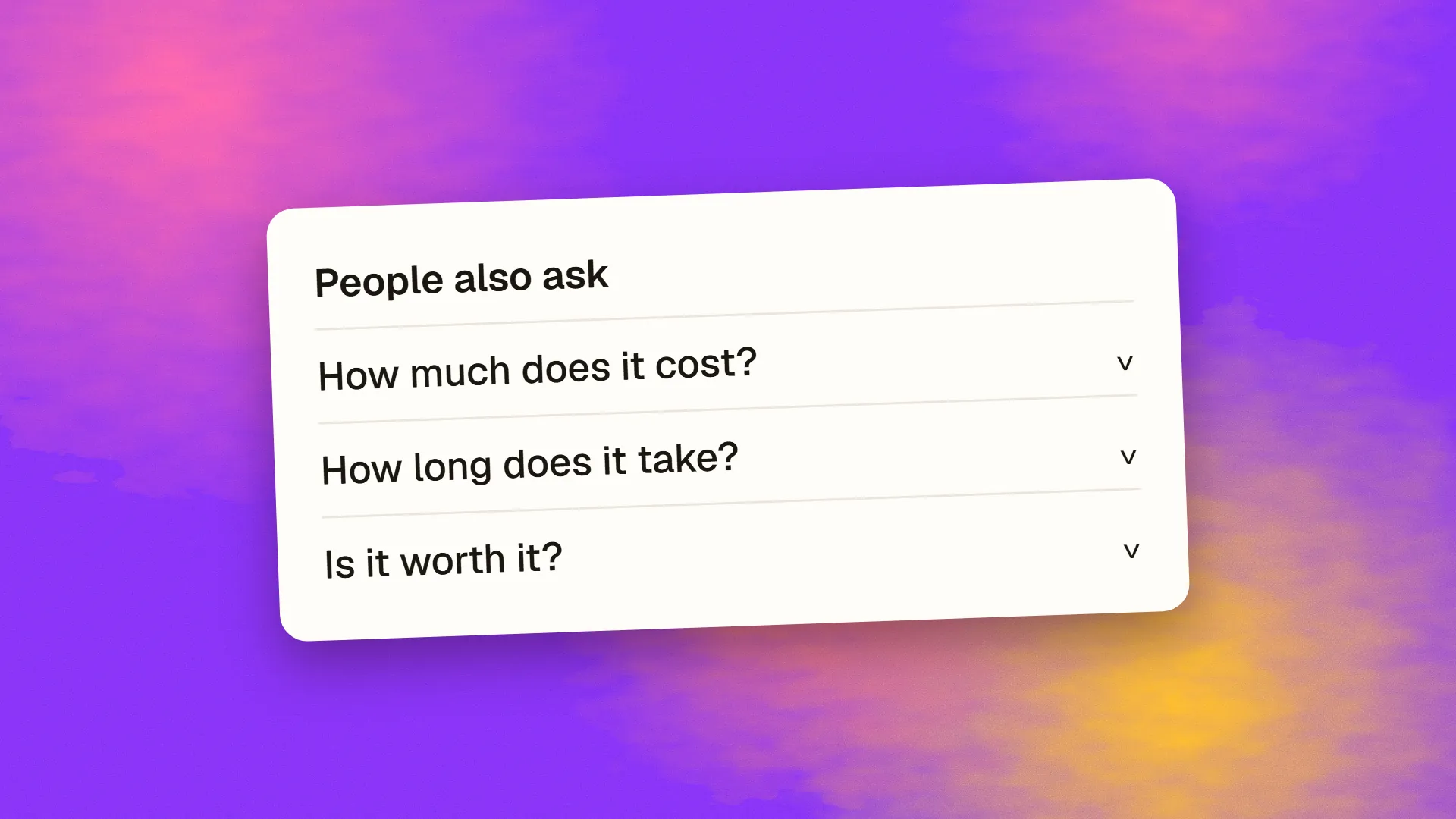
People Also Ask is a Google search feature showing a box of related questions beneath or among the results; clicking one expands it to reveal a short answer extracted from a web page, with a link, and loads further questions. Google selects answers the way it selects featured snippets, from pages that answer the question directly in a concise, self-contained passage under a heading matching the question. To rank in it, answer the specific questions the box shows for your topic, each in a 40-to-60-word passage under a question-phrased heading, on a page that already ranks reasonably for the subject.
What it is
Search almost anything informational and a box appears with three or four questions: "How long does…", "Is it worth…", "What is the difference between…". Click one and it expands to show a two- or three-sentence answer lifted from a web page, with the page's title and link beneath, and two or three new questions appear at the bottom of the box. Keep clicking and the box grows indefinitely.
Google introduced it in 2015 and it now appears on a large share of informational queries on desktop and mobile. Each expanded answer is, in effect, a featured snippet for the sub-question, chosen by the same mechanisms.
Where the answers come from
Google extracts each answer from a page in its index, usually one ranking on the first page or two for the sub-question itself, that contains a passage answering it directly. The passage is typically 40 to 60 words, a short paragraph or a list, sitting under a heading that closely matches the question. The page need not rank first for the main query; it needs to have the best short answer to that specific sub-question.
The selection favours the same qualities as featured snippets: a heading phrased as the question, an immediate direct answer in plain language, and a page that is clearly about the subject.
Using it for research
Before anything else, People Also Ask is the best free view of what searchers want to know next. For any topic:
- Search the main query and note the four questions.
- Expand each; note the new questions that appear.
- Continue two or three levels; the questions become more specific and reveal the full shape of what people ask.
- Repeat for the main query's variants.
An hour of this produces the outline of a topic's long-tail questions, grouped by Google's own understanding of relatedness. It is how the question list for a topic cluster should be built, and it is more reliable than any tool's list because it reflects what Google shows rather than what a model estimates.
Several tools scrape and organise PAA data at scale; for a single topic, the manual method is faster and free.
Ranking in the box
Answer the question as asked. Use the question, or a close paraphrase, as an H2 or H3, and put the answer immediately beneath it.
Make the answer self-contained. Forty to sixty words that make sense lifted out of the page: a definition, a number with its condition, a yes or no with the reason. No "as mentioned above", no pronoun referring to a previous paragraph.
Then elaborate. After the extractable passage, the section can go into depth. The snippet is the first paragraph; the rest serves readers who clicked.
Cover several questions per page. A page addressing the main query and its four to eight PAA questions, each under its own heading, can hold multiple positions in the box for related searches. This is the structure of a good FAQ section and of most pages that win PAA placements.
Be on the first two pages for the question. Google picks from pages that already rank for the sub-question reasonably well. A page with no visibility for the topic is not a candidate, however well the passage is written.
Use lists and tables where the question wants them. "What are the steps" wants an ordered list; "how do X and Y compare" wants a table. Google extracts those formats too.
FAQ structured data does not directly put a page into People Also Ask, and Google restricted FAQ rich results in 2023 to government and health sites, but the FAQ page structure itself, question headings with direct answers, is exactly what the PAA selection rewards.
What a placement is worth
Less than a featured snippet, more than a mid-page ranking. PAA answers are seen by a large share of searchers, and the link beneath an expanded answer receives clicks from those who want more; the click-through is modest per impression because many questions are answered in the box itself. The larger value is presence: a brand that answers four of the five questions in a box for its topic has demonstrated authority to the searcher before they visit anywhere. PAA placements are also volatile, rotating between pages as Google tests them, so they are a portfolio to hold rather than positions to defend.
In AI search, the same passages that win PAA placements are the ones answer engines cite, since both are extracting direct answers to specific questions. Writing for one wins the other.
The practical programme
Mine the PAA box for the topic's questions. Group them onto pages, one main question plus its sub-questions each. Answer each sub-question under its own heading in a short, self-contained passage, then elaborate. Get the pages ranking for the topic through the usual work. Check the box monthly for new questions and add sections. If you would like the question map for a subject built from the PAA box and turned into a page plan, book a call.
Common questions
How does Google choose People Also Ask answers?
The same way it chooses featured snippets: from pages ranking reasonably for the sub-question that contain a short, self-contained passage answering it directly, typically under a heading phrased as the question. Concise definitions, numbers with their conditions, and short lists or tables are the formats it extracts.
How long should a People Also Ask answer be?
About 40 to 60 words, the length Google typically extracts: a two- or three-sentence paragraph that makes sense on its own, placed immediately beneath a heading that matches the question. Longer explanation can follow for readers who click through, but the extractable passage comes first.
Does FAQ schema help you appear in People Also Ask?
Not directly. Google restricted FAQ rich results to government and health sites in 2023, and structured data is not what selects PAA answers. The FAQ page structure itself, question headings each followed by a direct answer, is what gets passages chosen, with or without the markup.
Is People Also Ask good for keyword research?
It is among the best free sources. The questions reflect what Google knows searchers ask next, and expanding them repeatedly reveals the full set of sub-questions for a topic, grouped by relatedness. An hour with the box produces the question list a topic cluster should be built from.
How much traffic does a People Also Ask placement bring?
Modest per impression, since many searchers are satisfied by the answer in the box, but the placements are seen widely and the link beneath an expanded answer draws clicks from those wanting more. The larger value is authority: answering several questions in a box demonstrates expertise before the visit. Placements rotate, so aim for many rather than one.