In short
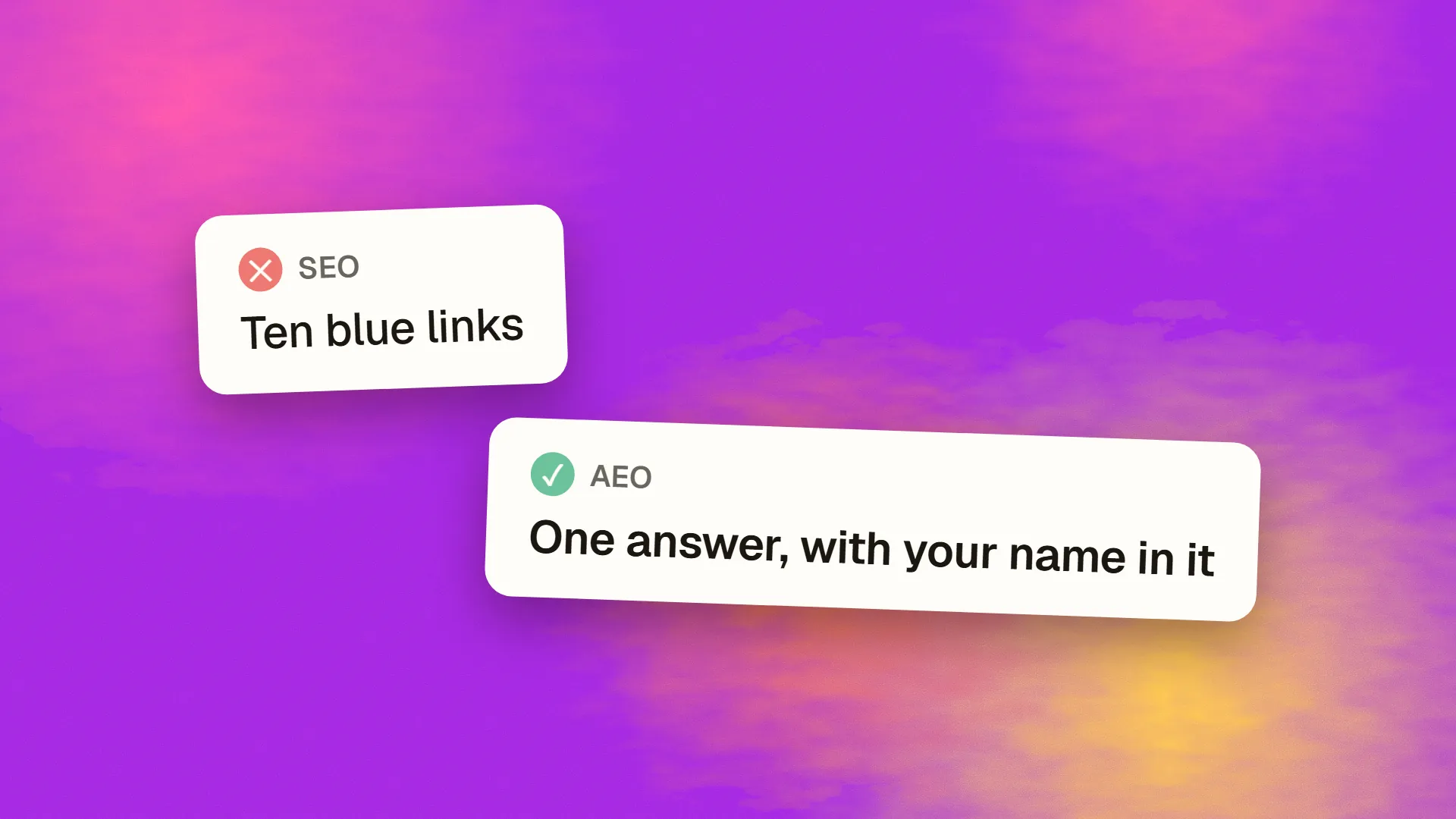
Answer engine optimization (AEO) means making your content likely to be used and cited when systems like Google's AI features, ChatGPT and Perplexity answer questions directly. It overlaps heavily with SEO and GEO, and the terms are often used interchangeably. Google treats it as SEO for its own products. Practically, it means direct answers, specific facts, crawlable pages and a brand that others mention.
A plain definition
Traditional search gives you a list of links. An answer engine gives you an answer, and may cite where it came from. AEO is the work of making your content the source that gets used. The term has been around since featured snippets and voice assistants, and it's come back into fashion with AI search.
AEO vs GEO vs SEO
There's no standards body for these terms, and marketers use them loosely.
| Term | Usual meaning | Typical goal |
|---|---|---|
| SEO | Search engine optimization | Rank in search results, earn clicks |
| AEO | Answer engine optimization | Be the direct answer or cited source |
| GEO | Generative engine optimization | Be cited or mentioned in AI-generated answers |
Some people draw fine distinctions, such as AEO for answers and snippets, and GEO for generative models. Others, including one analysis, ask whether there's any real difference. For practical purposes, AEO and GEO are close to synonyms. Our guide to GEO vs SEO goes deeper into where the work overlaps and differs.
What Google says
Google's AI features guidance says there are no additional requirements for appearing in AI Overviews or AI Mode, and that standard SEO fundamentals apply. Reports on its May 2026 guidance say that it formally frames this work as still SEO.
That applies to Google's products only. It doesn't speak for ChatGPT, Perplexity or Claude, and some in the industry have questioned how far it should be generalised. It's reasonable to accept both points: for Google, good SEO is the main route; elsewhere, you also need to think about things such as crawlers and third-party mentions.
What actually changes
Most of the work is familiar. These are the places where the emphasis shifts.
Answers come first. A page that buries the answer beneath several paragraphs of introduction is hard to extract from, and annoying to read. State the answer directly at the top of each section.
Passages matter, not just pages. An answer engine can use one paragraph from your page. Make each section understandable on its own. See how to write content that AI answer engines actually quote.
Questions cover more ground. AI systems may split one prompt into several searches. Query fan-out means a page can be used for a sub-question, even if it doesn't rank for the main one, so covering related questions pays off.
Being mentioned elsewhere counts. Assistants often draw on reviews, forums, comparison pages and news. Your reputation beyond your own site can influence answers. See how to get your brand cited by ChatGPT, Claude and Gemini.
Different crawlers need access. OpenAI, Anthropic and Perplexity each operate their own bots. See our AI crawler list.
Clicks may not follow. You can be cited and get no visit. So you have to measure influence differently, too.
Practical tactics that hold up
- Write direct answers. Put a 40–60 word answer beneath each question heading, then expand on it.
- Use real questions as headings. Take them from sales calls, support tickets and People Also Ask.
- Be specific. Use numbers, prices, dates, names and steps.
- Add original material. Data, testing and experience are hard to copy, and give a system a reason to cite you.
- Use clear structure. Headings, lists and tables, where they suit the content.
- Add accurate structured data where relevant, without expecting miracles. Google says that no special schema is needed for its AI features.
- Keep your facts consistent across your site, profiles and directories.
- Keep pages current, and show the date honestly.
- Make sure content is in the HTML, not just rendered by JavaScript. See why AI-built websites struggle in Google.
- Earn real mentions through useful work, PR and genuine community participation.
What to ignore
- Claims of guaranteed AI rankings. These systems change their answers, and vary between users.
- Precise “ranking factor” percentages. They're estimates from outside the system, at best. See how Perplexity chooses its sources.
- Special file formats as a silver bullet. It costs little to add llms.txt, but don't expect it to transform your visibility.
- Mass-produced answer pages. Thousands of thin Q&A pages can do more harm than good. See what scaled content abuse is.
How to measure it
- Prompt tracking: run real buyer questions on a schedule, and record if you're mentioned and linked.
- AI referrals: see how to track AI referral traffic.
- Brand search: watch for growth in people searching for you by name.
- Ask your customers: a simple “how did you find us?” often surfaces AI recommendations that analytics can't see.
Tools can automate some of this. See AI visibility tools compared, and start by hand before paying for anything.
Does your business need it?
If you're asking whether to create a separate AEO programme, the answer is usually no. Add these habits to your existing SEO and content work. Be wary of an agency proposing a completely separate retainer without explaining what's different. Do more if your buyers demonstrably use AI assistants to research purchases, which is more likely in software, professional services and considered purchases.
If you want to see how you appear in AI answers today, book a call.
Common questions
What is the difference between AEO and SEO?
SEO aims to rank pages and earn clicks from search results. AEO focuses on being the source of a direct answer. They overlap heavily, and Google treats this as SEO for its own products. Good AEO usually starts with good SEO.
Is AEO the same as GEO?
They're very close, and the terms are often used interchangeably. Some people use AEO for direct answers and snippets, and GEO for generative AI answers. In practice, you'd do almost the same things for both, so don't get caught up on the label.
Do I need a separate AEO strategy?
Usually not as a separate programme. Add direct answers, specific facts, crawler access and third-party presence to your existing work. If your buyers clearly research through AI assistants, then measure prompts regularly and invest in the gaps that you find.
How do I measure AEO success?
Track a set of real buyer questions across AI engines, along with AI referral traffic, branded search and how customers say they found you. Results vary between runs, so look for trends over months rather than individual answers.